Chris Goodwin: from secretly dropping out of university to masterminding Britain’s greatest supercars
He shaped how modern McLarens handle and was instrumental in Aston Martin’s Valkyrie too. Chris Goodwin explains why, for him, testing has always trumped racing
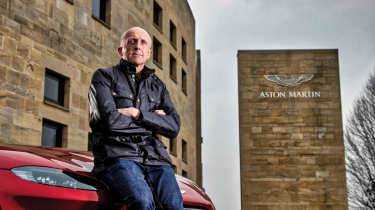
You might ask the question ‘Are these two Goodwins related?’ The answer is: not as far as Chris and I know, but a simple DNA test would settle it. A less scientific method, though I think also accurate, would be to compare lap times between Chris and Colin, with the latter’s very lacklustre numbers indicating that there is no genetic link between us.
We could also go up a generation, for whereas my father never drove a car in his life, Chris Goodwin’s dad Tony was a passionate and successful racing driver. ‘My dad joined the RAF after he finished at medical school and in the early 1960s he was posted to RAF Changi in Singapore as chief medical officer,’ explains Goodwin, ‘and he took with him his Lola Mk2, which was a Formula Junior car but with a different engine in it. He competed in events like the Singapore and Malaysian Grands Prix and also at Macau. We’ve got some great photographs of him on the front of the grid at Macau in a Lotus 20 [another Formula Junior car, this one mid-engined] in a race in which he came third.
> Aston Martin Valkyrie review – 700 miles in the world's most extreme hypercar
‘Soon after his return from the Far East he decided to give the European Formula 3 circus a go, joining that bohemian group of racers who travelled around the continent with vans and trailers, living frugally and picking up start money and living hand to mouth. That was in 1967, the year that I was born. I was born in Guildford and we lived in a flat in Dorking. Dad’s foray into F3 didn’t work out, so he came back to being a local GP. He never, however, stopped racing.
‘Growing up I was captivated by his stories of racing in Europe, at places like AVUS and the Nürburgring. After his single-seater racing he took up endurance racing and owned a couple of Chevrons and Lolas shared with other drivers who were a bit better off than he was. He had some good results, winning the 2-litre class at the Spa 1000km for example.’
Tony Goodwin, who is still with us at 88 years old, moved from contemporary sports car racing to historic racing in the early 1980s. ‘That was when I was old enough to get properly engaged in it,’ says Chris. ‘I’d go to races with him, having helped prep the car in the garage during the week. He had some fairly dreadful cars, like a Diva, but also a Merlyn sports car that was a bit like a Lotus 23. We’d go to historic races in Europe, which was a lovely thing to do with him. He raced right through the ’80s, eventually getting into historic Formula Junior. In the last year that he raced, when he was in his seventies, he was on the front row in his Junior at the Monaco historic.’
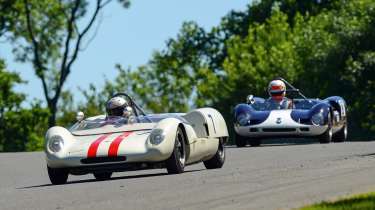
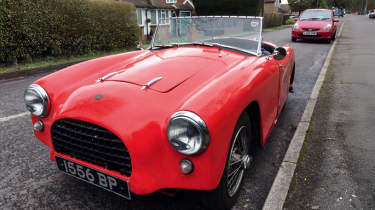
Unsurprisingly, this exposure to motor racing rubbed off on young Goodwin. ‘I was at sixth form college and dad and I found this old Turner for sale in Exchange & Mart. It was pretty rough but Dad said to me, “This will be your first road car and you can go racing in it, too, in a series called Historic Road Sports run by the HSCC [Historic Sports Car Club]. If you rebuild the car and get it into shape, then I’ll help you with the racing.” So that’s what I did. We had a great time. I won races with the Turner and we even took it abroad to Zandvoort, among other places. I learned a great deal about setting up a car from the Turner, so it played an important part in my future life.
‘I’d done OK at school and chose to go to Imperial College in London to study mechanical engineering. After about a year I realised that I didn’t have a burning desire to be an engineer and that I had one chance to really get into racing while I was still young. Meanwhile, I was living on friends’ floors while working at the racing school at Brands Hatch, where they had these rather dreadful cars called Formula First. The deal was that I could race one of the cars and pay for the inevitable repairs through working at the school.’
From Formula First Goodwin graduated to Formula Ford, where he raced against fellow youngsters such as David Coulthard and Kelvin Burt, the latter of whom Chris reckons is the fastest driver he’s ever seen and someone who should have gone all the way. ‘I did quite well in Formula Ford in 1988 and 1989, in the second year winning the Brands Hatch championship and runner-up in the Junior FF championship. I was still living at home in ’88 and was also still at Imperial College. I couldn’t prepare and race my own car and do a university course, so that’s when I decided to leave university, but I didn’t tell my parents for a year, which was not great.
‘I spent the entire next winter pounding around Snetterton helping Van Diemen develop its new car for the 1990 season. Ralph Firman, who owned Van Diemen, was brilliant and was key in my learning the skill set of testing and suspension set-up that I trade on today. I did several years of winter testing on Formula Fords, Formula Renault and F3 cars. I loved the whole process of learning about ride height, spring rates, rebound damping and all the other dynamics of race car performance. Most of my contemporaries were only interested in going faster, but I found that I enjoyed the testing more than I did the actual racing. I feel the same way today.’
Road transport in the early years was a Golf GL. ‘It towed a trailer with the Formula Ford on it, lugged engines and gearboxes around and was generally a bit of a heap with saggy rear suspension and shot dampers. I was able to upgrade by using my Formula Renault winnings to buy a Renault 5 GT. What a deathtrap; no wonder you don’t see many on the road today.’
With good results in Formulas Ford and Renault, presumably next comes Formula 3? ‘I just didn’t have enough money,’ explains Chris. ‘Instead I jumped ship from Van Diemen’s Formula Renault team to Swift for a second season in British Formula Renault. Unfortunately the car was rubbish due to – as we found out later – its bending in the middle. Swift also ran a Formula 3000 team, and the team manager said that if I won the Thruxton Formula Renault round I could have a race in the F3000 car. I was beaten by Jason Plato but they still let me have a race in the 3000 at Brands Hatch, but I wasn’t strong enough or well enough prepared and didn’t do well.
‘I had around another year getting drives in single-seaters but it wasn’t going well. By now we’re in the early ’90s and the area in which British motorsport was really booming was touring cars. That was where all the money was, so I turned my focus towards tin tops. I’d done a couple of races in a Saab Group N car with Lionel Abbott, which went well, and Lionel reckoned that he could get me a test with Ray Mallock’s team, which was running the Ecurie Ecosse Vauxhall Cavaliers. The test went well, I got a few races, did well, and it was planned that RML would run a three-car team for the 1994 season and I would be driving alongside John Cleland and Jeff Allam. Great. Until John decided that he didn’t want to be in a three-car team and I was relegated to a testing role. Vauxhall lent me a car from the previous year but it was a bit of a shitter.
‘Ray Mallock was great and it became an extension from learning about testing at Van Diemen as I became involved in multiple RML programmes, including its Nissan BTCC team. I never got a proper break in touring cars; several opportunities looked promising, such as a drive for Honda and then Alfa Romeo run by Prodrive, with both of those deals collapsing at the eleventh hour. It was unbelievably disappointing and left a bad taste in my mouth, especially as I knew and had proved that I was quick in these cars.’
And so we come to phase three of Chris Goodwin’s racing career: GTs. ‘Steve Farrell, one of the guys at Prodrive, had contacts at Lotus and very kindly put me forward to help them with their GT programme in 1995 with the Esprit GT2 car, and the next year with their black Esprit GT1 cars that either caught fire or broke down. That led to a drive in a McLaren F1 GTR in 1997 that went brilliantly well, and I thought, “Right, this is more like it.” I was being paid and working with proper professional people, led, of course, by Gordon Murray.
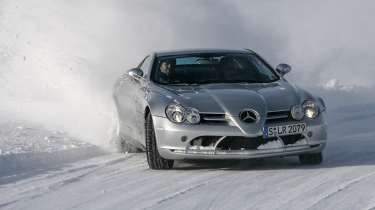
‘Gordon recognised my passion and abilities as a test driver and said, “Why don’t you get involved in some projects that we’re working on?” which led to my involvement in the McLaren Mercedes SLR road car, the McLaren two-seat F1 car and also their simulator, which was the first F1 simulator in the world. But it was the SLR that really excited me because I knew that this was me. After about a year of this, Gordon took me to sit down in front of Ron [Dennis]. He’s not everyone’s cup of tea but you can’t deny that he’s a visionary. Anyway, he told me that I was fitting in well, doing everything asked of me, driving well and proposed that I join McLaren full-time. “We’re going to be like Ferrari,” he told me, “with a Formula 1 team and a road car operation building several different models, and I want you to be the test driver who defines what these cars are all about.” And that was the start of my 20 years at Woking.
‘One of the high points was driving Lewis Hamilton’s championship-winning MP4‑23 F1 car. It was so beautifully balanced and the relationship between throttle, steering and every other dynamic feature so well harmonised that it was by far the easiest-to-drive F1 car I’ve ever experienced. It reinforced my feeling that a sports car shouldn’t be difficult to drive or edgy. It’s a philosophy that we put into all the McLaren road cars.’
Goodwin left McLaren in 2017 for reasons he explains as ‘artistic differences’. Next came Aston Martin, where Adrian Newey had recruited him to develop the Valkyrie. Is there a McLaren in Chris’s garage? Yes, but it’s an M6 CanAm car. ‘Before that I had an M1B, which I bought because I wanted to experience McLaren history and also because I could race it at Goodwood.
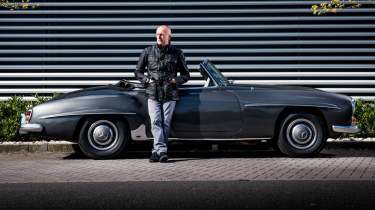
‘I’ve also got a Lotus 23B, which I bought in 2008, and also a Lotus 22 Formula Junior. Both of those are nostalgic cars to own and race because they’re very much from my dad’s era. A career driving the world’s most exotic supercars – either the cars I was developing or Ferraris, Lamborghinis or Porsches brought in for benchmarking – has left me with no strong desire to own one. For 15 years I’ve owned a 1959 Mercedes-Benz 190 SL. It’s a dreadful thing to drive but it’s never let me down, is so well made and is absolutely charming. And people are nice to you when you’re driving it. Same goes for my 1970 Fiat 500, which I also drive regularly. I recently bought a 1970 911S that is now like new and I intend to drive that as a daily car – when I’m not driving our 2013 Land Rover Defender, which I also love.
‘When I was at McLaren we could have one Mercedes company car plus a Smart. I had several Smart Roadsters and Coupes and it’s only a matter of time before I buy one.’
Chris Goodwin is allegedly retired, but as he admits, is as busy as ever. Not only is he still involved in his Garage 59 racing team, but he also looks after an American gazillionaire’s vast car collection in the US, which includes modern F1 cars. The love of testing and developing cars has never left him. His idea of a perfect day? ‘I’d drive my 190 SL to Goodwood, where I would drive my Lotus 23 around the circuit, with the track to myself, honing and tweaking to get the car to go just a little bit quicker. Just for the pure joy of it.’
This story was first featured in evo issue 340.