
New Cupra Raval review – EV hot hatch targets the Alpine A290
A small hatchback with well over 200bhp and a limited-slip diff sounds like the perfect recipe for fun. Can Cupra’s Raval VZ deliver on the promise?

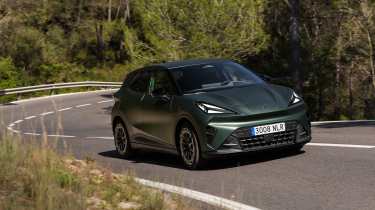
A small front-drive hatch with 222bhp, a sub seven-second 0-62mph time and a limited-slip differential. A decade or so ago, a car of this description would've gotten us very excited indeed, suggesting something from Renault Sport, or maybe fast Ford. Today you'll find these specs attached to the Cupra Raval – a brand new electric supermini based on Volkswagen's ID. Polo. Is there still cause for excitement? Not to the same level that would have applied to hot hatches from the bygone era, certainly, but this is still a warm hatch with plenty of ability and appeal – enough to give the Alpine A290 something to think about.
The Cupra Raval isn't a cut down version of its bigger brother, the Born. Far from it, actually. It's front rather than rear-wheel drive for a start, and sits on the Volkswagen Group’s new MEB+ architecture (shared with the ID.Polo as well as the Skoda Epiq crossover). Being front driven aids packaging and makes for a deeper boot, but also gives the Raval the layout of a classic hot hatch, with its drive unit and driven wheels up front. As much as the idea of a rear-drive hatch is enticing, the benefits haven’t really come to fruition in the Born, which is straight-laced and neat rather than fun.
On paper, the £34,995 Raval VZ we're testing seems like a proper performance model, rather than just an EV with the wick turned up. The chassis setup includes a 15mm ride height drop, 10mm widened tracks, sport tuning for the adaptive dampers and different suspension knuckles for more negative camber at the front. There's also an electronic limited-slip diff and 235-section tyres – which Cupra says are the widest in class – to put its power to the ground.
The VZ and 208bhp Endurance model get the Raval's largest 52kWh battery option, while lesser versions – with either 114bhp or 133bhp – get a 37kWh unit. The smaller battery delivers around 186 miles of range, with the Endurance and VZ achieving 277 and 273 miles respectively. On a mixed route of towns, motorways and back roads we averaged 3.9 mi/kWh in the VZ, which translates to a predicted range of just over 200 miles.
The natural competitor for the VZ is the Alpine A290 GTS. The two are similar in size and power, and although the Raval’s 6.8sec 0-62mph time is four tenths slower, its range is a useful 50 miles longer. It's also a noticeably more roomy car, with adults able to sit in the back relatively comfortably – something that can't be said of the A290.
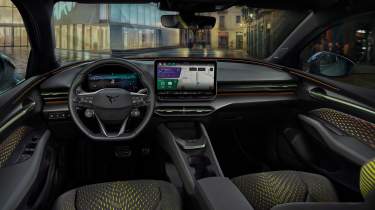
The Cupra’s cabin is solidly put together and there are funky textured surfaces and copper details, although the materials are sturdy rather than plush. The infotainment system has a familiar user experience to those in other Volkswagen Group cars, with a large central touchscreen and – sadly – minimal physical buttons save for those on the steering wheel. The graphics are crisp and the screen is responsive, but the layers of menus and sub-menus can be tricky to navigate on the move.
The driving position is better than in most superminis. A little high, perhaps, but there's plenty of reach adjustment in the steering wheel that allows you to roll the seat back and make room for your legs. Get going and the levels of isolation are better than you'd expect from a small car, too. Not only because of the electric powertrain (which still emits a subtle whine), but because there's not much in the way of road noise, and only a little wind noise from around the windscreen. It feels mature and refined from the off.
In Comfort mode it's compliant too. It doesn't float over the surface and it can be reactive to big bumps, which you notice especially strongly given the short wheelbase, but there's give in the suspension and no harshness as it picks off imperfections. The adaptive dampers have 15 settings, which helps give the Raval this impressive bandwidth, although going softer than the preset Comfort mode introduces too much vertical movement in the body. Likewise, we wouldn’t venture beyond the stiffest Cupra setting on the road.
What the Raval doesn't have is the immediately tack-sharp, tenacious feel of something like a Ford Fiesta ST, but it's also not as lifeless as most conventional EV hatches. The steering is well judged, particularly in the middle Performance weight setting, feeling precise and building a good sense of load as you wind on lock. There's plenty of zip from low speeds too, particularly in Cupra mode, which noticeably sharpens the throttle (and top loads the response of the pedal a little too much). Like the Alpine, it feels like a warm hatch rather than a truly hot one, but one that's eager and responsive all the same.
Flick the Raval through some corners and it's agile, keen and quite good fun. While it doesn't feel especially light on its feet (it weighs 1540kg) you sense that the mass is concentrated low, and doesn't give the suspension a hard time in trying to control it. On smooth Spanish roads Cupra is the mode of choice for the dampers, allowing the body to stay tightly controlled and settle quickly on turn in. Soon you start driving the VZ like a traditional hot hatch, loading up the front end to rotate it before hitting full power to spring onto the next straight. Acceleration tails off quite heavily at higher speeds but there’s a good level of performance on offer, and it feels well matched to the chassis’ abilities.
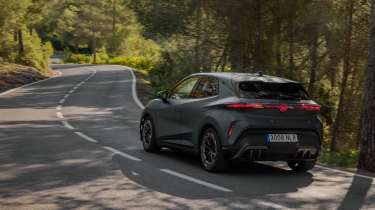
The e-diff in particular helps make the most of the performance. Under power it draws you towards the apex and tightens your line, but it's not so aggressive that it dramatically changes the balance of the car. The steering stiffens and gently tugs at your hands as it hunts for traction. It hooks up more cleanly than the torque steer-prone A290, which uses torque vectoring by braking to control slip at the front.
Eventually you do find the limit of the front end, but given the relatively modest power levels the Raval isn’t unruly when it breaks traction. You simply keep your right foot planted and allow the fronts to regain grip. In faster corners there’s good stability and grip to lean on but the outside front tyre starts to scrub as you push harder. The balance returns to neutral when you back off however, and you can hold the Raval on the edge, tweaking its balance with the throttle. It could be pointier and more dialled-in but there’s nuance in its handling, and adjustability built in.
Is it more fun than an A290? The Alpine is polished to a higher level, with more feedback and finesse in how it drives, and better brake feel. But the Cupra counters with its diff, which really does make a huge difference to how hard you can commit and how the car puts its power down. It’s still not at the level of our favourite hot hatches – it’s missing that ultimate sense of focus, plus a combustion engine to engage with – but the Raval is an endearing electric supermini, with what feels like a more defined personality than the Born.
