
BMW iX M70 review – Pagani torque makes Munich's electric SUV worse
The flagship BMW iX is a bit more powerful and more sensibly priced than before. It’s still basically pointless
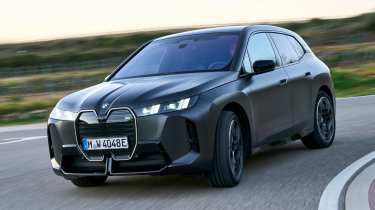
Cards on the table. You might not believe me once you get to the end of this review of the BMW iX M70, but I like the standard model. I can’t think of another car that’s quite so appreciably enjoyable to be in (if not necessarily drive in the dynamic sense) as it is unpleasant to look at. The Bavarian engineers really did overdo it, where composure, ride and refinement are concerned. You could just as easily ship the bones of an iX off to Rolls-Royce, get them to re-clothe it, redo the interior, double the price and offer it as a competitor to Bentley’s upcoming ‘urban EV’. That’s how accomplished it is.
Such is the well-roundedness of the standard iX range at the purpose that it is intended to serve, the uber-power flagship - the M70 now replacing the M60 - sort of sits uncomfortably at the top, not really bringing much of any use to the table. The performance is ultimately surplus to requirements, the range takes a chunk of a hit as a result and the price is some £20,000 up on the next fastest iX, the xDrive60 M Sport. It's also some £40,000 more than the entry-level iX, that for its purpose is plenty quick enough and doesn’t go without any of the model’s inherent talents. On the right wheels in M Sport trim it'll still be as imposing too.
Engine, gearbox and technical highlights
- Pagani Huayra levels of torque (749lb ft)
- 650bhp, up 40bhp from before
- Carbon and aluminium construction
More reviews
In-depth reviews
The M70 picks up the larger of the iX’s two battery options as standard, with 111.5kWh of gross capacity (108.9 usable). This powers an electric motor on each axle that together produce a peak combined figure of 650bhp, 114bhp more than the xDrive60 variant below it and 40bhp up on the old M60. As before it also packs a frankly abused 749lb ft and is good for 0-62mph in 3.8sec.

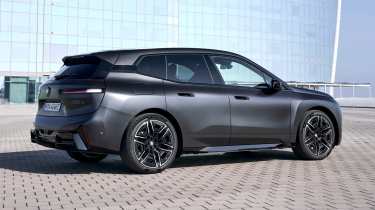
The chassis hardware is otherwise unchanged, featuring a combination aluminium space frame and carbon composite chassis with exposed carbon elements in the sills and door shuts. There’s also carbon in the roof and tailgate support structure, helping keep weight down to, erm, 2580kg, down 15kg versus the M60 thanks to savings in the updated battery and electronics.
It rides on a combination of air springs and adaptive dampers and has M-specific tuning for the anti-roll bars, steering and brakes. It also comes with a rear-wheel steering system.
Design, interior and tech
- New iX3 makes BMW curved display look a little dated
- Quality still solid
- UI still mixed
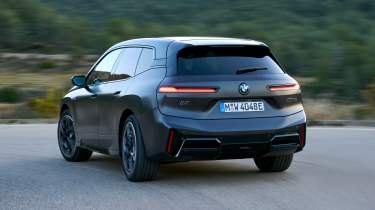
Visually the M70 is a sight to behold. It’s big, yes, but also full of visually awkward angles and odd design elements offset with high-quality detailing and sharp, modern LED lighting.
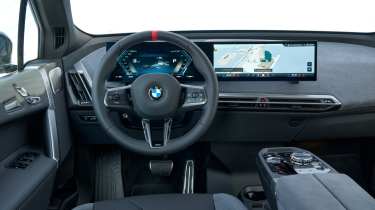
Step inside and the quality of the standard iX remains and is enhanced here, with BMW’s sportier steering wheel present, now featuring a red centre stripe – about as incongruous in an electric SUV as over 1000nm of torque.
The iX used to feel like the future until the latest iX3 arrived, with the new BMW cabin architecture in all its glory. Now, the curved display, if not the iX’s avant garde design, looks current rather than futuristic. The UI isn’t perfect either – I wish switching between the levels of regenerative braking were a tad more intuitive.
The pleasantly airy feel, solid build quality and sumptuous minimalistic vibe remains and does not betray even the M70’s £113,000+ price. Seat bolstering could be more aggressive given the performance stance, though there is now at least M Sport trim on offer. The crystal central gear selector and rotary infotainment controller do occasionally catch the sun in bright conditions too.
Performance, ride and handling
- Warp-speed performance…
- … that feels incongruous in the otherwise serene iX
- Ride, refinement and body control balance is applaudable
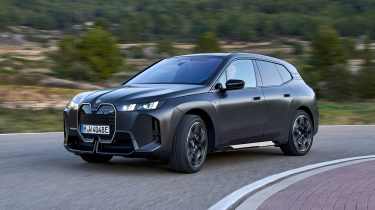
This feeling of quality is maintained the moment you pull away. The powertrain is quiet - you’d expect that of an all-electric car - but its calibration is good, with a natural and very responsive throttle. Comfort is any iX’s natural mode, with softened responses for a more relaxed driving style. And refinement is astoundingly good, beyond even that expected of a high-end EV with little to no road, wind or suspension noise – just the occasional thud of the 22-inch wheels clobbering potholes, that would shake the bones of many other cars. The iX almost feels like it’s gliding through space in a vacuum, with only varying levels of Hans Zimmer-designed noise being the indication that you’re building speed.
A bit out of character for all iXs is just how quick the steering, something accentuated by the standard-fit rear-wheel steering system. You do have to recalibrate yourself and wind back the inputs you’d normally expect to be required in an SUV. There’s a good view out with good placability on the road, though it feels its size when navigating tight car parks, for instance.
Pick up the pace and there’s a slickness and composure that the iX M60 shares with its lower-spec siblings. The comparatively large 22-inch wheels have no detrimental effect on ride quality, and regardless of the chosen driver mode the body remains flat, composed and directionally stable. Change over to Sports mode and you’ll feel the ride busy as small bumps make their way into the cabin, but the upside is even more lateral stability.
Plumb the iX M70 for all its hypercar-level torque and supercar performance and the pace is dumbfounding. In an otherwise serene, relaxing motorcar, it feels almost entirely out of place. It's just unnecessary. It’s not like the M70 is totally incapable of harnessing its performance. The powertrain has a noticeable rear bias to its torque delivery and with that capable air suspension and damping, it carries itself well and feels agile and sportier than you’d expect. You pump the throttle, hold on for dear life, laugh maniacly once you let off and then think ‘why?’.
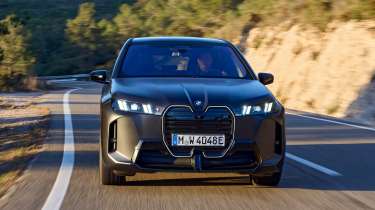
Because it’s still a far cry from being fun to drive. Impressively resolved and comes with a distinct dynamic character that helps it feel like a BMW, yes. But it’s still heavy, with full use of its performance requiring that you’re very familiar with the brake pedal, exactly what’s delivered across its travel and what its full capability is.
You just find yourself wondering, why not the iX xDrive60 instead? It’s still fast, just as refined, offers better range, is much cheaper and with the leftover spending power, you could buy a proper driver’s car to park alongside it – there are plenty of used proper M cars for the £20-£40k you'd save buying a lesser iX instead.
Beyond the appendage waving rights that M70 badge affords (which admittedly will have appeal to those at which the iX is generally aimed), I struggle to see the point. The M70’s increase in performance is noticeable, but as with all EVs it remains more of a gimmick than useful commodity. The M70 has no useful new traits, so shines brightly only because the standard iX is as accomplished as it is.
Driver's note
'Performance is fun, but in the right cars and context, just as paintballing is fun, just perhaps not while you're mid-hot stone massage on a Spa day. That's what over 1000nm feels like in the iX M70. The incongruity of it is just unsettling and when you see the reduction in range compared to the model down, a little bit irritating.' – Ethan Jupp, evo web editor.
Range and efficiency
- 300 miles real world in the summer
- 220-250 in winter
- More battery, less range, than 'lesser' iXs
Speaking of range. That 108.9kW of usable battery is claimed to be good for between 321 and 366 miles of WLTP-certified range is nominally up on the M60 it replaces, by 18 miles. It's also effectively the same as what you get from the iX 45 M Sport with its smaller 94.8kWh battery. Here is our first gripe with the M70. Fundamentally you are paying more and getting more in terms of performance. But rarely if ever are you relishing in it, or really needing more than 60 per cent of it. The sense you actually get is that you’re paying more for less… because the range deficit is what you feel every time you look at the range indicator.
Admittedly, the iX’s does appear to be pessimistic, highlighting the expected minimum larger than the potential maximum, where you actually land on the scale being dependent on your driving. As an example, it suggested 64 per cent would deliver 156 miles of range which, extrapolated out to 100 per cent, suggests 244 miles to a 100 per cent charge. That was however just after we covered 46 miles and used just 16 per cent battery in the process – a performance that implies 288 miles are possible to a full charge, all after having been indicating efficiency of between 2 and 2.5mi/kwh.

For reference, this was at 10deg C ambient, so colder temperatures would surely drag this down by a further 10 per cent at least. Either way, you’re doing well to cover 300 miles in an iX M70 with a full charge. As we approach 2030, that should be the worst-case-conditions performance from any EV, not aspirational in a £114,000 SUV.
Charging speed isn't exactly cutting edge either – 195kW in the iX M70, or in other words, enough for a 10-80 per cent charge in 35 minutes. The new Cayenne Electric's peak speed is over double that at 400kW, likewise the Lotus Eletre at over 350kW. The killer and what renders the iX a bit old hat? The new iX3, good for 400kW charging and 500 miles of range. Surely an iX5 will come soon to take the iX's place...
Price and rivals
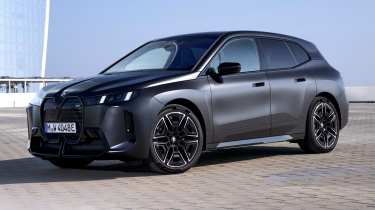
In 2026, the BMW iX range kicks off at £75,405 for the xDrive45 Sport variant with the smaller 94.8kWh battery pack – it’s the bottom of the range that felt the biggest improvements with this facelift and what makes it difficult to justify the £114,305 M70. Granted, it is cheaper than the iX M60 it replaces, which was priced from £124,605 in 2024. But it's still excess money for excess car. The best iX is the xDrive60 that pairs the best range - up to 426 miles (claimed) - with 536bhp and 564lb ft.
If a vast, excessive electric SUV is a must, there’s plenty to choose from. The Lotus Eletre R, for better or worse, turns heads like no other, though its ability to deliver dependable range - if not absurd performance thanks to its tri-motor 900bhp set-up - is questionable. It’s pricey too, costing from £131,305. As with the iX M70, lesser models do the same things well without the excess performance and price.
The Polestar 3 is probably the most attractive option of this type and is nicely resolved dynamically, with quality steering, damping and a nice balance. The 670bhp Polestar 3 Performance is cheaper than the iX too, available from £92,040, though it is a bit smaller than the BMW.
Coming on stream soon is Porsche’s long-awaited Cayenne Electric. In £130,900 Turbo form, it almost doubles the iX’s power output, with a Veyron-busting 1140bhp and 1106lb ft when in launch mode. We’ll report back on exactly how unnecessary that feels when we drive it soon… The final alternative to the iX M70? The most obvious... any other lesser iX. Because you simply don't need it.
