New BMW 3-series review – powerful M350 shows BMW can still be brilliant
A more familiar recipe lives on in BMW’s brave new era: a handsome saloon with a powerful six-cylinder engine and polished dynamics

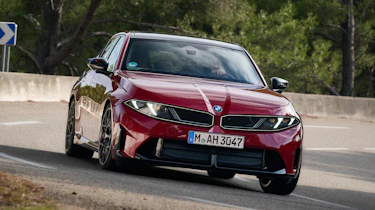
The new 3-series is a big deal for BMW. It always is, of course, but this eighth generation ‘G50’ model is pitched as a major re-set, aesthetically and in terms of engineering, earning the description ‘Neue Klasse’. BMW last used the term in the early 1960s at the launch of the 1500, the car that created the compact sports saloon class and saved the company. BMW isn’t in dire straits today but with the transition to electrification looming, it decided it was time to reestablish its core values.
The first Neue Klasse model launched was the iX3, debuting a new exterior look and a radical new interior, and the new 3-series features both too. Four models will be available in the next few months, two petrol-powered ICE versions - the 2-litre, rear-drive 320 and xDrive M350 - plus two full electric models, the i3 40 xDrive and i3 50 xDrive.
2027 BMW 3-series – engine and technical highlights
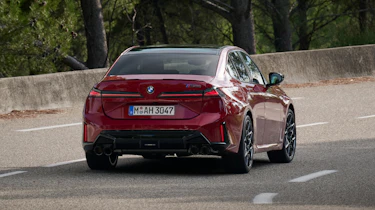
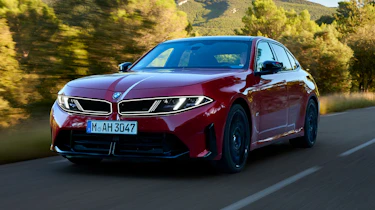
In the metal, the new 3-series looks modern and clean, tidier than recent generations with smooth, deep flanks featuring flush door handles and a front end dominated by the headlamps that meet in the middle and double as the kidney grilles. The ICE and BEV models look the same but are fundamentally different: the distance between the front arch and the door is longer on the ICE models, indicating that they are on built on different floorpans.
More reviews
The new 3-series is a fraction bigger in all directions than the model it replaces and a little heavier too. At 1860kg the M350 is about 100kg heavier than the M340i it replaces but has more power too, the mild-hybridised 3-litre twin-turbo six now delivering 443bhp. Visual signifiers of the M350 are subtle at the front, limited to yellow headlamps – a reference to BMW race cars – but much more obvious at the rear where you’ll find a slim boot lip spoiler and four massive tailpipes.
BMW M350 – performance and handling
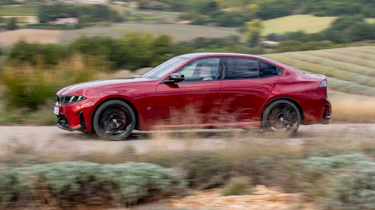
The standard spec of the M350 includes adaptive dampers and variable ratio steering and despite the huge, 20in wheels and tyres the ride is supple and quiet over various city surfaces. The steering is light and a bit lacking in feel but the weight improves with speed. Every time you give the throttle a decent squeeze, the sound is classic BMW straight-six.
Foot down, it’s a fast car but it does feel like the mass is working against it. You can sense its heft in the corners too but on fast, flowing roads the M350 feels very poised and comfortable. There might not be much feel through the steering but it’s an easy car to place with precision because it wants to turn but not in an unnatural, over-agile way. The rate of turn is perfectly matched to your steering input. As ever, BMW claims a near-perfect front/rear weight distribution.
On twistier roads the M350 raises its game again. The chassis balance works all four tyres and hooks every apex with a calm competence, so progress is fluid and confident. You have options to sharpen the feel with the various modes and in the sportier settings you get a bit more engine noise too. Get on the throttle early in hairpins and you can feel the rear wanting edge out a little on the exit, and if opposite lock is your thing, BMW has you covered. ‘Drift Moment’, which will give rear-drive only, will become standard during 2027 and will be available as an update on cars already delivered.
2027 BMW 3-series – interior

If, like me, you’re unaware of the dramatically different Neue Klasse interior, you’re in for a major shock when you drop into the driver’s seat. The steering wheel is square-ish and fat-rimmed with two spars, strong thumb rests and haptic switches. Beyond it there’s no instrument pod but to the right there's a massive, 17.9in lozenge-shaped screen leaning towards the steering wheel.
A prod of the start button fires up the straight-six with a reassuring growl and reveals the main instruments, which are projected onto a curve at the base of the screen. BMW calls this Panoramic iDrive and within a couple of miles I’ve got used to it, though I’m still not a fan of the strip-like rev counter hours later.
Against expectation, the odd-looking steering wheel wasn’t an issue; once we got going properly, I didn’t think about it again. I still don’t like the look and some switches are a little awkward to operate but fundamentally it works just fine. Same goes for the panoramic instruments but I miss having a drive mode switch – scrolling on the touch screen feels backward in a car with HMI designed to ‘keep your hands on the wheel and your eyes on the road’. BMW points out that you can configure voice activation but some of us don’t want to talk to our cars.
Price and rivals
Neue Klasse brings a clean look and a radical new cockpit but also recognises traditional BMW 3-series qualities; the heart of the M350’s appeal is its superb dynamics and character-rich engine. Same as it ever was.
The BMW M350 will be the flagship combustion 3-series at the top of the range before the next combustion M3 arrives. Prices for the M350 start from £66,785, putting it right in the ballpark of Audi's S5 saloon, which is a hair cheaper from £66,655. Mercedes-AMG's C53 is due to arrive next year and is expected to be pricier than the M350. Prices for the 3-series range will start from £44,975 for the 211bhp 320, with PHEV versions set to fill out the range next year.