New Bentley Supersports review – 500kg lighter Continental GT is the best yet
The new Bentley Supersports goes against the hybridisation trend, removing its electrical components, becoming 500kg lighter and rear-driven in the process

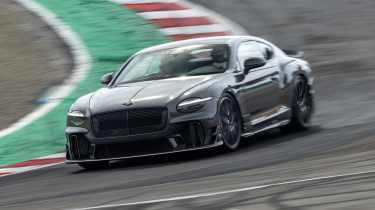
Like hot sauce and ice cream, ‘Bentley’ and ‘lightweight’ don’t normally go together. This latest model, the Supersports, is the lightest Bentley in 85 years – rather put into context by it being the first in that period to weigh less than 2000kg. It’s approximately 500kg lighter(!) than the Continental GT Speed it’s based upon, partly through becoming a strict two-seater and doing away with the plug-in hybrid element of its powertrain. That makes this the only current Continental GT model to be purely combustion-powered. It’s also the first ever Conti GT road car in general to be purely two-wheel-drive (and the first rear-drive Bentley since the Mulsanne).
Numbers are not the point of the Supersports, however. It promises to be a new kind of Bentley, one which prioritises feel and driver involvement more than ever before. It’s been signed off and developed under chairman and CEO Dr. Frank-Steffen Walliser, who took over the reins at Crewe in 2024 following a three-decade stint at Porsche. We can expect more diversification of the Continental GT model line – perhaps following the example of the Porsche 911 – in the future, and the Supersports might just be a sign of things to come. It will be limited to 500 cars, priced at around £343,000 each, before personalised options. All are spoken for.
More reviews
Group tests
In-depth reviews
- Bentley Continental GT review – not Ferrari sharp, but still the ultimate grand tourer
- Bentley Continental GT (Mk3, 2018 - 2024) review – ultimate luxury meets performance
Reviews
- New Bentley Continental GT S review – the sweetest Continental aimed at Aston Martin's DB12
- Bentley Continental GT Speed 2025 review – driving the most powerful Bentley yet
- Bentley Continental GTC Speed 2025 review – huge power, huge weight, huge price
- Bentley Continental GT W12 (Mk1, 2003-2010): the car that saved Bentley
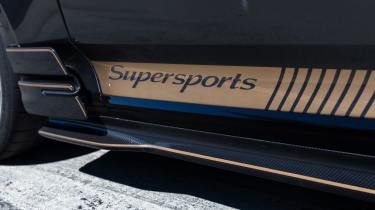
It also ditches the Continental GT part of its name entirely to be called simply the Supersports, and it’s the fourth Bentley to wear that moniker. The original Supersports, 18 of which were built between 1925 and ’27, was the first Bentley to crack 100mph. The next time the name appeared was on the Continental Supersports in 2009, and its successor in 2017. Both immensely likeable cars (particularly the 2009 model) but not the last word in precision, and both weighing more than 2.2 tonnes.
Bentley Supersports – power, performance and specs
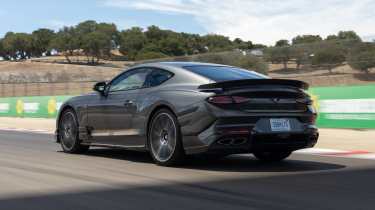
The new Supersports goes further than both of those modern-era cars in terms of spec and focus. We meet it at the Laguna Seca race circuit in California. There are two cars here, both of them pre-production builds (and in fact the only two such Supersports that currently exist; full production of customer cars starts imminently, with first deliveries planned around the end of the year).

One of the two cars is finished in an eye-catching red-to-black ‘print-fade’ graduated colour scheme, an option offered by Bentley’s Mulliner customisation department’s new Bespoke programme. Supersports customers ‘can have whatever they want’ in terms of colour and trim, Bentley says, and two identically specced Supersports will be an unlikely find.
Regardless of colour scheme, from stem to stern it’s clearly an evolved animal compared with the regular range-topping GT Speed. Most obvious visual changes are the various aerodynamic surfaces that have sprouted along the lower edges of the Continental’s body such as the new carbonfibre front splitter, dive planes and ‘fender blades’ near the front wheel arches, to reduce front-end lift and tidy airflow around the wheels. Most prominently, there’s a scoop-shaped single-piece carbonfibre spoiler along the bootlid which contributes the lion’s share of a claimed 300kg improvement in downforce over the GT Speed.
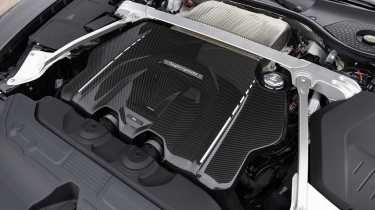
Under the bonnet is an evolved variant of the twin-turbo hot-vee 4-litre V8 engine used in other Bentleys and VW Group cars. This is the only car in the group to be fitted with this new iteration, with an altered crankcase and heads. The turbos are new, larger, single-scroll units. Variable valve timing has been reintroduced, as has the starter motor, since this is no longer a hybrid. It develops 657bhp and 590lb ft, compared with the GT Speed’s hybrid-assisted 771bhp and 738lb ft – but with half a tonne less to haul, the Supersport’s power-to-weight ratio is greater.
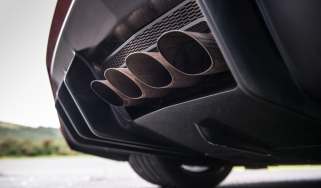
Bentley says that approximately 300kg of the weight saving comes from losing the hybrid system and front-drive elements of the drivetrain, which does sound like an awful lot. The other 200kg comes from other measures including a full-length titanium exhaust system, carbonfibre roof and mirrors, and 22-inch forged wheels supplied by motorsport specialist Manthey.
Hop aboard and behind you there are smartly finished carbonfibre panels where you’d normally find the rear +2 seats, with indented wells in their place to help stow bags. The front cabin is still a thoroughly luxurious setting, however. Customers can choose from all manner of leather upholstery options, or go in a sportier direction with carbonfibre and dark-tint chrome trim. Single-tone, duo-tone, tri-tone colour schemes and stitching options; customisation is as limitless as it comes.
You sit a little lower in the leather seats than in other Contis, the hip point having sunk slightly for a heightened sense of connection. While it’s been designed to be capable on a track, the Supersports is very much a road car, and Bentley says it’s still intended to be capable of a thousand miles in a day while keeping its occupants feeling fresh, as per the regular car.
Bentley Supersports – track test
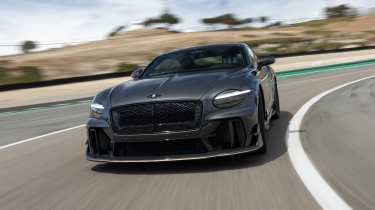
Firing up the V8, it settles into a purposeful, offbeat thrum at idle through the titanium exhaust system. Putting the eight-speed dual-clutch transmission into first gear and moving smoothly away, the exhaust note hardens into a muscular rumble. It’s a considerably spicier exhaust note than that of other Conti GTs.

Learning Laguna Seca for the first time, it’s a circuit that comes at you thick and fast, with many of the corners blind. Famously you can’t see the plunging Corkscrew chicane until you’re in it, but that’s the case for many of the other corners too. The Supersports is a good companion, with consistent responses and a confidence inspiring balance.
It retains the 48V anti-roll control of other Contis, with twin-valve air springs. The anti-roll software has been recalibrated, as have the electronic locking differential and traction control systems to work with the new rear-drive format.
Bentley has retained the GT’s rear-wheel steering system, as testing showed deleting the system did not improve grip levels and by virtually lengthening the wheelbase, it helps with progression and confidence at the limit. The rear-steer and electronic anti-roll systems have been recalibrated to work together to give the car more direct and agile yet predictable behaviour, particularly in Sport mode.
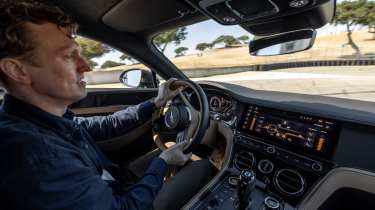
While the active anti-roll system keeps a flat stance in corners there’s enough roll programmed in to give you a good sense of what’s going on, and the air suspension handles the kerbs well, particularly the rather brutal bump at the apex of Turn Six. Without the extra bump of hybrid power the Supersports doesn’t feel overwhelmingly quick in a straight line but it makes a fantastic noise and 100mph comes and goes on the speedo in short order. It’s certainly not slow.
Bentley is not making any pretence that the Supersports is a trackday car or a 911 GT3 rival; this is still a two-tonne luxury coupe, and you need to get all your braking done in a straight line before the corner and the speed wiped off before you begin a turn, to avoid asking too much of the front end.
However, losing the front driveshafts, with accordingly recalibrated power steering, has aided steering feel. Front-end response is impressive, with the rear following faithfully. It’s not darty or nervous; it still has a weighty-feeling, measured response. The rear-steer is unobtrusive in action, only really becoming noticeable in the very tight left-hand turn around the pitwall at the end of the lap.
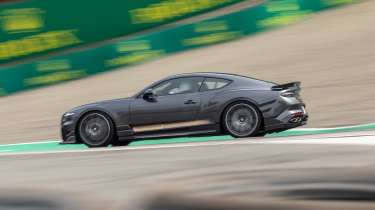
Brake feel, too, is good on track. The Supersport uses 440mm front discs in carbon-silicon carbide with 10-piston calipers, which are an option on other Continental GT models but fitted as standard here. There haven’t been any alterations to the braking system, since the car is carrying so much less weight than previously.
Firmer dampers, with higher initial damping forces to inputs, help with body control and a stronger sense of connection with the road. In the heavy braking zone for Turn Five, there is a tendency for the car to get up on its toes and need a little steering correction under braking but otherwise there’s a confidence-inspiring sense of stability. To get the best from the Supersports, you need to get on the power early and get the e-diff engaged to energise it. You can feel it engage and help to turn the car, pivoting it slightly from apex to exit.
Bespoke Trofeo RS tyres have been developed with Pirelli (though less focused rubber will be available as a no-cost option), for greater grip and also sharper steering response. Bentley claims the Supersports is capable of lateral cornering forces of 1.3g, and it feels believable.
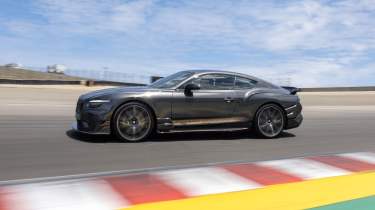
With the traction control switched on, it’s resolutely safe whereas in its handy halfway-house ESC Sport mode or entirely switched off, it can let go quite quickly if you’re heavy handed – after all, there is 590lb ft going directly to the rear tyres – but it’s controllable when it does. The Supersports needs a good cooldown lap (or two) for the brakes after being exercised. It’s no lightweight sports car and it is not intended to be a track-focused car yet it acquits itself very well around this particularly challenging circuit.
A more driver-focused kind of Bentley, yet one which doesn’t lose its Grand Tourer character, feels in-keeping with the brand. The Supersports unlocks more of the potential within the Conti GT platform without losing its usability. Its essential ‘Bentley-ness,’ for want of a better term, is still intact.
Hot sauce and ice cream can go surprisingly well together. It’s not a flavour for everyone but people who like it really like it. You get the sense the 500 Supersports customers will like their cars a lot, too. The road will be the Supersport’s natural habitat, and what it feels like out there will be the real acid test. From this brief, track-only snapshot at Laguna Seca, you get the sense it’s going to be a lot of fun.
Price and rivals
The Supersports has no exact or obvious rivals. While its power, reduced weight and performance figures might have you looking to the new Aston Martin DB12 S, it could be considered a more serious car than Gaydon’s recently refined GT. At £342,900, it’s over £130,000 more expensive too, potentially then putting it in the firing line of the Vanquish, or Ferrari’s 12 Cilindri, at which point it’s wading into battle with a deficit of 150bhp+. It being a limited run of just 500 cars, that are all sold, perhaps makes such a comparison redundant anyway.
Specs
| Engine | V8, 3996cc, twin-turbo |
|---|---|
| Power | 657bhp |
| Torque | 590lb ft |
| Weight | c/1924kg (347bhp/ton) |
| 0-62mph | 3.7sec |
| Top speed | 193mph |
| Basic price | £342,900 |