Bentley Continental GT (Mk3, 2018 - 2024) review – the last 12-cylinder Bentley is now BMW M2 money
Bentley’s last-generation GT was an major upgrade on its predecessor and now, it’s properly good value
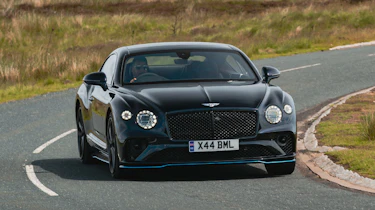
The third-generation Bentley Continental GT arrived in 2018, with a refreshed W12 engine and new bones shared with Porsche’s Panamera. Over the course of its life, V8 versions joined the range, as well as the Speed, the best-resolved Continental we’d yet seen.
Though the current hybrid car remains a significant derivation of its predecessor, what did end with the Mk3 was the venerable twin-turbo W12 engine.
Engines, gearbox and performance
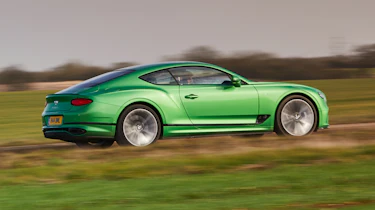
- The W12 engine is brutally effective as a power plant but not overly burdened with charisma or personality
- The V8 might be slower but it’s quick enough, better-balanced and a more engaging power plant
- Dual-clutch transmission is responsive but also languid and relaxed when required
Both Continental GT coupe and Convertible models were powered by either a V8 or W12 engine. The latter is a 6-litre twin-turbo unit, which despite featuring the same capacity and a similar fundamental design as the old W12, was genuinely a brand new engine. It was also bespoke to the Bentley brand. Audi had long dropped the W12 option for its A8, and VW had long dropped the Phaeton with which the Continental was once twinned altogether.
Changes inside the engine included further development of the variable valve timing system and the firing order, making the engine smoother yet more sporting in feel. The outputs are still impressive. To begin with 626bhp between 5000 and 6000rpm and 664lb ft between 1500 and 5000rpm was potent enough, with power rising in the Speed to 650bhp.
More reviews
Group tests
In-depth reviews
- Bentley Continental GT review – not Ferrari sharp, but still the ultimate grand tourer
- Bentley Continental GT (Mk3, 2018 - 2024) review – ultimate luxury meets performance
Reviews
- New Bentley Supersports review – 500kg lighter Continental GT is the best yet
- New Bentley Continental GT S review – the sweetest Continental aimed at Aston Martin's DB12
- Bentley Continental GT Speed 2025 review – driving the most powerful Bentley yet
- Bentley Continental GTC Speed 2025 review – huge power, huge weight, huge price
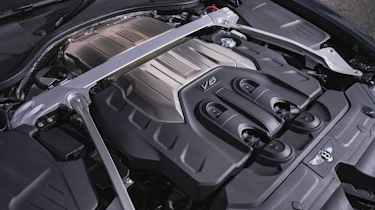
The V8 option was more familiar, sharing the same 4-litre hot-V twin-turbo unit found in Audi RS models from the RS6 to the RS Q8, Porsche’s Panamera and Cayenne and the Lamborghini Urus. It does have its own bespoke mapping, but otherwise shares its critical figures with the Porsche Cayenne Turbo specifically, with 542bhp produced at 6000rpm, and a peak torque figure of 568lb ft between 2000 and 4500rpm.
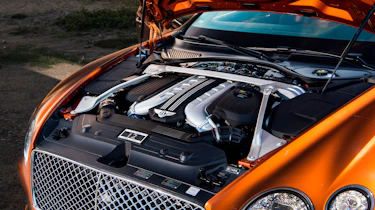
Both engines were paired to an eight-speed dual-clutch transmission, feeding power to a rear-biased all-wheel-drive system. While a dual-clutch system might not sound like the most natural ‘box for the ultimate grand tourer, it’s a superb example of the type and delivers an impressive balance of smoothness and responsiveness. That responsiveness was increased for the GT S model and Speed, too.
The Mk3 Continental GT’s performance is impressive (borderline ridiculous) across the board, with V8 models taking 4.0sec to reach 62mph, and the W12 taking just 3.6sec. Top speeds are not electronically governed, so the V8 reaches 198mph and the W12 an astounding 208mph.
And blimey does the W12 feel blisteringly quick in a straight line. The way it summons its energy with such effortless efficiency and simply propels you towards the horizon is as if you’ve been released from a giant bungee cord at the very extreme of its tension. It reminds us of the first time we drove a Bugatti Veyron.
The sense of acceleration is total, yet the sense of control – as if everything is going to be just fine, despite the fact that you appear to be travelling at Mach 2 for much of the time – is also all-encompassing. Combined with a dual-clutch gearbox that picks off ratios as quickly and calmly as a pickpocket plundering its victims all the way along Oxford Street makes the GT a deeply impressive car to drive fast, or even just to be driven in.
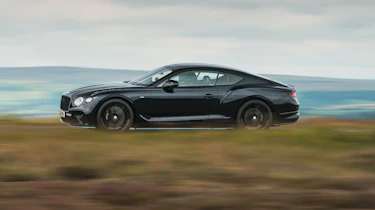
The only thing the W12 lacked is a level of character that’s difficult to instil in something with a W-cylinder layout. Even with turbocharging, Aston Martin’s V12 was more vocal. Aside from its unrelenting capability to build speed, there were precious few reasons to splurge on the twelve and with the latest hybrid packing over 750bhp, precious few reasons to lament its passing all too much.
The V8 does lack the W12’s ultimate punch, but it is both noticeably more responsive and charismatic. Things start well with a low-speed burble that perfectly suits the GT’s sinister demeanour, and even if the ultimate turn of speed is more measured there’s still plenty for everyday driving.
With a relatively low state of tune, the V8 is also just as effortless as the W12 when just pottering around at low to moderate speeds. Start exercising the V8 and there’s still plenty of performance, though, with that background grumble growing into a more clandestine bark that almost feels forbidden in something with so much embroidery.
Ride and handling
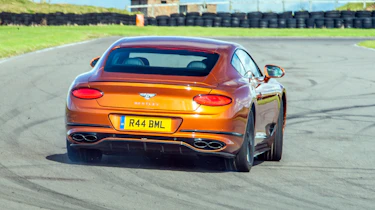
- Finally a Continental GT that trades heavily on dynamism and reward, as well as luxury
- The way it disguises its weight is uncanny, its myriad systems shaving 500kg off how it feels
- But its ability as a comfortable, cosseting GT car is unaffected. It’s a jack of all trades
Rather than having to work with hand-me-down parts from the VW empire, Bentley’s engineers were involved with Porsche in the development of the Conti’s chassis right from the word go, so they could dictate exactly what they were going to end up with.
The engine is set around 150mm further back in the chassis than before, which in itself makes a huge difference to the GT’s fundamental balance. At the front there are double wishbones, with a multi-link arrangement at the rear, but at both ends there is a three-chamber air suspension system with 48V electronically “active” anti-roll bars on both axles.
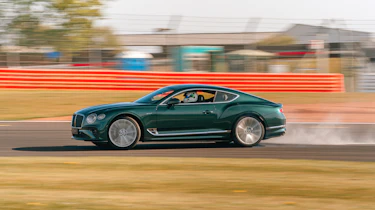
A key mechanical addition to the Speed is the use of an electronically controlled limited-slip rear differential. It might sound counterintuitive to fit an eLSD to a car with all-wheel drive, but it fundamentally changes the Speed’s behaviour at high speeds, cleaning up any sideways action and making it as comfortable with some degree of opposite lock as no car with a kerb weight of 2273kg has the right to. The GT S misses out on the rear diff, but gains the active anti-roll bars as standard. Weight for the V8 models varies depending on technical specification, but at its lightest sits at 2165kg.
The brakes were some of the biggest seen on any production road car, with 420mm cast iron ventilated discs at the front and 380mm rotors at the back, but both Speed and GT C models could be had with ceramics which measure in at 440mm on the front axle and 410mm on the rear, making them the biggest brakes fitted to any production car. Both the cast iron and carbon-ceramic brake packages use colossal 10-piston calipers on the front axle and 4-piston calipers out back.
The Mk3 GT is four-wheel drive the way in which the power and torque is deployed was radically altered. Switching between the three different drive modes available is key to the distribution of energy, and to the personality of the car in general.
Compared to the previous generation, the Mk3 Continental GT is borderline brilliant to drive with the caveat of its considerable mass. The chassis and suspension are arguably the areas in which it improved the most, and there are numerous reasons why.
The main reason is that Bentley’s had much more say in the underlying chassis design than it did before. There are now a wide range of driver modes including Comfort, Bentley and Individual. In Comfort mode up to 38 per cent of the engine’s torque will reach the front axle, which means the GT essentially feels like a cosseting four-wheel-drive limo. At the same time the maps for the dampers, throttle, gearbox, ESP and exhaust all settle into their most relaxed and least intrusive settings, and as such the GT goes properly into waft mode.
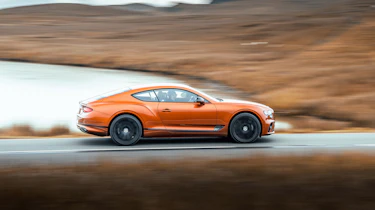
The steering, however, remains the same across all modes unless you go deep into its menus and select Custom mode, in which you can alter everything to your own tastes (although quietly, Bentley admits that only a few owners will want to change the way the car steers). Next mode up is Bentley, and that’s the one in which the engineers believe the car gives its best when being driven on the road. It’s a touch more sporting everywhere than in Comfort but still retains a sizeable dose of soothing refinement.
There is a delicious, deep sense of serenity about the way the GT glides across the landscape in Bentley mode. It purrs. It floats across uneven ground with a genuine feeling of majesty. And it’s also quiet, whisperingly so if you sit back and really think about it.
Yet at the same time the GT feels properly sorted on the road dynamically in Bentley mode, because it somehow manages to disguise its vast weight to a point where you might think it weighed only 1700 or so kilograms, not two and a quarter tons. That’s how crisp its responses are, how nimble it feels, despite the silly numbers.
Sport mode lets you fully appreciate how far Bentley went with the car’s dynamics, driving to a level that is WAY beyond anything you might expect of it, and so far beyond the previous version that you’d have a job to associate one with the other.
In Sport mode only 17 per cent of drive goes to the front axle, and everything else is set to deliver maximum sporting thrills, especially the exhaust and throttle maps. And the electronic suspension. In Sport mode the GT feels like an adequately sporting GT car. And if you turn the stability control off it will do things and reach angles of slide that a previous GT owner would never, ever believe possible.
All of the above, plus being such a rewarding and engaging package on the kind of demanding and twisting A- and B-roads where the previous car became so unstuck is what impresses most. Clearly working alongside Porsche’s engineers during the platform’s development has paid dividends.
The three-chamber air suspension underpinning the Mk3 Continental GT provides the perfect base to develop something quite unexpected. No matter the driving mode you select, the chassis deconstructs the surfaces beneath you knowing exactly what’s required to smooth out the imperfections, delivering the perfect rate of response and adjustability.
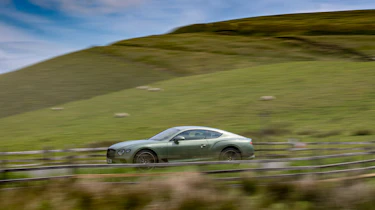
Where the old Conti would soon get in a bit of a flap on a road with crests and undulations, this model calls upon all the hardware (and software) available to it in order to remain composed without holding back the mighty performance. For all the adjustments provided by the dynamic controls, even when left to its own devices the Conti GT proves to be as precise and rewarding as when you fine tune every component to your personal preferences.
Things are taken up another notch on the Speed thanks entirely to the eLSD fitted to the rear axle. The Conti GT is more than capable of some impressive angles on track, but the differential cleans things up considering the sheer amount of torque of the full-specification W12.
Ultimately, if you’re after a GT with a more defined sporting bent, the Ferrari Roma is much more agile and engaging, but if the grand touring bit of the experience is key there are few that do it better.
evo Car of the Year 2020 result
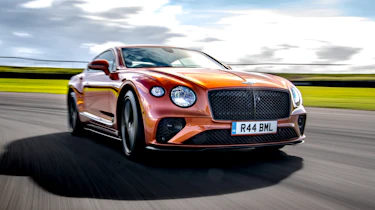
Bentley’s Continental GT V8 arrived at evo Car of the Year 2020 purely on its own merit. The third generation Conti GT arrived as such a leap on from its predecessor it wouldn’t have been a surprise if Bentley had considered a name change. With the VW Group’s ubiquitous twin-turbocharged 4-litre V8 installed it became arguably the best driver’s car Bentley had built.
During that Car of the Year test it surprised us all how adaptable it was, absorbing mile after mile of tedious journeys with its long-legged stride, soaking up the surface, isolating you from the white noise of society like few others. That it no longer fell over itself the moment the scenery turned interesting is where the Mk3 Continental GT V8 grabs you by the lapels and makes you take notice. Previously where you would resign yourself to wafting along with the occasional blast down a long, clear straight, you could now plug yourself in and prepare to get involved.
This third generation of GT takes hold of any slack, tightens its resolve and indulges you in the action beneath its deep-pile carpets. It doesn’t transform into a Cayman GTS but it enjoys being driven hard and at no point does this come at the cost of its luxury grand touring brief.
On track it’s a slightly different story, although not one where the Bentley understeers off the edge of the circuit into the Irish Sea. Its dynamics lose their focus and become a little one-dimensional. ‘Lift off on turn-in to unload the rear and encourage it to swing and help turn the car into the apex,’ was John Barker’s method.
Ultimately the mass that allows it to glide across the road struggles to be discreet on track. ‘That’s not to say there isn’t balance and some poise in there, far from it,’ explained Henry Catchpole during that test. ‘It’s just that such huge mass inevitably pummels the tread blocks and strains the sidewalls all too easily, which is not a very nice feeling.’
Adam Towler was taken with how it isn’t shy to loosen its tie and roll up its sleeves: ‘It’s a right giggle how you can fling it around Anglesey, smoking the rear tyres if you provoke it and get on the power really early. Yes, it’s all a bit silly, and not what you’d buy one for, but this is a car with a spirit just beneath the surface.’ Quite.
It’s the Bentley’s spirit that got so far in 2020’s end of year shoot-out and won it many admirers, bar John, who concluded: ‘It’s undoubtedly a better road car than track car but the Bentley leaves little impression on me.’ And while there were a few eyeing it up for a long run to that year’s second part test Scotland, we were unanimous that while it was the best Continental GT Bentley had produced to date, providing the platform for today’s even better Mk4, it didn’t have the credentials to take it any further in 2020’s evo Car of the Year, even if it was the best new GT car we had driven that year. – Stuart Gallagher, evo editor-in-chief.
Interior and tech
- Porsche family relation isn’t invisible inside
- But the fit, finish, quality and customisability is extraordinary. It’s a proper Bentley
- Rotating screen is one of those rare gimmicks that’s aged really rather well
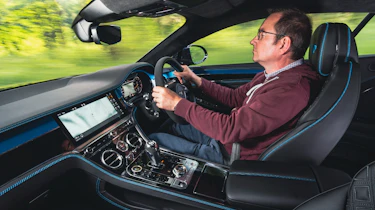
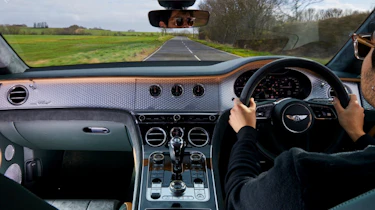
The cabin of the third-generation GT is extremely plush, with a combination of superb build quality, materials, and technology that’s at once contemporary and sumptuous in a balance that’s been finely trodden by Bentley’s designers. That it’s largely gone unchanged for the current car, save for some advancements in customisability, speaks favourably of its timelessness.
Quite the achievement given the optional rotating display felt like a lovable gimmick at the time. Then again, the ability to retract the screen when not in use and instead enjoy finely wrought analogue dials and the finely detailed accompanying physical switches is one of modern motoring’s great pleasures that’s more relevant today than ever. All told it remains one of the most, if not the most, impressive cabins in any car at any price point.
The connection to the Panamera shows itself in the steering wheel – borrowing heavily from Porsche – and infotainment, which is also no bad thing. The system isn’t quite the most intuitive available, but with exposure it’s never irritating to use. There are also enough physical controls within the cabin to only need to enter the screen’s lower menus for very specific tasks such as connecting phones or changing the interior ambient lighting.
Values, running costs and buying guide
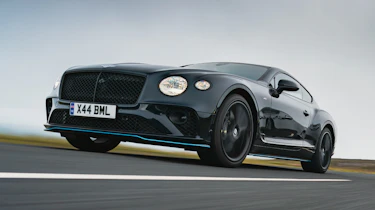
The W12-powered Speed has a combined fuel economy claim of 20.6mpg, with 311g/km of CO2. These are fairly wild numbers in 2023, so don’t expect to be on the shortlist for any sustainability awards. All V8 models are marginally more efficient with a 23.3mpg rating but like the W12, it sat in the top tax bracket. Being a car launched after April 2017 however, earlier examples will be in the region of just £200 per year to tax.
Overall running costs are extensive, though. Everything on the Continental GT is large in both physical size and specification. Most Continental models that came off the line run on the larger 22-inch wheels (be sure these aren’t kerbed) and tyres at 275-section front and massive 315-section rear. These will set you back serious money to replace. Brake pads and (god forbid) discs will also be expensive replacements. As such, a car with fresh sets of these consumables, or at least with plenty of life left, will be much more desirable. Or at least price replacing these into your negotiations if the right car happens to be on tired tyres and brakes.
Full service history is a must. You'll want a W12 car that’s had a major three-year/30,000-mile service recently, as this involves the notoriously involved process of doing the spark plugs in what is a cramped W12 engine bay. Be sure all the electronics are working as they should, that the complex three-chamber air springs are also in fine fettle. Otherwise, this car is a product of the final flourish of the VW group’s pre-dieselgate Piechian solidity and as such, should perform admirably.
Price is a point of real appeal where Conti GTs are concerned, as much to the chagrin of those that buy them new, they depreciate spectacularly. Cars that were £150,000-plus in 2018-2020 are now around for between £60,000 and £100,000. They’ve further to fall but that makes them a mighty bargain, given you won’t order a new Conti GT today for less than £200,000… The GT Speed and the GTS are the picks of the range, from £110,000-£150,000 still. These will have been between £190,000 and £220,000 new.
Specs
| Bentley Continental GT V8 | Bentley Continental GT W12 | Bentley Continental GT Speed | |
|---|---|---|---|
| Engine | V8, 3996cc twin-turbo | W12, 5950cc, twin-turbo | W12, 5950cc, twin-turbo |
| Power | 542bhp @ 6000rpm | 626bhp @ 5000 and 6000rpm | 650bhp @ 5000-6000rpm |
| Torque | 568lb ft @ 2000-4500rpm | 664lb ft @ 1500-5000rpm | 664lb ft @ 1500-5000rpm |
| Weight | 2090kg (263bhp/ton) | 2169kg (293bhp/ton) | 2273kg (291bhp/ton) |
| Top speed | 198mph | 207mph | 208mph |
| 0-62mph | 4.0sec | 3.7sec | 3.6sec |