Audi RS6 GT (2024 - 2025) review – the ultimate super-estate
The pure-combustion RS6 super-estate went out in a blaze of glory with the bombastic GT, complete with 1980s racing battledress. What’s not to like?
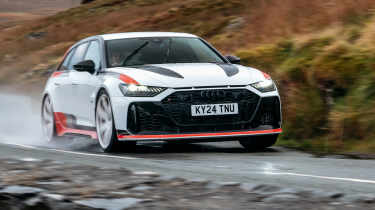
These are truly the end of days. Witness the RS6 Avant GT, a spectacular last hurrah for Audi’s petrol-powered super-estate before it cedes to an electrified successor. A total of 660 Avant GTs were sold at £177,115 a piece (that’s more than a £60k premium over the regular RS6 Avant), though just 60 were allocated to the UK.
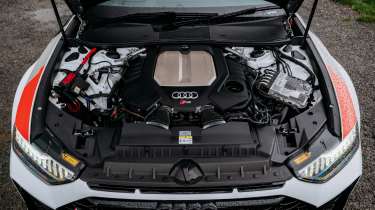
Though unchanged from the regular RS6, the GT’s headline stats still grab your attention. With 621bhp and 627lb ft from its twin-turbocharged 4-litre V8, the GT can hit 62mph in 3.3sec, 124mph in 10.4 and power on to a top speed of 190mph. The V8 is coupled to an eight-speed automatic gearbox and quattro all-wheel drive, while the GT boasts the latest-generation centre differential along with a retuned rear diff to bring extra agility and greater rearward bias in Dynamic driving mode.
> Audi RS7 Sportback Performance (2023–2025) review – an antidote to the hybrid BMW M5
Adjustable passive coilover suspension replaces the regular adaptive damping for the first time. Spring rates are increased, as is the stiffness of the anti-roll bars (up 30 per cent at the front and 80 per cent at the rear) and the dampers offer triple adjustment. Quite how many people will deviate from the factory settings is debatable, but the tools and instructions are on-board for those who want to try some experimentation.
More reviews
The GT boasts what can only be described as a strong look. One that borrows directly from the RS6 GTO concept from 2020, which in turn harked back to the rampant Audi 90 IMSA GTO race car from 1989. This fire-breathing 710bhp five-cylinder monster combined Audi’s Group B powertrain and all-wheel drive with a bespoke spaceframe chassis clad in composite bodywork that looked like a production Audi 90 that had been on a diet regime of creatine and anabolic steroids.
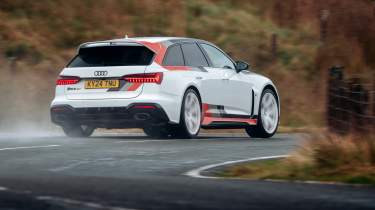
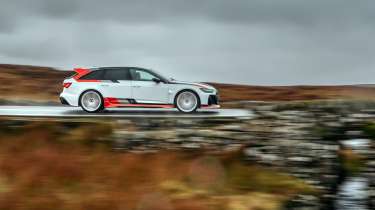
Transposed onto a modern Audi estate car, the IMSA livery is attention-grabbing to say the least. Given it borrows from an epic but obscure chapter in Audi’s motorsport history there’s every chance most observers will be oblivious to its significance, but as with most cars aimed at people like us, if you know, you know. The GT also comes in Mythos Black and Nardo Grey with more subdued decals, but going down that route would surely be a cop-out.
The bonnet and wheelarches are made from carbonfibre – a first for a production Audi – which saves weight and allows for sections of exposed carbon to be integrated into the Heritage decal design. There’s a host of aero and styling tweaks, the most obvious of which are the new front splitter, big rear wing and air vents aft of the blistered front wheelarches. Massive 22-inch alloys shod with Continental’s latest SportContact 7 tyres (285/30 all round) fill the arches to perfection.
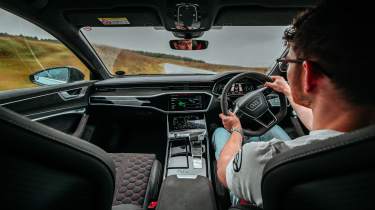
The interior is less in-yer-face but still has some bespoke details to remind you you’re in something special. Foremost amongst them is the numbered plaque, which allocates an individual number to each car, rather than the non-specific ‘1 of XXX’ seen in too many limited-production specials. The bucket seats are brilliantly comfortable and hold you firmly in place, while red and copper details – including red seatbelts and numerous embroidered RS6 GT logos – contrast nicely against the black leather and Dinamica fabric upholstery.
There’s more than a whiff of M5 CS about the RS6 GT. I can remember thinking BMW had jumped the shark by building a hardcore ‘lightweight’ M5 with bucket seats front and rear, but it turned out to be one of the most remarkable M cars ever. The same reservations crossed my mind with the RS6 GT, with the added question mark over the swap from adaptive air suspension to multi-adjustable passive coilover dampers. And there’s also the 1980s tracksuit aesthetics to consider.
When you first clap eyes on the GT amongst other cars it looks outrageous. If stealth is the root of the regular RS6’s appeal, then the GT’s dazzling Arkona White paint and Audi Sport decals are like dressing a Secret Service agent in a Ronald McDonald outfit. Still I’d be lying if I said it doesn’t make me smile, and once your eyes look beyond the decals they settle on the details that give substance to the nose-to-tailgate upgrades.
It’s been a while since I’ve driven an RS6, so it’s fun to get reacquainted. The engine starts with a seismic pulse before settling into a gently throbbing idle. Let the eight-speed ZF ’box do its thing, steer clear of selecting an aggressive dynamic mode and the GT has an imposing swagger, effortless propulsion mated to meaningful connection.
The steering is freer and lighter than you might expect, but combined with the taut damping it makes for a car you feel confident in from the off, accurate placement requiring little in the way of conscious effort. It feels compact, too, which comes as a surprise.
The firmness of the suspension makes you wonder if it’s going to be crashy, especially when you remember those massive 22-inch wheels and ultra-low-profile tyres, but there’s an underlying suppleness to the body control that’s immediately satisfying and bodes well for more challenging roads.
The powertrain has a feeling of immense performance, but with a surprisingly laid-back side to its character. Once lit, the GT is rampant, but it is equally impressive when you let it flex its way down the road using that huge reserve of torque. The Tiptronic gearbox doesn’t have the incisive punch of a DCT, but it responds very well in manual, even if the paddleshifters are a bit apologetic.
Selecting RS mode squirts a double espresso into the powertrain’s responses, but because the dampers are passive you don’t immediately get crashy suspension. They just remain constant. Yes, I know you can tailor things in Individual mode, but being perfectly honest I’ve never found a car that gives you exactly what you want.
Better, I think, to have suspension that strikes a sweet compromise and then have a few options on engine and gearbox characteristics. Finding that balance of support and compliance is not easy, but the simplified, more confident GT is my kind of car.
In evo issue 342's test between it and the BMW M5 CS, James Taylor said: 'With cleverly calibrated rear-wheel steering, it tucks into hairpins like a sports car. As with the M5 CS, it feels smaller than it really is. While it can’t switch between all- and rear-wheel drive like the BMW, the Audi’s clever centre diff and GT-specific rear diff can themselves do remarkable things. A little like the CS’s active electronic rear diff, the RS6 GT can balance the rear axle’s torque left-to-right under acceleration and deceleration. It can also apportion more to the outside rear through a bend, helping the RS6 turn more keenly, or do the opposite during oversteer to help stabilise it. So both on- and off-throttle, it’s possible to tighten the GT’s line with real precision.'
The V8 is surprisingly characterful, with a bit more woofle and rumble than the equivalent BMW. For the most part it simmers away in the background, never intrusive or overbearing, but always present. You can catch it napping accelerating out of second- and third-gear corners, but it’s only a momentary pause, as though filling its lungs. Once awake, the boost builds rapidly but doesn’t slam in, so the delivery is smooth and relentless. There’s light and shade to it, too, with ample mid-range building to a keen top-end.
> Best fast estate cars – performance cars with space and pace
Brakes are carbon-ceramic as standard. As you’d expect, they have epic power and stamina. It seems there’s a slight inconsistency in the initial response, because they’re progressive at low speeds but have a tendency to fractionally over-deliver on brake pressure when you make your first pedal application at higher speeds. It’s frustrating, because once through that phase you can modulate the brake pressure beautifully, but it’s not a deal-breaker.
Out on fast, open roads, the GT is a fabulous machine in which to make rapid progress. It absolutely devours the road, swallowing straights whole and chomping through curves. There’s a little bit of Nissan GT‑R about the way it settles into corners and powers out of them. Likewise, the way it deals with compressions and crests, though it does so with more pliancy. You’d expect a 2075kg estate to feel heavy under such significant vertical loads, but it shrugs them off brilliantly, feeling supremely controlled yet fluid and free within its range of suspension travel.
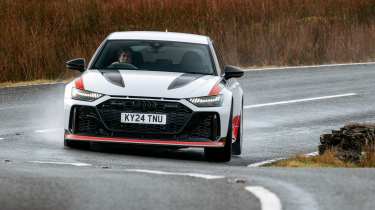
Equally unexpected is the feeling of agility and response. It’s been a long while since big, fast Audis were hobbled by understeer, but the GT is unusually deft. The new Conti tyres play a part, but it’s the way this RS6 rotates, and then how the torque is distributed, that brings it to life. In giving you options, it engages you more deeply and feels suited to a wider range of roads and corner radii, rather than forcing you to tackle every turn in the same style.
That’s not to say it has the repertoire of the M5 CS, which can be switched from all-wheel drive to rear-wheel drive, but the quattro system has learned a few new tricks thanks to the updated centre diff and GT-specific tune of the rear diff. The former divides torque 40:60 front to rear, but if slippage is detected then up to 70 per cent can be sent to the front axle, or 85 per cent to the rear.
It’s the recalibrated Sport Differential that makes the biggest difference, with the ability to send nearly all of the rear axle torque to one wheel, balancing it between left and right under acceleration and on the overrun. When turning or accelerating while mid-bend, torque is sent towards the wheel on the outside of the curve to maximise traction and counteract understeer. If the car starts oversteering, torque is shifted to the wheel on the inside of the curve. In Dynamic mode the tune has been adjusted so the GT is permitted a bit more yaw.
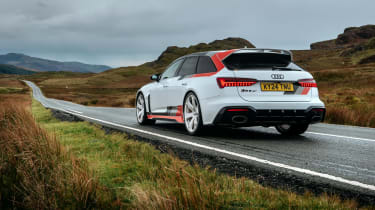
It’s clever stuff, not least because you don’t sense it working. What you do notice is that the GT has more rotational energy and greater throttle adjustability. Tighter corners can be attacked with more enthusiasm, and fast corners can be taken with greater precision, the smallest variation in throttle opening subtly tightening or widening your line.
Such is the GT’s focus on performance, you forget it’s also a spacious five-seater estate. I’m not offended by super-SUVs, but there’s no question I’d rather own the GT. The exterior presents it as a kind of stretched Mégane R26.R, but it’s a fabulously grown-up driving experience. One that is meaningfully different and more entertaining than the already excellent RS6 Performance, though I’ll concede even the most fanatical Audi enthusiast would struggle to justify the £60k premium in objective terms.
Better perhaps to see the RS6 GT as an emotion-led project. One which defies logic and threatens to miss the point, yet ultimately delivers a genuinely special driving experience. It seems a travesty that we should be bidding farewell to a car right at the top of its game, but at least Audi’s ultimate petrol-powered estate car has not gone gently.
evo Car of the Year verdict, John Barker
We’re big fans of the regular RS6 but the GT takes things to the next level. It’s such a complete and engaging upgrade that we can almost forgive the brazen decal pack.
‘Mistake it as an RS with some naff graphics at your peril,’ said Stuart Gallagher. ‘The precision with which you can deploy its colossal performance is totally unexpected.’ The more he drove it, the more Henry Catchpole liked it too. ‘There’s naturally still some aloofness that comes with it being a family car you could daily, but an estate car that can perform like it does when the right road – or track – presents itself is a wonderful thing.’
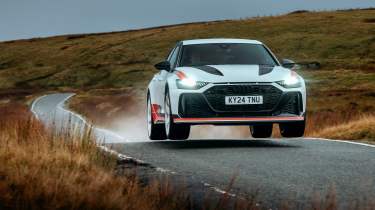
‘Got a bit of a love-hate thing with the decals,’ said Meaden, ‘but otherwise, what a car! Epic performance in a perfectly resolved package.’ I’m a fan of big, powerful cars and was wowed by its composure but reckoned its lack of steering feel prevented it impressing like the BMW M5 CS in 2021.
James Taylor loved it, but added: ‘My only doubt is that some of the “wow” feeling is that the RS6 is doing all these remarkable dynamic things despite, rather than because of what it is'.
Price and rivals
Such is the specialised nature of the GT that it didn't really have any direct rivals when it was on sale, nor today. BMW's previous-generation M5 CS is close in philosophy despite being a saloon, and a low-mileage used example will cost you around £120k today, compared to the RS6's c£175k when one does surface. BMW's G99 M5 Touring is another V8, four-wheel drive super-estate, but as a PHEV it's very different in concept to the RS6 – and much cheaper at £113,905.