Audi RS5 review – Audi Sport's super estate eyes the BMW M3 Touring
Hybrid power provides Audi’s new super estate with a class leading 630bhp, but it comes at a price. Well two actually

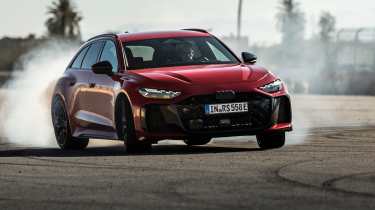
Just as the circle of white smoke is completed and any view of the Marrakech street circuit obscured, there is a sudden, scolding sound from the new £92,120 Audi RS5, a tell-tale tack-tack-tack-tack. I can feel it, too, not just the percussive beat in the arch but the slightly lopsided change in balance. The right rear Pirelli P Zero R has delaminated, spectacularly.
Yes, rear. The RS5 was mid-oversteer, not understeer, when rubber began flaying the arch-liner. Not a stance that an Audi RS Avant has really been associated with in the last 30 years. But the latest B10 RS5 has a new trick up its back axle. A world-first no less. An electromechanical torque-vectoring rear differential with its own 10bhp, 30lb ft electric motor that can shift torque powerfully between the rear wheels in either direction, regardless of throttle or brake input. Where the old Sport Differential could only deploy torque differences of up to 1200Nm, this can manage 2000Nm and it can do so in just 15 milliseconds.
> BMW M5 CS v Audi RS6 GT – the greatest supersaloon v the ultimate fast-estate
The result is that you can pick Torque Rear from the Drive Select menu, turn the steering wheel, bury the throttle and, as long as you trust the algorithms to do their job, hold the RS5 in a big, long drift. It’s fun, albeit a very four-wheel-drive sort of slide, in that you need to keep the throttle pinned and use the steering to adjust the angle and direction of the oversteer. Feather your right foot as you would in a purely rear-drive car and the rear axle will think it’s time to turn on the house lights, roll the credits and end the show.
More reviews
In-depth reviews
Reviews
- Audi RS5 review – Audi Sport's super estate eyes the BMW M3 Touring
- Audi RS5 Sportback (2019 - 2024) review – the sensible BMW M3 alternative
- Audi RS5 review – finally an M4 beater?
- 2017 Audi RS5 review - Audi's most entertaining coupe yet?
- Audi RS5 Cabriolet (2014 - 2015) review – the first and last of its kind
- Audi RS5 (2011 - 2015) review – stylish, less dynamic BMW M3 alternative
- Audi RS5 Review
To that extent, maintaining a drift or donut is quite brutal on the tyres, as I found out after just a handful of circumnavigations of the cones. The fact that the Audi engineers didn’t seem in the least surprised or concerned suggests I wasn’t demonstrating an unexpected level of heavy-handedness either. The swiftness with which a new set of Pirellis was bolted onto the rear end also indicated they had come to Morocco prepared.
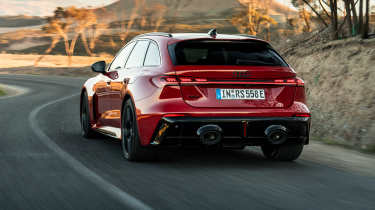
Donuts and indeed the Torque Rear setting are, of course, the extreme expression of what the system can do. A few more regular laps of the dusty, bumpy, scruffy Marrakech street circuit in the RS Sport setting reveal a car that is well balanced and easy to adjust both on- and off-throttle. The central (passive) Torsen differential, capable of shifting up to 70 per cent of torque to the front or 85 per cent to the rear, now has permanent preload, making it quicker to respond – and it feels it. There is real precision, and thankfully it’s not all about big, blunt inputs and lurid outputs.
Through a long, medium-speed left-hander, between unforgiving concrete barriers, with a jolting dip in the middle just for good measure, the big RS5 Avant is easy to play with. It feels very natural to hold right on the edge and you can calmly let small slides play out without any sense that they must be gathered up immediately for fear of momentum building into something monstrous. The steering ratio is quick at 13:1 and although it isn’t brimming with fluctuating weight and granular texture, you get a really nice feeling of connection to the car through both hands and backside. Turn into a corner and you can quickly sense how the sidewalls are loaded, making the RS5 feel both smaller and lighter than it really is.
Which brings us to the pay-off. As you might have read, the RS5 is a hefty beast because of its burden of batteries beneath the boot. Yes, the weight is distributed very evenly, 49:51 front:back, but there is no sugar-coating a kerb weight of 2370kg (or even the 2355kg of the rather attractive saloon). The decision was taken early on in the RS5’s development that it would be a PHEV, heralding a new era for Audi Sport, and that there should be a decent EV range and not just something token, as is the case with so many hybrid supercars – and the C63 AMG. So the new RS5 comes with a 25.9kWh battery and a radial flux motor mounted between the engine and gearbox. The battery can be fully recharged at home on an 11kW charger in 2.5 hours, or replenished on the go with the V6. All in, it’s good for a range of about 54 miles of pure EV driving, so its hybrid capabilities do feel genuinely useful and something that might actually sway consumers.
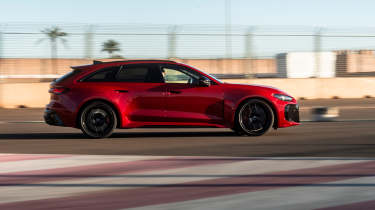
However, just adding EV capability and over 600kg to the old RS4 recipe would have felt like tipping the scales too much towards the practical and away from the performance. Yes, there is an uplift in the power and torque figures, the 2.9-litre, twin-turbo V6 gaining 59bhp on its own and the addition of the electric motor boosting the overall numbers to 630bhp and 603lb ft from the B9 RS4’s 444bhp and 442lb ft. But it could be argued that these increases really only serve to mitigate the uptick in weight.
Audi would argue that the 0-62mph time has dropped by 0.3sec from 3.9 to 3.6. It also claims that in the first 2.5sec of a launch, the new RS5 travels 22.6m compared with the old RS4’s 14.7m, which is impressive. However, I would still argue that’s not a big enough benefit to mitigate the mass. The addition of that Dynamic Torque Control rear axle, though? That just might be, and Audi says it wouldn’t have been possible without the 400V architecture that came with being a PHEV.
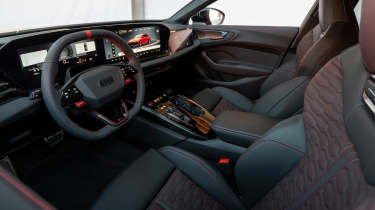
Heading out into the maelstrom of Marrakech traffic and the mixed surfaces that sometimes do a good impression of the UK’s own cratered highways, the RS5 is a very relaxed place to be. The screens and the graphics therein are large enough not to feel fiddly and they’re augmented with a few sensibly chosen physical buttons for things like the drive modes, ADAS and hi-fi controls. It would be nice if the HVAC controls weren’t on the touchscreen, but there is at least a little lip to rest your hand on while fiddling with the fan or tweaking the temperature.
It’s testament to the steering’s precision that you feel confident and relatively calm threading the RS5’s big arches through gaps between buildings and oncoming traffic. The five-link suspension has twin-valve dampers that independently adjust compression and rebound, and despite running the optional 21-inch wheels wrapped in 30-profile rubber, the result feels a world away from the monastic mattress ride of old RS models. The fact that I’d just done 800 miles in an air-suspended Range Rover Sport yet never found myself diving for the Audi’s suspension settings to soften things off speaks volumes.
Unfortunately what doesn’t speak volumes is the exhaust system. It’s an increasingly common refrain these days as legislation seeks to strangle any sense of soundtrack joy, and despite the most prominent ovals since the US President’s office, there really isn’t a great deal of aural interest in the new RS5. There is just enough aggression in the noise under hard acceleration to make you know you’re in something performance-orientated, but it’s not musical or inspiring, which is a shame given the V6 under the bonnet.
The eight-speed torque-converter doesn’t leave much of an impression either. It’s not obstructive, but neither the demeanour of the shifts nor the action of the small paddles screams RS. I asked about the decision not to go for a DCT and it sounds as though the engineers were faced with choosing between what was already available and what would fit with the integration of the e-motor.
The braking is much more impressive, however. All the launch cars were fitted with the optional carbon-ceramics, which measure a mighty 440mm in diameter at the front but also save 7.5kg in unsprung mass per corner. The system is brake-by-wire, but you’d never know and, perhaps aided by the new rear diff, it inspires real confidence. Audi actually claims that, despite the RS5’s extra mass, its stopping distance from 62mph is 11 per cent shorter than the B9’s – 34.4m reduced to 30.4m.
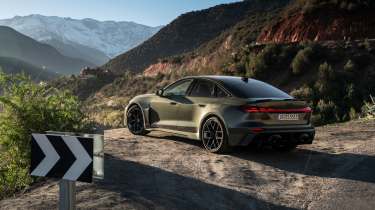
Some of the same sensations that were in the surprising RS6 GT are present in the RS5, particularly that connection to a back axle that feels alert and ready as soon as you turn into a corner, willing to be adjusted with more or less throttle as necessary. I wouldn’t say the big Audi feels delicately fleet of foot, but rather as the Revuelto cleverly doesn’t feel heavier than the Aventador, so the B10 with its new tech doesn’t give you the sense that it’s carrying around 30 per cent more weight than the B9.
It will be interesting to see how the dampers, diffs and that weight cope with the particular bumps and lumps of a Welsh or Yorkshire moorland road, but the signs are promising. I’m pretty sure the lighter M3 Touring will feel like its dynamic superior, but I also think the gap will be closer than it was with the old, non-hybrid RS4 Avant. Just how close, it will be interesting to find out.
After slightly losing track of time and mileage and possibly being distracted by camels, I even put the new EV range to good use on the return to Marrakech as night fell. With about half the battery charged, I easily covered almost 50km without troubling the twin-turbo V6 (which didn’t have anything like enough fuel left to get me even half the way back). It wasn’t thrilling, but it made the RS5 feel very much the modern all-rounder. It added another facet to that blend of space and pace, practicality and performance that has always made a fast Audi (especially in Avant form) so appealing. And given that the PHEV architecture has facilitated smoky donuts as well as zero-emissions travel, it feels like the balance has been maintained as well as given more breadth.
Audi RS5 Avant (B10, 2026) specs
| Engine | V6, 2894cc, twin-turbo, plus e-motor |
| Power | 630bhp (combined) |
| Torque | 603lb ft (combined) |
| Weight | 2370kg (270bhp/ton) |
| Tyres | Pirelli P Zero R |
| 0-62mph | 3.6sec |
| Top speed | 177mph |
| Basic price | £92,120 |