Audi RS3 Competition Limited review – can a hot hatch ever be worth £93k?
To celebrate fifty years of five cylinder engines, Audi has built the RS3 Competition Limited – its most focused hot hatch yet, with a £90k+ price tag. We find out if it's a worthy tribute

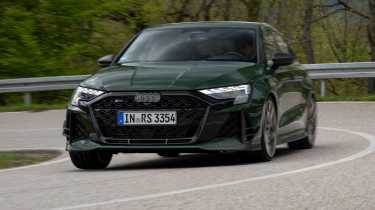
After fifty years of service, the future of Audi’s five-cylinder engine is hanging in the balance. In Europe, anyway. With the industry push towards electrification and more stringent Euro 7 emissions regulations coming into force this year, the current 2.5-litre unit is under threat, needing either emissions-related modifications or hybridisation to stay alive in European markets. That Audi will invest in either is not a given, meaning the five-cylinder’s final days may not be far away.
The RS3 Competition Limited is a swansong to the engine in its current form, and celebrates fifty years of five-cylinder Audis. The current RS3 is already one of our favourite hot hatches, and this special edition has been sharpened up by a track-focused makeover, which includes adjustable coilover suspension, standard ceramic brakes and subtle aero modifications. Limited it certainly is – 750 numbered cars will be built, with just 11 destined for the UK. The price? A quite scary £92,855, or the equivalent of a well-specced Mazda MX-5 more than the standard car. We’re driving the Competition Limited in Germany to find out whether it has any chance of doing that astronomical price justice.
> Why you've probably been driving the Audi TT RS wrong this whole time
More reviews
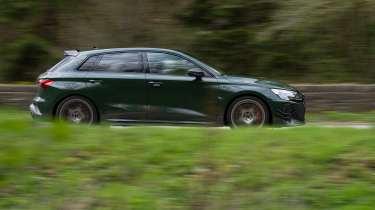
Visually, you can pick out the special edition from its 19-inch Neodymium gold wheels (a silvery shade not dissimilar to Porsche’s Weissgold), matte carbon front canards and rear spoiler, plus the 10mm drop in ride height from the coilovers, which tucks the wheels into the arches nicely. You might also notice the mostly slick shoulders of its optional Pirelli Trofeo R tyres. Test cars are running on the standard P Zero R, however, which I’m thankful for with scattered showers swooping over the region.
Inside you get RS carbon buckets as standard finished in a lovely beige suede (how lovely they'll look after a few thousand miles is another matter), and a squared-off suede wheel. Hit the start button and there's a deep, rich note as the Competition fires into life and settles at idle. The engine is unchanged and still puts out 395bhp and 369lb ft, but it has a slightly stronger voice thanks to reduced sound deadening around the bulkhead, and an RS sports exhaust with valves that open earlier in the most aggressive drive modes. The change isn't transformative but the engine is more present from inside the car. Once moving there's a smooth, satisfying beat not dissimilar in tone to a Lamborghini V10.
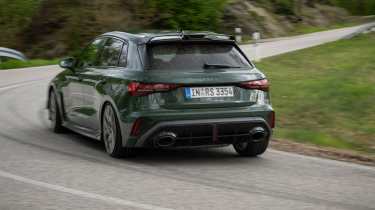
There's also a more polished ride quality from those new dampers. They're beefy units, stainless steel at the front with remote reservoirs and aluminium at the rear, with three ways of adjustment – low-speed compression (12 clicks), high speed compression (15 clicks) and rebound (16 clicks). They combine with stiffer rear springs than standard (the fronts are the same) and a stiffer rear roll bar to give the RS3 noticeably more keenness, which is evident even when flowing along at normal speed. There’s less slack in its responses and more precision to the steering, the car taking less time to settle and follow your inputs.
With the dampers in Audi’s recommended road settings there’s still tight control and a directness to the ride (it feels like there’s scope to slacken them off further, which you can) but the Competition’s movements are much more poised than the sometimes clunky standard car. There’s a dampened thump as it picks off imperfections – say, a drain cover – and it gets better with speed, the car staying keyed into the surface with less pitch and roll under high loads. More three-dimensional, broken surfaces in the UK will be a tougher test of the Competition setup but it’s far from uncompromising, and less busy than something like a GR Yaris.
The Competition’s newfound control means you can use the full might of the engine more of the time, at which point the RS3 really comes to life. The five-pot has never felt as sharp or free-revving as the best four cylinders but flexing it through the revs, hearing its tone change and feeling the rush of boost is so satisfying. The hard-hitting character fits well with the RS3, which has never been a delicate or lithe hot hatch but one that muscles its way along, fighting the surface for grip. The DSG gearbox is quick and obedient when using the paddles, but such is the engine’s flexibility that you don’t need to use them much. Perhaps a flick down into second for hairpins, but that’s all.
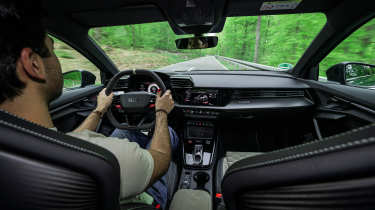
The RS3’s torque splitter diff – which can send all the torque going to the rear axle to one wheel – hasn’t been recalibrated for the Competition, rather its control systems naturally adapt to the new hardware. As in the standard car, it’s a really powerful tool in how it generates rotation under power. In how you’re encouraged to use the throttle to keep the diff lit (the nose will counter-intuitively take a wider arc if you lift off), it’s a bit like driving an aggressively setup front-drive hot hatch.
In the damp the strengths of four-wheel drive come into play, and Competition is superb; confidence inspiring with great traction, with the ability to subtly play with the balance under power thanks to the diff. In the dry it’s more prescriptive; neutral, stable and really capable, needing big commitment to come alive and feel the rear working. You need to get on throttle hard and early in a corner – usually well before the apex – for the tail to swing into action by the time you exit, meaning you can’t pick and choose your moments as in something rear-drive. Part of the problem is that the Competition generates more grip than the standard car anyway, which doesn’t allow the stiffer rear springs and roll bar to unlock the playfulness you might expect.
Still, get it right with the engine fully lit, the rear squirming and tyres hopping against the surface (something that happens in the standard car too, less so here) and the RS3 is properly exciting. Not as nuanced and meticulously honed as a Civic Type R but with depth and layers to explore, and a wonderful engine to accompany it all. More than ever, this is an RS3 that wants you to attack, with control and composure to spare. The only element that doesn’t feel up to scratch are the ceramic brakes. They generate good power but there’s a deadzone at the top of the pedal which saps your confidence. They stand out more here because the car as a whole is less fuzzy in its responses, more dialled in than the base RS3.
In fact this Competition is quite simply the best RS3 yet, one with the ability and focus to do its engine justice, more so than the already excellent standard car. Could Audi have done more? For the price, something resembling the RS6 GT’s wild visual makeover, and perhaps more power, would be fair to expect. Equally, the cost doesn’t seem to matter to those putting their name down for one of the 11 UK-bound Competitions (all of which are hatchbacks rather than saloons), with demand supposedly outstripping supply. Some will surely lock them away in incubated garages, but they’ll be missing out on one of the best Audi RS products of all.
Price and rivals
At £92,855 the Competition Limited clearly doesn’t abide by logic or reason in its pricing. It’s Audi’s best hot hatch yet, but it’s not £30k better than a standard RS3, and certainly not twice as good as a £46k Toyota GR Yaris. Its exclusivity will matter to collectors, but for the money you could have access to a number of far more specialised and exciting cars.
A BMW M3 Touring costs the same as the RS3, for example, and is a far more powerful and dynamically capable everyday performance car, while also being more practical and better equipped inside. Alfa Romeo’s Giulia Quadrifoglio, meanwhile, isn’t as well finished as the RS3 but more special and exciting to drive, for £6k less.
If you can forgo rear seats, Chevrolet’s brilliant C8 Corvette is also available at this level, so too the Lotus Emira and lightly used 911 Carreras. There’s also the BMW M2 CS to consider, which is similar in size and price to the RS3 but substantially more powerful and expressive, with 523bhp, rear-wheel drive and detail changes to its chassis over the regular M2.
Audi RS3 Competition Limited
| Engine | 2480cc in-line 5cyl, turbocharged |
| Power | 395bhp @ 5600-7000rpm |
| Torque | 369lb ft @ 2250-5600rpm |
| Weight | 1565kg |
| Power-to-weight | 256bhp/ton |
| 0-62mph | 3.8sec |
| Top speed | 180mph |
| Basic price | £92,855 |