Volkswagen Mission Efficiency revealed as record-breaking XL1 successor, with a twist
Well over a decade since the production VW XL1 hit the road, its maker has launched a 2026 equivalent with the wild Mission Efficiency
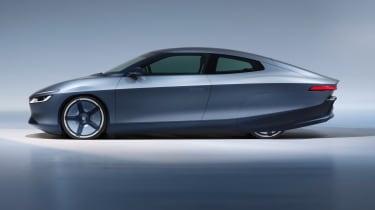
The Volkswagen XL1 launched in 2013 as the most economical production car ever built, and it captured the imagination of many in the process. Its ultra-exotic design is more akin to a Bugatti than an everyday eco car, which isn’t entirely coincidental given it was the brainchild of Ferdinand Piëch, the man behind the Veyron. It’s been 13 whole years since the XL1 hit the road, but now Volkswagen has created a successor for 2027: the Mission Efficiency.
That name isn’t just for show, as it’s already set the world record for the most economical near-production car ever built. Unlike the XL1 though, it doesn’t utilise a small-displacement diesel engine, but instead the same single-motor 134bhp electric powertrain as the new ID.Polo to give it twice the power of its predecessor. It shares its MEB underpinnings too, alongside its 52kWh battery pack (now expanded to 54.9kWh to utilise all of the available headroom in the ID.Polo unit).
> Volkswagen XL1 (2013) review – hypercar-level engineering aimed at MPG not MPH
It doesn’t have a huge battery pack, but even so, Volkswagen claims that under the right conditions it will extract 500 miles from a single charge. In a 794-mile test drive from Wolfsburg to Vienna via Poznan its engineers only needed to charge it a single time, achieving average efficiency of 8.2mi/kWh over the journey. Volkswagen claims it will achieve 8.4mi/kWh overall, which isn’t far from double the officially stated efficiency of the already efficient ID.Polo at 4.5mi/kWh.
Some of this extra efficiency comes from the wild new aero-led bodywork, giving it the same slick teardrop shape as the XL1 for an incredible drag coefficient of 0.158 – that’s less than the 0.19 of the incredibly slippery Mercedes-Benz EQS, and the XL1 for that matter. Rear track has been narrowed by 170mm and wheelbase increased by 100mm over the ID.Polo, with a low, smooth nose, active slats in the lower grille, a tapered rear end and flush wheel covers all contributing to improved efficiency. VW won’t disclose a weight figure, and while it will be significantly more than the featherweight 795kg XL1, carbonfibre-reinforced front wings, doors, bonnet and bootlid will all bring the figure down.
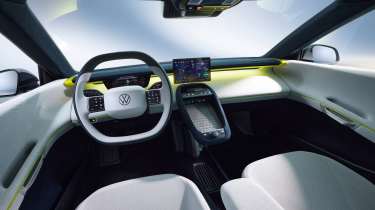
Despite the impressive stats, the Mission Efficiency is much more practical than the two-seat XL1. It's a genuine two-plus-two, with a double bubble roof for rear headroom, a not-insignificant 481-litre boot and even extra storage cubbies behind the wheel covers making it much more usable. Interior design is familiar though, taking the steering wheel from the ID.Polo and the smaller central display from elsewhere in the range. In the pursuit of lower weight, it goes without door electronics, with its bespoke seats (upholstered in recycled material) manually controlled. Even the sound system has been taken out and replaced with a Bluetooth speaker.
The Mission Efficiency is not available to buy as it stands, but Volkswagen says it’s ‘looking into’ making it a production vehicle. The XL1 was an ultra-limited near-£100k offering, but a VW spokesperson told our sister title Auto Express that a price target of around £42,000 is being considered. Fingers crossed.