Volkswagen AE 266 – dead on arrival
Few cancelled automotive projects have had such significant consequences, or been as costly, but the culling of VW’s original choice for a Beetle successor proved to be the right decision
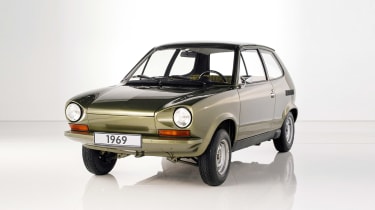
This page usually deals with stillborn models of an evo-ish bent, so you might think the gawky hatchback you see here doesn’t fit that bill. But this was no ordinary gawky hatchback. This was a multi-million-pound, Porsche-developed, mid-engined moment of madness that could have killed Volkswagen.
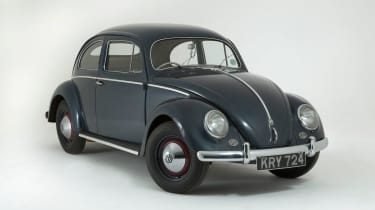
The backstory to this deranged project starts in the late 1950s, when the Beetle became such an unexpected hit in the US that Americans were waiting six months to get their hands on one. This runaway success set up VW for a wild ride through the ’60s during which sales kept rising and profits kept growing, leading to a giddy spending spree that saw the company buying NSU and Audi, and building itself a vast new proving ground at Ehra-Lessien. This last move seemed particularly lavish, since in product development terms Volkswagen wasn’t stretching itself, launching just two new models in the ’60s, both variations on the air-cooled and rear-engined Beetle theme.
In light of this, the German press began to run scathing stories calling VW a one-car, one-idea company. Even the federal finance minister waded in, accusing Wolfsburg management of ‘sleeping’. In a fit of pique, Volkswagen invited two journalists from Der Spiegel to its R&D centre to prove that it had not been sitting idle while the Beetle brought home the bacon, but this petulant show-and-tell backfired since the reporters were shown a vast collection of abandoned prototypes, all rear-engined and air-cooled, only underlining the company’s apparent lack of imagination.
To kick its over-reliance on one model, cash-rich VW decided to get radical and in 1966 commissioned Porsche to conceive a free-thinking family car for the ’70s that would be ‘sporty, comfortable, safe to drive, spacious and compact’. Overseen by Porsche’s head of development, a promising young engineer called Ferdinand Piëch, the result was EA 266, which featured water-cooled, in-line engines mounted lengthways in front of the rear axle, starting with a 1-litre three-cylinder and moving up through 1.3 and 1.6-litre fours, the latter with a spicy power output of over 100bhp.
With a three-door hatchback set to be followed by saloons, sports cars and a people carrier on the same platform, it was an ambitious project, and one that took on a greater urgency as the ’60s drew to a close and VW found itself in choppier waters. Beetle sales were falling, an unfavourable exchange rate had wiped out the juicy profits coming in from America, and famed safety campaigner Ralph Nadar had singled out the ageing Bug as the ‘most hazardous car’ on the road. Volkswagen quickly needed something new in its showrooms.
In 1969 the EA 266 was officially signed off for production. Porsche built up a fleet of 50 prototypes, tooling was ordered, some early promo photos were taken. VW’s 1970s saviour was on its way. But EA 266 wasn’t it, because EA 266 was a terrible idea. Aside from its awkward looks, the car was compromised by that radical mid-engined layout that made it hot, noisy and pungently fume-filled inside, as well as alarmingly twitchy in the wet. It was also shaping up to be absurdly expensive to build, and needlessly complicated to maintain too, since anything more than minor work required the engine to be taken out.
In October 1971 Rudolf Leiding took over as boss of Volkswagen and within two weeks ordered not only the cancellation of EA 266 but also the complete destruction of everything relating to the project. Porsche duly obliged by lining up most of the prototypes and driving a Leopard tank over them. A survivor is on display in VW’s museum.
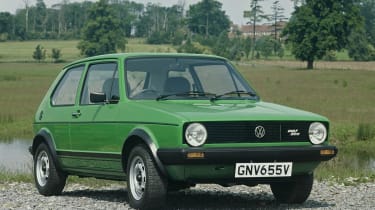
EA 266 consumed five years and £300million but it could have been worse: it could have gone into production. Instead, Leiding rolled the dice on a design his in-house engineers had been working on even before Porsche’s EA 266 was cancelled. It was the car that would become Volkswagen’s actual 1970s saviour: project EA 337 or, as we know it, the Golf.