Driving the mid-engined GR Yaris – everything we know about Toyota's secret sports car
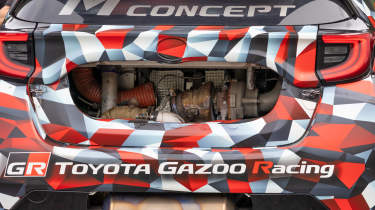
Toyota’s mid-engined GR Yaris M goes racing with the new G20E high-performance petrol engine, and it could offer our first look at the next MR2

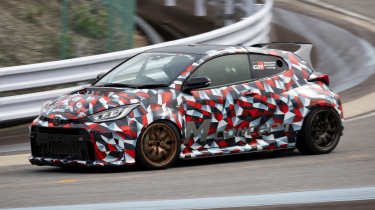
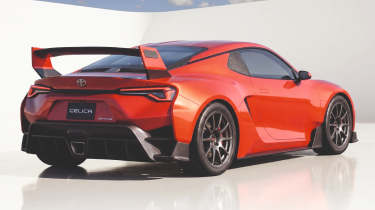
Toyota has no plans to give up on the performance car; on the contrary it is pushing its Gazoo Racing division to design and develop even more models, spanning from GR Yaris to the upcoming GR GT supercar. And next off the line will be a new mid-engined sub-£50,000 sports car that, despite its ‘MR’ working title and the mid-ships position of its four-cylinder, turbocharged engine, isn’t the new MR2 but could well be the new Celica.
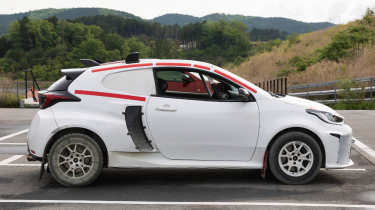
Rumours of a new sports car have been doing the rounds since late 2024 and were bolstered when Toyota presented the mid-engined GR Yaris M Concept test mule at the Tokyo Auto Salon in January 2025. Since then, GR has continued to develop the concept, including entering it in last month’s Fuji 24 Hours, where it qualified 26th.
The production car will get Toyota’s new G20E 2-litre turbocharged four-cylinder engine, a development of the 1.6-litre three-cylinder motor fitted to the current GR Yaris and Corolla, with peak power in the region of 400bhp.
As with both current GR hot hatches, the new mid-engined model is expected to be all-wheel drive, but what isn’t known is exactly what form it will take. With both GR86 and Supra production all but over, GR has space for a coupe in its line-up, and with the positioning of the engine in the GR Yaris M prototype, most speculation has revolved around a possible spiritual successor to the MR2.
However, speaking to evo at the Fuji 24Hrs, Toyoda suggested that a number of key decisions had yet to be made for its new sports car, including its seating configuration – a strict two-seater or 2+2 coupe – and the name.
To add further intrigue (or confusion, delete as applicable) Toyota is also testing its new World Rally Championship car, which will run to the WRC27 technical regulations that are set to replace the current Rally 1 rules. These new regulations require manufacturers to utilise a spec-spaceframe chassis that’s built to a uniform footprint.
> Toyota’s new 400bhp four-cylinder aims squarely at Mercedes-AMG
The power source must be a 1.6-litre three-cylinder turbocharged engine producing in the region of 290bhp, with suspension and brakes taken from the current Rally 2 regulations and updated accordingly. The body design is free, which is why Toyota has been seen testing a two-door coupe on Rally Raid events, hence the revitalisation of the Celica name.
As has always been the case with Toyota’s development of its GR performance division, its decision to build a new sports coupe is driven by a desire to create exciting performance cars that will appeal to existing customers and enthusiasts, rather than force them into electric performance cars, as other firms are attempting to do, many of which ultimately fail due to lack of interest. At the end of May, sister company Lexus announced it was canning its flagship all-electric saloon, and the electric version of the Toyota GR GT, previewed by the LFA Concept, may also be quietly sidelined.
‘In the past, Toyota had big meetings. Everyone was talking about specifications and horsepower that has to be the best in the world. But I want us to build a car that I love and our customers love,’ Toyoda-san told evo.
‘In the past we have built cars to suit the business, to make money. But I want us to also make cars that people love. Because I love cars and I need to show our people that Toyota loves cars too.’ In its last financial year, Toyota booked a $26bn profit, which was a near 20 per cent drop on the previous year and the third consecutive year profits have fallen. Thats said, in 2025 Toyota was still the world’s largest car manufacturer, producing over 11m vehicles, three million more than second-place Volkswagen Group.
Toyota has never been a company to follow convention. It has been criticised by some for being slow to market with 100 per cent battery electric vehicles, preferring plug-in and mild/self-charging hybrids. And it continues to develop hydrogen powertrains with BMW too, with the first production fuel-cell X5 due in 2028.
The growth of its GR performance brand is the most obvious example of building cars that excite and entertain first and foremost. In the same 24Hrs that the GR Yaris M contested, GR also entered its hydrogen-powered Corolla, while at Le Mans it had its hydrogen-powered WEC Hypercar.
‘Toyota is a global company operating in markets all over the world, including continents such as Africa where they don’t have [the] electricity [infrastructure for electric cars]. So we have to be at least competitive in all energy sources,’ continued Toyoda. ‘We have to be very good at hydrogen. We have to be good with battery technology. We have to have engines that are efficient with sustainable fuels. So I think: “Which powertrain will the customer choose in that market?” I can’t decide which one they have to choose. But always the enemy is CO2.’
What remains clear with Toyota’s GR division is that the product comes before the market insight, and at the heart of that product’s development is Toyoda himself. The former president, who took on the role of chairman in 2023, has been instrumental in the development of Toyota’s performance cars.
The GT86 was the result of his desire to provide an affordable, accessible and tuneable sports car for the next generation of Toyota customers. The GR Yaris was only conceived as a homologation requirement for Toyota’s continual commitment to the World Rally Championship, but when the regulations changed and there was no longer a requirement to build such a bespoke road car, Toyoda insisted his engineers carried on. ‘We didn’t make any money at first, but its success now means we are. The business is happy about that.’
As with the GT86, the return of the Supra in 2019 required Toyota to think laterally about how it could bring the car to market. So while the former was a collaboration with Subaru, Toyota collaborated with BMW after the German giant struggled to justify its next Z4 development budget and Toyoda saw an opportunity. ‘We helped Subaru. We helped BMW. Toyota led the development on both. We built two cars we loved.’
Driving the GR Yaris M
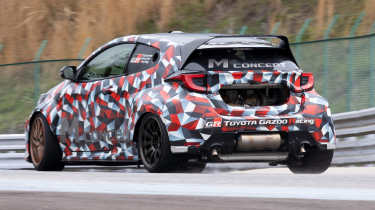
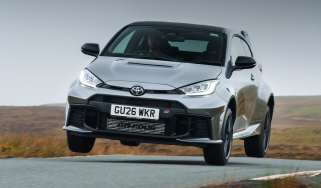
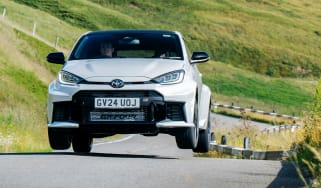
'As with all drives of prototypes, time is short behind the wheel and the specification is far from whatever the production car will be. The GR Yaris I’m driving has the 1.6-litre triple producing around 280bhp, positioned where the rear seats should be. The mid-engined project came about because Akio Toyoda was looking for a solution to make the regular GR Yaris rotate better, his engineers suggesting the best solution was to place the engine in the middle. Which they duly did.
> Toyota GR Corolla review - why the GR Yaris’s big brother will be worth the wait
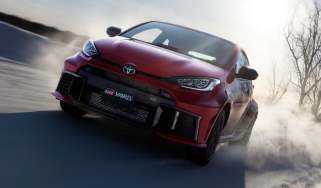
'What really grabs your attention is not the noise, the heat and everything else associated with driving a test mule with quite a lot of its internals fully exposed, but the way this fifth-generation prototype changes direction on tarmac. It’s lively, rotating with more accuracy and linearity but still requiring more corrections than expected as you build up to its limits. The GR Yaris has always hidden the length of its wheelbase well, and does so here too, and you feel the benefit as you correct your course in a calm(ish) manner that a Clio V6 owner could only dream of.
'On loose surfaces you need to unplug your regular GR Yaris muscle memory and calibrate for the new weight distribution. With little mass over the front wheels, the car requires you to get the nose turned in before opening the throttle and powering out of the corner. Carry too much speed in and the front will wash out like an early-noughties Audi RS.
'There’s an ongoing debate as to how the final car should feel. The more experienced race drivers on the development team like the edginess and raw approach of this prototype; others feel the car needs to be calmer if it’s to appeal to a broader audience. Whatever set-up – and name –they settle on, the next GR is unlikely to disappoint.' – Mat Watson