What is a plug-in hybrid?
The hybrid performance car is no longer an oxymoron. Here’s how manufacturers are using this new tech to make them better, not just greener

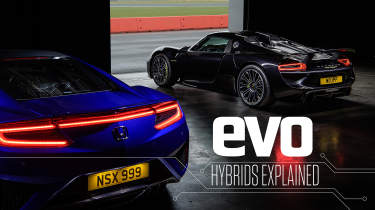
Plug-in hybrids take the parallel hybrid format and push it one step further, incorporating one or more electric motors and a much larger battery pack into the powertrain. As with the other categories, plug-in hybrids that are focused on economy generally focus on using as much of the electric powertrain as possible to reduce reliance on the combustion engine, but when tuned for a performance car work to a premise that focuses on overall performance regardless of where the power’s coming from.
The Porsche 918 Spyder was one of the first performance plug-in hybrids, which combined a race-derived V8 with two electric motors, one sitting on the engine powering the rear wheels, and the other on the front axle powering the front wheels. The 918 is able to achieve around 12 miles from its electric motors and battery pack, but the emphasis is on those electric motors providing extra power and traction, not improving on efficiency. A majority of the Porsche’s power is still generated from the combustion engine, but the electric motors are able to augment it, torque-filling like the McLaren P1 to bulk up torque and power at low engine speeds. The Porsche’s batteries are replenished by both regenerative braking and the ability to plug into external electrical sources. This technology has filtered down into lesser Porsche models such as the Panamera and Cayenne, their ranges topped by Turbo S e-hybrid models which combine a small electric powertrain with a twin-turbo V8 petrol engine.
The Polestar 1 is also considered a plug-in hybrid, but emphasises its electric powertrain which is supplemented by a downsized, twin-charged, four-cylinder engine. It’s 592bhp maximum power output is generated from a roughly 50/50 split between the electric and combustion motors, and is put to the ground via all four wheels. Like many plug-in models with all-wheel drive, the Polestar 1 doesn't have a physical power connection between the axles, as the front wheels are powered purely by the combustion engine and the rears from the electric motors. Driving the electric motors is a more substantial 37kWh battery pack, which gives the Polestar 1 an EV range of up to around 90 miles, reducing the powertrain’s overall reliance on the petrol engine when cruising, but using it to full effect when pushing on.
The disadvantage of having such a substantial combination of electric and combustion hardware is weight, which despite a carbonfibre body and other substantial weight-saving efforts means the Polestar 1 still breaks 2.3 tons. Plug-in powertrains with a smaller electric motor and battery set-up, such as that fitted to the Porsche Panamera, are nearly as detrimental to the overall weight and performance, in the Panamera’s case still adding around 300kg to the kerb weight of an equivalent model without the hybrid system.
Like few other hybrid systems, a plug-in arrangement can distinctly change depending on the individual layout. It might have the widest spread of capability, but it also comes with the most compromise, one that for performance cars is very difficult to justify at any level.

Plug-in hybrid performance cars
Pro: Able to drive useable distance on EV power; electric motors are power dense and can dramatically increase system power
Con: The heaviest option as it requires a full suite of hardware of both propulsion systems