Theon Design Porsche 911 review – twice a GT3 RS's price, but twice the car?
Theon Design's latest Porsche 911 restomod calls back classic racers and costs twice as much as the best new 911. We drive it to see if it's worth it
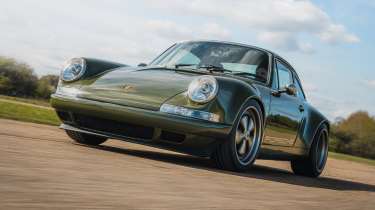
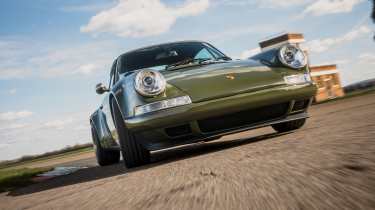
Porsche restomods, eh? Ten a penny nowadays, it seems. Only they cost rather more. It’s easy to be sceptical about the breed, but Theon Design’s work is too compelling to ignore. Cars from the Oxfordshire-based outfit have thoroughly impressed us on previous occasions and this is its latest creation: the MEX001 Porsche 911. It’s not a new model line, rather a variation on the existing Theon Coupe recipe: each car the company builds is a private commission, and this one is for a Mexico-based client, hence its designation.
Who or what are Theon? A small independent company producing five to six cars a year from its inconspicuous Banbury workshop, each using 964-generation Porsche 911s (built between 1988 and 1994) as source material and taking around 18 months in total to complete.
Alterations are sympathetic, modernising and upgrading the bits that need it, preserving the bits that don’t. The build process begins by taking the shell back to bare metal before corrosion-proofing and strategically stiffening the structure. Where possible, donor cars (some supplied by customers, some sourced by Theon, depending on the commission) are ‘tired’ examples, to avoid gutting pristine 964s. So far, more than 20 commissions have been completed since the company’s founding in 2016.
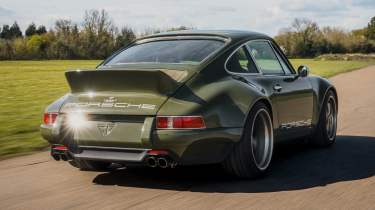
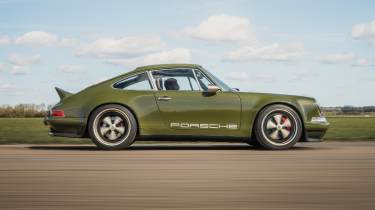
This one began life as a 1991 Carrera 4 but has been converted to rear-wheel drive. As with other Theon Coupes, the wheelarches are broadened, making them similar to those of competition 911s in period. The inspiration comes from the 2.7 RS of the early ’70s, as it does for the ducktail rear spoiler.
Some customers opt for motorised ones; this one is fixed, and taller than most, for an RSR-style road-racer vibe. The paint colour is a blend of two different hues, Nato Olive Green and Underberg, to create a unique shade, with ‘champagne’ metalwork details. The paint finish is first-class, even on the bits you can’t see, under the upholstered boot lining (with its matching luggage set) for example.
More reviews
In-depth reviews
- Porsche 911 Carrera GTS review – why Porsche's T-Hybrid is also one of the best
- Porsche 911 Targa review – the opposite of a purists 911, but still superb
Long term tests
Reviews
- Gunther Werks Turbo review – part Porsche 911 Turbo, part hypercar
- Porsche 911 Turbo (1974 - 1989) review – why the 930 was the original 911 wild child
- Porsche 911 GT3 S/C review – does a convertible GT3 really make sense?
- Porsche 911 (992.2) GT3 Manthey Kit review – a road-legal race car with a warranty
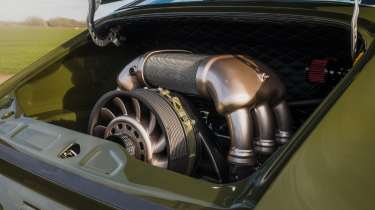
Theon offers a choice of 3.6, 3.8 and 4-litre engines; this is a 3.8, turning out 407bhp. Still air-cooled and naturally aspirated (though supercharging or turbocharging are options), it’s been rebuilt, lightened and balanced, with altered internals, bigger valves, individual throttle bodies and myriad other upgrades, including carbonfibre ‘tinware’. It’s already idling and warming up as I climb in, with an enjoyably offbeat thrum.
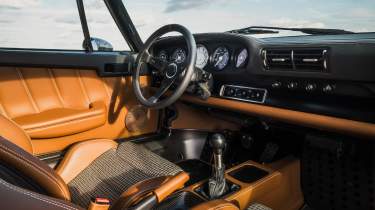
The driver’s door closes with a satisfying thunk. Every body panel is carbonfibre apart from the doors, which remain steel to preserve the original side-impact protection. There’s limited adjustment to the steering column but you can get comfy enough in the Recaro seat, here trimmed in tan leather and Pepita houndstooth-style fabric, a finish taken from the 991-gen 911 Sport Classic.
Customers can choose to take their car in a more relaxed GT direction or a racier direction; while still very much a road car, this spec is to the latter end of that scale and the lightweight flywheel gives remarkable throttle response. So much so that I use far more revs than intended to pull away, even though the clutch is user-friendly and the gearchange likewise.
Whilst there’s power steering (an electro-hydraulic system sited at the front, instead of the original unit’s position on top of the engine, for improved weight distribution) it doesn’t feel obviously assisted. Since the front tyres – Michelin Pilot Sport 4 S, chosen for their versatility in various temperatures and conditions – are nearly as wide as the rears on the original 964, the assistance is very useful at parking speeds, but there’s a firm, transparent feel to the steering at speed.
Likewise to the ride, which is on the moderately firm side but can be softened by adjusting the damper mode: this car is fitted with TracTive adaptive dampers, with five levels of damping force (and a nose lift function), switchable from the dashboard. Regardless of setting, since there’s not much mass to carry, the body’s movements are neatly controlled.
Other modern elements are neatly integrated into the machined-billet aluminium dash in era-style controls. For example, to switch the valved exhaust system between its quiet and louder settings, you pull an organ-stop-like switch. The audio system is Bluetooth only, and there are hidden USB‑C ports for charging.
Under heavy throttle loads the exhaust valve system is triggered actively, to help the engine breathe. It sounds fantastic when there’s the space to open the taps: lots of induction noise and a real rasping edge to it, yet it’s anything but coarse. Since the power curve is effectively a diagonal line and torque like a table-top, the engine’s delivery is very smooth.
With a kerb weight of only 1150kg (325kg lighter than the donor car), the power-to-weight ratio is on par with a current 911 GT3 and the MEX001 doesn’t hang about. In a car full of intoxicating details, the engine is a star attribute. It’s an addictive feeling to trundle through villages with the exhaust valve closed and then savour the hand-built flat-six’s full rasping, metallic howl once you’re clear of earshot.

This is a brief drive on busy roads, and so it’s not possible to explore the full handling envelope, but the MEX001 has a blend of classic and modern to the way it conducts itself through a set of bends. Though wider than the original (and lower than a 964 RS), it’s far more compact than most modern cars, and you can use its lack of width to boost sight-lines, avoid potholes and so on. It has the consistency of a competition car in its response but feels very much a road car.
And yes, it does cost rather more than a penny. Each Theon commission costs a minimum of £430,000. And that does not include the donor car, nor local taxes. In return, customers get painstaking attention to detail and an enormous tally of man-hours: more than 6000 in this car’s case.
There’s no question that’s a gigantic sum of money. However, there’s no questioning Theon’s attention to detail and quality of componentry, nor the appeal of speccing a car, customising it and following its build, before taking delivery and exploring the abilities of the finished product around 18 months later – just as MEX001’s owner will now be doing.
Getting hands-on with a personal 911 project could forge just as close a bond, but Theon’s experience, expertise and resources allow an ‘OEM-plus’ level of build quality beyond the reach of most. For those with the means, the thought of commissioning an ultimate, personalised 964 ready for decades of use ahead is a justifiably enticing one.