Peugeot's 805bhp E-T16 Concept could make it to production, says CEO
Peugeot revives its ‘80s rally champion in 2026 style with the E-T16 hyper hatch, and it might not be a concept forever...
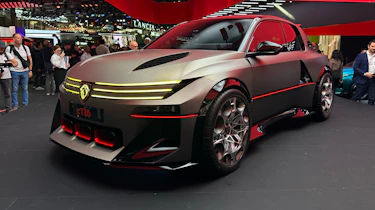
Its power source might be very 2026, but the new Peugeot E-T16’s spiritual roots can be traced all the way back to the ‘80s. The original 205 T16 by which it’s heavily inspired claimed two manufacturers' titles in the World Rally Championship, and while its modern relative won’t attempt to do the same, it instead forms the basis for something much more accessible: the next-generation 208, and perhaps even a road-going rival to the Renault 5 Turbo 3E.
This is the most powerful Peugeot ever, with a triple-motor powertrain delivering 805bhp to all four wheels for a 2.5sec 0-62mph time. That's similar power to a Ferrari 296 GTB, and a 0-62mph to match the Bugatti Veyron. Renault’s (admittedly production-spec) 5 Turbo 3 E is a very similar proposition, but delivers a comparatively modest 547bhp from a single rear-mounted motor for a 0-62mph time a whole second slower. To call this Peugeot a hyper hatch would be an understatement.
> Renault's new 5 Turbo 3E feels like a race car, but can it be worth £140k?
At its core is an 800v architecture built around an 85kWh battery pack, and while that’s larger than the 70kw unit in the Renault 5 Turbo 3 E, its claimed range is near-identical at 249 miles WLTP. Weight stands at 1610kg all in, 160kg more than the Renault.
The technical details continue, which is of course unusual for what is said to be a concept. Peugeot has provided brake sizing (380mm), tyre sizes (275mm and 315mm Michelins front and rear), and details on its improved battery cooling – the E-T16 cools the pack through its side walls as opposed to only the base, meaning it can do three laps of the Nürburgring without overheating. It's also steer-by-wire like every new Stellantis model shown in Paris, with company CTO Ned Curic revealing that the system allows even an ordinary next-generation 208 to feel like a Maserati through the use of clever software trickery. Perhaps there’s a little more to this car than Peugeot’s letting on…
At the Paris Motor Show, Peugeot CEO Alain Favey said that he was completely open to the prospect of bringing it to market should there be demand, and given that a single importer has already request 50 units, he seemed very interested in the idea: 'I'm serious, we can make the car and if we get the elements right, even though it's not decided yet, I would love to be able to do it.' He went on to say that if Peugeot was to bring it to production, it would produce a much lower number than the 1980 units of Renault's equivalent, and while pricing has not yet been decided, he quoted a ballpark price of €200k as a possibility.
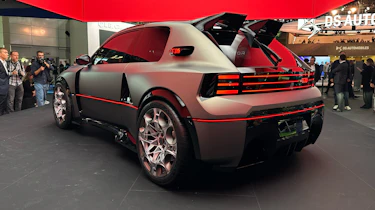
The design takes very clear inspiration from the original T16, with inflated arches, a deeply sculpted bonnet, oversized air intakes at the front and even side intakes making an appearance aft of the doors. The latter isn’t for cooling a four-cylinder this time though, instead a neat spot for its charging port.
There’s an enhanced take on Peugeot’s existing claw lighting signature featuring front and rear, now spanning the entire width of the car, and an illuminated red element surrounds the car just as the accent colour did on the original. It even goes as far as to replicate the rear-opening clamshell, only this time it reveals suspension and a pair of electric motors.
The cabin gives us a good glimpse at the next generation of Peugeot interiors, with an early preview of the next Digital ‘i-Cockpit’, including a 'Hypersquare' steering wheel inspired by the Peugeot 9X8 Le Mans Hypercar. There's also a configurable 21-inch central display designed to have key functions accessible at just a single press. This display covers the typical space for an airbag, but four-point harnesses mean it’s no longer required. There are carbonfibre bucket seats, a bold graduated red to black headliner and a red roll cage too, all bringing that accent colour through to the cabin.
The Peugeot E-T16 Concept is very much a concept for now, but should it ever make it to production, we’ll have one fascinating twin test on our hands...