Why the McLaren F1 wasn’t perfect but was the world’s first hypercar
Hypercar is a name applied retrospectively to a lot of cars. But only one is the watershed moment that earned the title

The exact moment the term ‘hypercar’ was coined is a little foggy. At least when explicitly describing a machine that exceeded the scope and capabilities of the humble supercar.
It certainly wasn’t May 28, 1992, when the McLaren F1 was first revealed at The Sporting Club in Monaco. Which is odd considering history tells us this was the moment the supercar was transcended by a meticulous new breed of mid-engined exotic.
The language surrounding the F1 at that launch event was earnest but emphatic. Containing no idle boasts nor a whiff of vapourware, the matter-of-fact way in which it was revealed and described, coolly and calmly positioned the F1 – McLaren Cars’ first road car programme, don’t forget – as something beyond the imagination and ambition of the incumbent supercar makers.
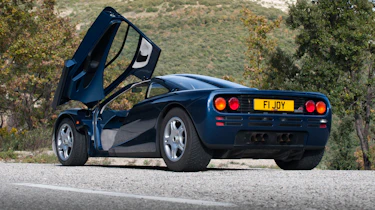
Audacious? Certainly. Arrogant? Possibly. Accurate? Absolutely deadly. Whichever way you sliced it, the F1 made Ferrari, Lamborghini and the rest look like they had been sleeping on the job. Which is also odd, given it had been an open secret that McLaren was working on a road car for years before it actually appeared.
True, scant details were known, other than it was being led by Gordon Murray. In hindsight this should have been enough of a clue, but back then the world had yet to see a contemporary supercar reframed through a scrupulous, imaginative lens like Murray’s.

Before the days of glossy hyperreal digital renderings and the need to feed a ravenous social media audience, the programme – cunningly referred to internally as ‘Project 1’ – quietly progressed behind the closed doors of McLaren Cars’ anonymous industrial unit on the Genesis Business Park in Woking.
Nevertheless, there was a buzz around what McLaren and Murray were up to. The shroud of mystery added to the clandestine allure, while the relaxed cadence of weekly and monthly automotive print media meant there was genuine intrigue and excitement quite unlike the endless teasers and multi-phase media junkets we endure today.

The launch event was as meticulously orchestrated as the F1 itself. Held on the Thursday before the Monaco Grand Prix, assembled guests and media were treated to a lavish 72-page book detailing the new car’s philosophy, design, technology and specification. Not once was the term hypercar used, yet the message was clear from the outset: ‘Our main objective has been to create the purest driver’s car, a new beginning, a design which simply re‑writes all existing standards,’ wrote Murray in his introductory statement.
And it really was a breathtaking advance on anything seen before. Extremely light and incredibly compact, its immensely stiff (for the time) structure, ingenious packaging and intoxicating V12 were the products of unconstrained engineering intelligence applied to a clean-sheet, money-no-object endeavour.
Thanks to designer Peter Stevens, it was also beautifully styled inside and out, its modest, immaculately surfaced exterior matched by an interior of fabulous simplicity and clarity. Given the strides in performance, it would have been easy to pursue an extreme, cartoonish aesthetic, but instead Stevens traded fashion for timeless understatement, perfectly capturing the essence of McLaren’s mission.
It would be another two years before the press would drive an F1. Talk of 250mph performance had been rife since that Monaco unveiling, but not until road testers slid themselves into the £540,000 machine’s central driver’s seat did the full magnitude of McLaren’s achievement hit home.
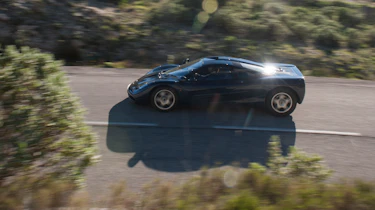
evo’s own John Barker, then writing for Performance Car magazine, was intoxicated by its scintillating engine and ability to gain speed (several personal bests were achieved during his two days with the F1), not to mention its tactility and usability. But he was also mindful of the limitations inherent in this immensely potent and entirely analogue car.

Devoid of driver aids or power-assistance, it was built around Murray’s purist, weight-obsessed and wholly road-focused vision. A vision that wilfully ignored certain engineering conventions in an effort to free the F1 from the recurrent compromises Murray identified in other supercars.
As we now know, this came with dynamic compromises of its own. Perhaps had the F1 not set so many world-firsts and blistering performance benchmarks, criticisms of heavy steering, underwhelming brakes and unforgiving on-limit handling traits would have been more than footnotes. Yet flaws notwithstanding, the F1 rightly garnered acclaim for its singularity and genre-shaking totality.

Ironically, the achievement that cemented the F1’s position as the ultimate proto-hypercar came at the 1995 Le Mans 24 Hours, where much against Murray’s original wishes for the car, minimally modified race-spec F1 GTRs finished 1st, 3rd, 4th, 5th and 13th. It would be the last true series-production road car to take outright victory in the world’s greatest endurance race.
Inevitably, and against McLaren’s launch day predictions, the world eventually caught up with many of the F1’s achievements, though remarkably it remains the world’s fastest naturally aspirated series-production car. It’s also amongst the most valuable; road car prices are now in the £20m bracket, with storied GTRs and the ultra-rare F1 LM considerably more.
As if to underline its seminal status, Gordon Murray himself has revisited many of the F1’s ground-breaking ideas with the GMA T.50, and even directly emulated it with the S1. But while these are superior driver’s cars that eclipse the F1 in terms of weight, power and point-to-point pace, when it comes to pioneering purpose, historical significance and raw star power, they – and every other mid-engined exotic – remain firmly in its shadow.