Ares Panther Evo: De Tomaso Pantera revived as carbon-bodied V10 supercar
Ares has produced a modern incarnation of the De Tomaso Pantera with 641bhp and four-wheel drive

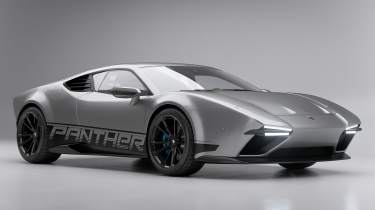
With the P72 project grinding to a halt, De Tomaso’s official revival is hanging in the balance. Seizing the opportunity, Italian coachbuilder Ares has built its own supercar inspired by the De Tomaso Pantera, recreating the 1970s icon with a Lamborghini-derived V10 and a carbonfibre body.
Called the Panther Evo, the new model traces its roots back to 2017, when the Panther was first revealed as a design concept. Since then the Panther has been continuously developed to evolve into this latest iteration; as before, the hand-built supercar borrows its chassis and drivetrain from the Lamborghini Huracan, but Ares has reworked some elements to give the Panther its own flavour.

The mid-mounted 5.2-litre V10 generates 641bhp (10bhp more than a Huracan STO) thanks to Ares-specific tuning, and sends power to all four wheels through a seven speed DCT gearbox. Don’t be fooled by the faux H-pattern gear selector between the seats – the Panther Evo uses conventional paddles, and the gear selector is used to switch between drive, neutral, reverse and park (although it does offer a sequential function). Completing the 0-62mph sprint in 3.1sec, the Ares is a fraction slower than a Huracan Evo off the mark, and reaches a top speed of 202mph.
Despite a full carbonfibre body, the 1423kg (dry) Panther Evo is also 84kg heavier than a Huracan STO, although the latter is rear-wheel drive with a spartan, stripped out cabin. By contrast, the Ares is lavishly appointed inside, with nappa leather and alcantara trim, bespoke carbon seats and a new dashboard that recalls that of the original Pantera. The Huracan’s central infotainment screen and digital dial pack remain, however.
Aside from paying homage to the Pantera’s wedge-like design, the exterior has been designed to optimise cooling and aerodynamic stability at speed, with the Panther using passive dampers at each corner and carbon ceramic brakes as standard. As ever with low-volume hand-built supercars, owners can choose from a plethora of bespoke options and personalisation requests, from the shape and moulding of the seats to the cabin materials and exterior paint. Pricing and availability hasn’t been announced for the Panther Evo, but for reference, the previous iteration cost in the region of £500,000 (including a donor Huracan).