Mercedes-Benz 300 SL Gullwing (1954 - 1957) review – the Porsche 911 Turbo of the 1950s
The Mercedes-Benz 300 SL was a spaceship in the 1950s, introducing tubular construction and fuel injection to the road
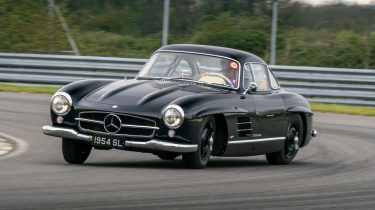
The W198 300 SL is like something out of The Jetsons for the 1950s. Born from racing, if not born specifically for racing, the ‘Sport Leicht’ was a direct descendant of the 1952 racer of the same name but different W194 internal designation.
The evolution from factory racer to showroom supercar was led by Max Hoffman, the visionary Austrian-born New York-domiciled importer of prestigious European automobiles to the US. Recognising that America’s booming post-war economy would create an unprecedented appetite for luxury high-performance sports cars, he persuaded Mercedes to build the Gullwing.
The fact that he agreed to buy at least 500 units soothed a nervous Mercedes-Benz board, and the W198 SL received a rapturous reception when it made its debut at the 1954 New York motor show.
Mercedes-Benz 300 SL in detail
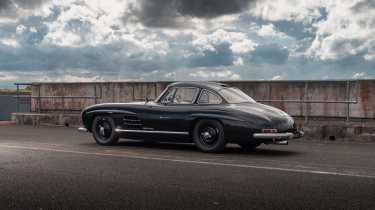
And with good reason, for the world had never seen anything quite like it. Credited as one of the first cars to use a true tubular spaceframe – Maserati’s famous ‘Birdcage’ didn’t come until 1959 – the SL road car employed many of the race car’s innovations, then added a few of its own for good measure. It was in every respect a car conceived at the cutting edge of automobile design and engineering.

The lattice frame – a brainwave of legendary Mercedes engineer and racer Rudi Uhlenhaut – was key to the SL’s lightweight build and excellent rigidity. Weighing just 50kg in the race car and a little over 80kg in the W198 road car, the structure was an extraordinary breakthrough.
More reviews
In-depth reviews
Reviews
- Mercedes-AMG SL63 2023 review – a match for the Bentley Continental GTC?
- Mercedes-AMG SL43 2023 review
- Mercedes-AMG SL55 4Matic 2023 review
- Mercedes-AMG SL63 (R231, 2017-2020) review
- Mercedes-Benz SL review - sports car or boulevard cruiser? - Mercedes-Benz SL prices, specs and rivals
- Mercedes-Benz SL400 AMG Sport
It was also inadvertently responsible for the adoption of the famous roof-hinged ‘gullwing’ doors, as it was not possible to incorporate conventional doors in the high-sided tubular structure. Arguably even more spectacular than the Lamborghini Countach’s famously showy scissor doors, the functional and structural authenticity of the gullwing solution is a marvel to this day, imposing a defining authority over the whole 300 SL experience.
When you’re in the presence of a Gullwing you do a lot of staring. It has a mesmerising presence, like standing in front of the Mona Lisa. Familiar yet endlessly fascinating, your eyes rove along its lines, devouring the details and lingering on the surprises previously overlooked, such as the scalloped vents in the trailing edge of the roof. It’s a breathtakingly beautiful machine.

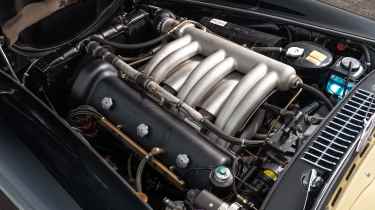
Enough water has passed beneath the bridge to say it’s clear to see wartime advances in the SL’s streamlined shape. Likewise, one of its other claims to fame – that of being the first car to use direct fuel injection – relied on technology developed by Daimler-Benz and Bosch for the Messerschmitt Bf 109 fighter plane.
The benefits of fuel injection were significant, with power rising from 175bhp in the carburetted W194 racer to 215bhp in the W198, along with gains in efficiency and a smooth delivery that was hard to achieve with conventional carburettors. You still use a choke to start it, but once warm it runs like a Swiss watch.
Thanks to those glorious doors, the ritual and occasion of getting into the Gullwing is never less than special. Press the protruding saw-toothed end of the slender recessed door handle and it slides out to reveal a notched face. Slide your fingers behind it, give a gentle pull and the door releases. It doesn’t take much effort to open thanks to a free mechanism and lightweight alloy door skin.
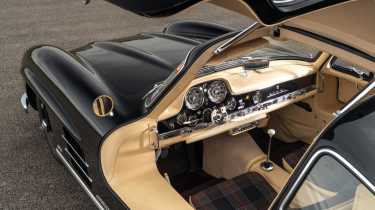
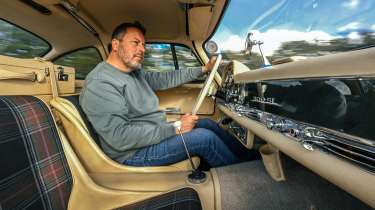
To climb in, you sit on the high, wide sill (always on the left side as all SLs are left-hand drive) and swing your legs over. The steering wheel hinges downwards for greater clearance. Once settled into the seat, and having pulled the door closed – remembering to control its descent before letting it drop the last inch or two to avoid an ugly slam – you’re treated to one of the all-time great cockpits.
Light and airy with a fabulous view through the letterbox windscreen and down that swooping bonnet with its long nacelle bulges, it immediately feels like a car in which you could cover huge distances. The boot is full of fuel tank – it holds 130 litres! – plus a spare wheel, so luggage is stored in tailor-made cases strapped on the deck behind the front seats. There’s a Becker radio and a neat array of knurled chrome knobs across the full width of the dashboard. It’s an immaculate piece of design and oozes quality; vital given the SL cost £5000 in 1954, around ten times the average annual salary in the UK at the time.
The unassisted steering is extremely heavy at parking speeds and is never less than hefty however fast you’re going, which explains why the wheel has such a large diameter. The transmission tunnel is low, from which sprouts a long, wand-like gearlever topped with a small white gearknob that could easily double as a bottle stop. The gate is a conventional four-speed H-pattern and the shift is a delight: clean, light and precise with a beautifully positive yet delicate feel.
Driving the Mercedes-Benz 300 SL
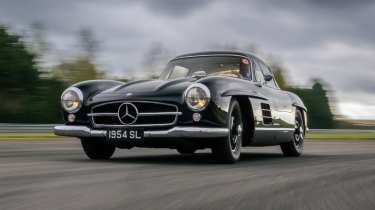
The 3-litre straight-six is smooth but unexceptional on small throttle openings, though you can sense there’s plenty of performance to call upon. The steering might be a workout but there’s a genuine sense of lightness about the way the SL makes progress. Refinement and modern manners, too, thanks to Bosch and its fuel injection.

Open the throttle, use all the revs and the SL’s racing pedigree comes to the fore. The engine is extremely impressive and much more vocal, the rising bellow of induction and exhaust noise delivering a sharp rasp that’s initially quite a surprise but quickly becomes addictive. The way the Gullwing will happily sit at 100mph belies the fact that this car is 72 years old. All-out it’ll do 155mph if ordered with the tall differential.
There’s wind noise (door seals have clearly always been the engineer’s nemesis) but the overall refinement and sense of imperious ground-covering capability is a wonder. For those fortunate to own an SL in period, it must have been a revelation. For other road users driving normal cars, which would have been incapable of reaching 70mph and taken almost 40 seconds to hit 60, an SL must have seemed impossibly advanced.
Braking is rather less mighty, the large, finned drums struggling to match the SL’s formidable straight-line pace. The pedal is spongy by modern standards, so the initial travel leaves you feeling unsure; once you’re into them they’re effective, though you sense they’re working hard when slowing from speed. Crucially they are consistent, so with time and familiarity you gain confidence and finesse.
Less than a decade after the end of the Second World War, Mercedes lacked the resources it enjoyed pre-war, so a degree of pragmatism was required for the motorsport department to build its first competition car since the all-conquering Silver Arrows. Consequently, though the original W194 SL had its advanced spaceframe chassis, to fast-track its development it borrowed heavily from the stately W186 Adenauer saloon, using a race-tuned version of its 3-litre straight-six and the same basic suspension design. This featured unequal-length double wishbones with coil springs at the front and a low-pivot swing axle at the rear. The W198 retained this design, tuned for road use.

If anything dates the 300 SL dynamically it’s that swing axle. Its lack of camber control means that under load the tail squats and the rear wheels adopt significant negative camber, but back off the throttle and the forward weight transfer sees the rear wheels shift to significant positive camber, with the heavily loaded outside rear wheel trying to tuck under.
Together with the huge fuel tank sat aft of the rear axle, the SL feels for all the world like an old 911: somewhat pendulous, punishing of indecision, and potentially perilous through transient direction changes. However, as with the 911, there is a knack to not only mitigating this behaviour but using it to your advantage.
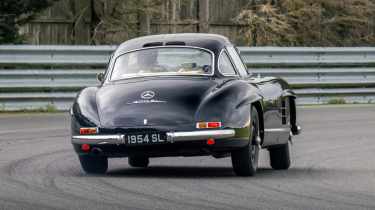
The key is to be calmly committed on the way into a corner, then precisely measured with your throttle inputs as you work your way to the apex and exit. Binary on-off throttle brings out the worst in the quirky swing axle’s kinematics, but operate in the shades of grey and you can feel the rear end working nicely. Squeezing into or blending out of the throttle allows you to sustain, increase or perhaps fractionally release the lateral load, and because you always retain a degree of positive throttle application you never completely unload the tail. It’s a fine balancing act, but one with rich rewards.
Driven thus, the SL adopts a hugely satisfying stance, rear nicely hunkered down with a hint of corrective lock, but never enough to require major adjustment or loss of momentum. The only caveat is that while it’s relatively straightforward to do this through a familiar corner in dry conditions, trying to do the same in the dark and rain through a tightening downhill bend or tricky set of esses would doubtless be a very different Kessel mit Fisch. Fast driving in an SL clearly requires healthy respect.
Whether the 300 SL conforms to the modern notion of a supercar is debatable. Its engineering credentials and motorsport DNA certainly commend it, as do its sensational looks, huge cost when new and the delta between its continent-crossing performance and motoring norms of the day. If it lacks anything it’s the drama and exuberance we’ve come to see as a supercar prerequisite, but the matter-of-fact way it delivers its elevated performance is prescient of that other great Teutonic supercar, the Porsche 911 Turbo. Seven decades on, its star quality survives undimmed.
Specs
| Engine | In-line 6-cyl, 2996cc |
|---|---|
| Power | 215bhp @ 5800rpm |
| Torque | 203lb ft @ 4600rpm |
| Weight | 1295kg (169bhp/ton) |
| 0-60mph | c8.5sec |
| Top speed | c155mph |
| Price new | £5000 (£121,000) |
| Value now | £1.25million-plus |