McLaren Senna (2018-2020) review – a supercar to make Porsche’s 911 GT2 RS look tame
The Senna is perhaps still McLaren’s most extreme road car in terms of its aero and track focus
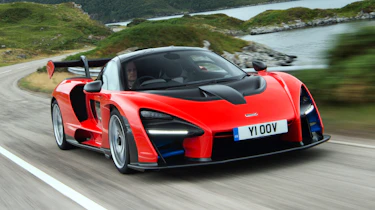
The McLaren Senna is an extraordinary machine, joining McLaren’s ‘Ultimate Series’ roster in 2018 as the ultimate track-focused supercar, lacking the P1’s hybridity and going even more extreme on downforce.
The backstory of the Senna is curious, with the original plan that it would effectively homologate a GTE racer, a-la Ford and the GT. Prohibitive costs put paid to the plans and the would-be Le Mans racer was evolved into the track-only Senna GTR special. Just 500 examples of the Senna were produced, with 75 GTRs, plus additional variants including the Senna LM, and US-only Sabre.
The ‘normal’ Senna is extraordinarily extreme yet inexplicably, it's a drivable and enjoyable supercar on the road.
Engine, gearbox and performance
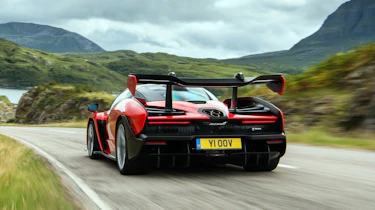
- Extraordinary, eye-widening performance on the road
- Made all the more intense by how close the engine feels to the driver
- Ignition cut shifts are dramatic in Sport but Track and Race ‘Inertia Push’ shifts are something else
At the heart of the Senna is a significantly upgraded version of the V8 in the 720S, known as M840TR. Having passed through the roof-mounted snorkel intake, the ingested air enters a carbon fibre intake plenum enables even better throttle response. Upgraded cams and pistons, two instead of one fuel pumps and additional sensors ensure the V8 is capable of its increased outputs of 789bhp at 7,250rpm and 590lb ft of torque from 5,500-6,700rpm. It doesn’t have much weight to shift either, at 1198kg (dry).
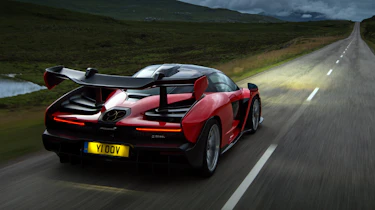
The spent gases leave via an inconel and titanium exhaust that exits on the top of the rear deck, with careful management of the airflow to ensure that it does not interrupt the workings of the rear wing. The exhaust is valved for the UK and many other markets, with the lower of the three pipes taking precedence at low revs and loads; in certain markets this additional silencer and pipe was removed, whereupon there are just two pipes exiting in the exhaust surround.
More reviews
Like all other McLarens, the Senna used a twin-clutch gearbox with manual control via paddles behind the steering wheel. In Sport mode the ignition is cut for the change of gear, but while it may seem impossible to get a quicker swapping of cogs, in Track and Race settings an ‘Inertia Push’ technology means there is virtually no interruption at all during the gear changing process.
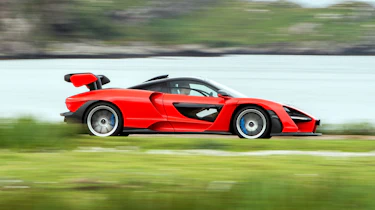
With 659bhp/ton you won’t be surprised to hear that the Senna is fast. Just how fast is clearly betrayed by the numbers, with 62mph arriving in 2.8 seconds, 124mph in 6.8 seconds and 186mph after just 18.5 seconds, but in reality it doesn’t seem that much quicker than the already studenously rapid 720S – perhaps additional performance becomes largely academic beyond a certain lofty point. In any case, the top speed is 211 mph, but such matters were hardly McLaren’s focus with this car. The M840TR engine, like all McLaren V8s, is a tool for the job, and not about enriching the soul. When it’s idling it feels like all those valves, springs, cam lobes and everything else are oscillating, rotating, vibrating right next to your ear canal, so close does it seem.
Gah-gah-gah it goes, with all the aural sophistication of a fairground generator. It’s dramatic and intimidating, I’ll give it that – a constant reminder that there’s 789bhp connected to my right foot, like holding a very powerful chainsaw and suddenly contemplating that one slip that could have life-changing consequences. Combining the final 3000rpm of the Senna’s engine output with its peak braking performance and aero-assisted grip on the road is like the Ghostbusters crossing the streams. Risky, and liable to set your hair on fire, but if you want the ultimate it needs to be done.
The Senna goes utterly berserk past 6000rpm. At first it seems heavily torque-restricted in the first two gears, albeit smooth in delivery, only really gaining impossible urgency once third gear has registered with a click of the right-hand paddle. But this is simply the ESP system massaging away the carnage. Switch the ESP to Dynamic, or off, and it all makes sense: it’s loopy, it’s like being strapped to the nose cone of a ballistic missile, it’s absolutely bloody marvellous. Even on a dry road the fat, sticky Pirellis spin up at the top of first and second gears, the rear axle faithfully betraying what’s going on, the tail occasionally swaying gently from side to side under full power in the pursuit of traction.
Into third and the speed readout is basically a blur, but a corner is approaching and the game crystallises on how long you leave the taps open for, how late you dare brake. You know you can brake impossibly late; you know the giant ceramic discs and parachute-like rear wing rotating forwards will mean the Senna will stop, and more convincingly than any car you’ve driven before, but such are the accelerative forces that everything is condensed into milliseconds. A blink of an eye too long on the throttle and it could be too much.
Ride and handling
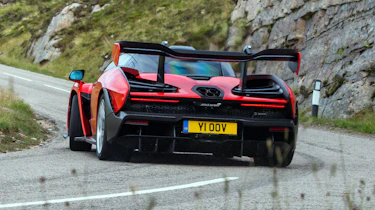
- Extreme though it is, the Senna is inexplicably hospitable on the road
- The steering is next-level – you’d need a Caterham or a Lotus Elise to get this feedback elsewhere
- You can actually feel the downforce, even on the road
The Senna uses a version of the firm's hydraulically interconnected double wishbone suspension setup updated from the 720S, with the emphasis on track ability. It’s called RaceActive Chassis Control 2, with many of the suspension parts fashioned from aluminium to save weight. It’s the adaptive dampers that are connected via the hydraulic system, and when Race mode is selected they not only stiffen considerably, but the ride height is also lowered – 39mm at the front and 30mm at the rear. All told its good for up to 800kg of downforce at 155mph. There are some very clever algorithms at work making sense of a mind boggling amount of technology.
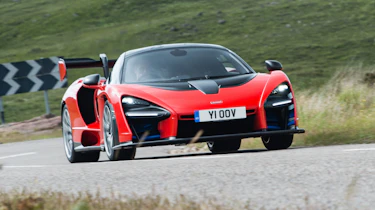
Yet on the road, it rides. Yes, it has an inherently stiff-legged approach below 20mph, but the faster you go, the better it gets, and once you’re driving at pace you never question whether a road, however poorly surfaced, is going to upset either you or the car. At one point on our route there’s a collapsed road surface, lasting for over a mile, but the Senna glides across it at unprintable speed in a manner that makes Aston and I turn to each other simultaneously with a look of utter bemusement. I don’t know how it does it, but clearly some very clever people have been involved with the Senna’s hydraulically interlinked damping.
What is most enjoyable on the road is the Senna’s steering, which is unlike that of almost any other car on sale when it was new in 2018. In fact, you’d have to turn – no pun intended – to the products of Lotus and Caterham to find a system on a par, for the Senna’s wheel chatters, cajoles, informs and occasionally shouts at the driver in a constant diatribe of astonishing clarity about what’s happening down at the front wheels. Yes, it loves to run with a camber, but you soon learn that the secret to driving the Senna well is to understand what it’s trying to tell you, and that 80 per cent of those movements away from the straight ahead are self-correcting: it’s knowing the 20 per cent that need a subtle input from the driver that’s the key.
The giant Pirelli Trofeo Rs are so sticky to the touch it’s like squeezing liquorice between your fingers, but cornering grip starts to take on a new meaning because something else, something deeply profound, is making its presence felt and lifting the Senna into another dimension.
I’m talking about downforce. The sense that it’s squeezing the Senna unwaveringly into the tarmac is palpable, the stability of the car hugely confidence inspiring. There is always more grip than you think, but that doesn’t make the car aloof; you don’t have to use all the grip to feel the reward. So beautifully direct and informative is the hydraulically assisted steering, so finely weighted, that apexes become a ludicrous game of dare with kerbstones and verges, an analogue activity where it’s utterly absorbing to deal in fractions of a degree.
The road twists randomly, and over the worst of the undulations the Senna’s rear wheels pick up and the engine slaps the rev limiter – ra-tat-tat – the car landing a few degrees sideways then moving back into line. Was it me, did I subconsciously get the lock on and then off again, or did the car sort it? No time to ponder, because we’re deep into a corner and on the brakes, the firm pedal giving the best feel to be found on any car currently on sale.
Trail off and sense the nose bite hard and the tail edge out: one turn, one line, everything in harmony. The Senna comes alive when it’s driven this hard, rising onto its tiptoes once enough forces are put through its chassis. Get a little greedy in the slower stuff and you can edge the tail out more with excess power, although it feels like juggling with cavalry sabres for a hobby.
An inadvertent whoop of laughter follows a successful slide, as much through relief that we’re not sliding backwards down a mountainside, composing the first line of an email to the insurance company, as it is through excitement. What really scrambles my brain is one downhill third-gear left-hander. Just at the apex there’s a pronounced compression, and the Senna is forced down onto its outer front wheel with enough G-force to thump my chin against my chest. Yet that large front splitter never once even kisses the road’s surface. That’s extraordinary damping; revelatory poise. It’s verging on witchcraft.
And then it’s all over, for the simple reason that the intensity, the physical battering the body gets, shoulders pinned repeatedly to the seat, becomes too much. As soon as I dial back the pace, I notice my mouth is dry, my forearms pumped, and although there’s no mirror to look up into, I bet my pupils are the size of squash balls.
Estoril track test – evo 253
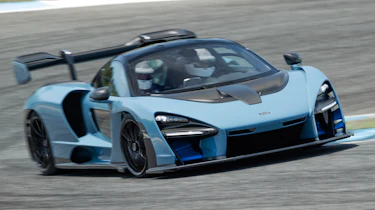
We’ve gone past the point of no return. If I screw up the braking now, we’re nose-first into the barrier; there’s no shying away from that alarming fact. But it’s OK. I’ve already driven a prototype Senna at Silverstone (evo 249), so I know its powers of braking are unlike those of any other road car I’ve ever driven, born from a combination of ludicrous downforce, tyres so sticky they squidge under thumb pressure, and ceramic brakes that take nearly as long as a human pregnancy to manufacture.
I know the Senna stops from very high speeds like it has driven headlong into a superglue manufacturing plant. ‘I KNOW THIS!’ I scream, silently, to the sensible half of my brain, the one that’s currently questioning my sanity as the 200-metre board approaches at 180mph. On the previous lap I hit the brakes hard at 300 metres. It felt like I was leaving things perilously late, yet I looked silly, because I had to accelerate again to take Estoril’s slow, 90-degree turn one. This time, despite every muscle in my leg twitching to come off the power, I will keep my foot in until the 200m board. Yes, I will.
It’s this re-evaluation of what’s possible that defines driving the Senna on a track. It does indeed slow from 180mph to 40mph in just 200 metres – in fact, just inside that mark by the end of the session. Rolling off the brakes as I turn in pivots the car into the corner, then we blast out, a single breath and then an early application of steering lock into the infamously ballsy turn two, before a big stop into turn three. The exit then is uphill, and it’s only on this corner that the remaining ESP net shows any sign of intervening, and then only if you’re a bit clumsy with the throttle.
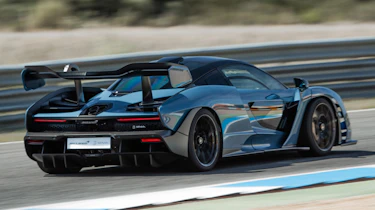
It’s turn five that illustrates the extraordinary amount of downforce available. Earlier, lapping in a 720S, the right-hand kink required a lift in fourth gear, and a sharp intake of breath. It was an uncomfortable corner that probed just how much commitment you were prepared to show. In the Senna it’s fifth-gear flat, an exhilarating rush through as if attached on a monorail, the delicacy of the steering input reflected in the car’s stability.
You also feel that extraordinary downforce in the final – and appropriately named – Ayrton Senna Parabolica, a fast right-hand curve that seems to last for an eternity. But it’s downforce that isn’t at the expense of adjustability, for any mild understeer can be trimmed away by miniscule alterations to the throttle.
And through all of this one thing I’ve barely considered is the car’s power, even though it’s quick enough to squish your vital organs to the back of your chest cavity under full-bore acceleration. A 789bhp car and yet its straight-line speed is almost an afterthought: that tells you everything you need to know about what the Senna’s like to drive on a circuit.
Interior and tech
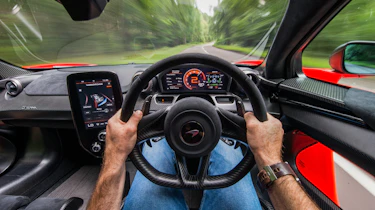
- Some familiar parts from the 720S (driver’s display), other totally alien stuff (roof-mounted door handles and window switches).
- Senna seats are supportive but quite extreme
- View out isn’t great, nor is it practical… duh
The Senna’s interior has been developed solely as an environment in which to drive quickly. Climbing in is hardly graceful, the driver needing to vault the sill and fit through the gap enabled by the butterfly doors. Even by McLaren’s formidable standards the driving position is exceptional, the wheel pulled back in the chest and an unobscured view of the rotating dial pack familiar from the 720S, with beyond that a sightline straight down to the road’s surface just in front of the protruding snout.
Above my head is a pod with the starter button, window switches, door releases and interior lighting, while in the middle of the dash a sliver of a TFT screen angled towards the driver constitutes the centre console, and the usual transmission selectors are placed in a carbon pod that’s actually attached to the driver’s seat, and hence moves with it. And what seats they are. Carbon shells with Alcantara pads, they weigh just 8kg each and you quickly realised they’re incredibly supportive and comfortable. I won’t get a single twinge from driving the Senna, even after almost 12 hours solid.
Visibility aft is poor, but you soon developed a technique to improve the line of sight from the side-mounted mirrors. Recalling how a Spitfire pilot taxis on the ground, weaving from side to side to peer down past the skywards-pointing Rolls Royce Merlin V12, I adopt the same technique in the Senna, gently weaving one way then the other when I want a clear view of behind. We christen it the ‘Spitfire shuffle’, and it soon becomes second nature.
A McLaren Track Telemetry (MTT) system was offered, that runs via the infotainment screen, capturing all the necessary data from laps recorded and offering split times over different sectors of the lap. It can be combined with a camera system – front facing, in-car to the front and rear-mounted – that records every lap visually: both this and the MTT data can then be downloaded for further analysis. Further interior options ranged from weight-saving and performance items, such as a fixed passenger seat and a drinks bottle system, to more luxurious items such as a ‘Touring’ specification seat and a Bowers and Wilkins hi-fi, the latter not necessarily quite in the spirit of the car…
Values and buying guide
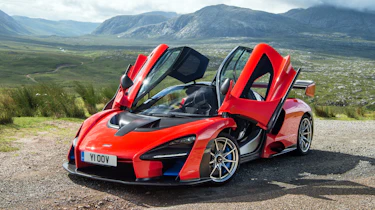
When the McLaren Senna went on sale in 2018 it cost from £750,000. Like all of the most special modern McLarens it didn’t shoot up in value immediately, as we used to expect of Porsche specials for instance. But at the time of writing (eight years on from the Senna’s release) values are firmly over the £1.1million mark, with some unique specs and low-miles models worth upwards of £1.5million.
Even for a McLaren, the Senna is a unique proposition, with even more porous, billowing bodywork and extreme aero addenda. Perhaps most famous are the Senna’s lower-door windows. Over the years the Senna has encountered a couple of issues – overheating and fires, which resulted in a recall in 2020. It’s a car that’s happiest at speed, funnelling plenty of air through its myriad apertures and cooling apparatus. Not the ideal Sunset Boulevard cruiser or Sloane Street poser, then. The Senna uses a similarly bespoke hydraulic accumulator system to the P1 and so associated costs with its maintenance are higher than the already pricey-to-maintain 12C, 650S, 720S and 750S.
Specs
| Engine | V8, 3999cc, twin-turbo |
|---|---|
| Power | 789bhp @ 7250rpm |
| Torque | 590lb ft @ 5500-6700rpm |
| Weight | 1198kg (dry, 669bhp/ton) |
| 0-62mph | 2.8sec |
| Top speed | 211mph |
| Price new | £750,000 |
| Value now | £1.1m – £1.5m |