New McLaren 788HS – the last pure V8 McLaren?
McLaren’s new era is approaching, but before that, it’s closing its current chapter with the 788HS – the last car to be built on the 720S/750S platform

It seems like McLaren is stuck in limbo at the moment. Sure, it’s just launched a shiny new seven-figure halo car, the W1, but there hasn’t been much activity at all in the mainstream supercar realm. The last truly new series production McLaren was the Artura, and brilliant though it is, it was first revealed way back in 2021. Scroll through the configurator and you’ll still find the GTS there, which is pretty much seven years old. Then there’s the 750S. Again, a fabulous supercar, but a facelift of the 720S, which came out nearly a decade ago. Right now McLaren desperately needs something fresh to capture our attention and avoid being swallowed up by the competition.
What you see here isn’t that. A new era of hybrid McLarens is coming, delivered by CEO Nick Collins under the ownership of Abu Dhabi investment firm CYVN Holdings, but before that comes a send-off for the pure V8 720/750S platform, in the form of the 788HS. Ultra limited with a more focused chassis, aggressive aero and more power, it’s a 750S pushed to the max with some LT magic in its setup. A tantalising recipe.

McLaren aficionados will recognise the HS badge. Meaning High Sport, it’s been used twice before on special versions of the 12C and 675LT, and denotes limited-edition cars created with the help of MSO, McLaren Special Operations. MSO is responsible for everything from personalised off-menu colour schemes for series production cars to one-off models, and though customisation is a big part of the HS treatment, they’re also engineered to a level beyond the cars on which they’re based. Rare, too. The last car to wear the badge, the 675LT-based MSO HS, was limited to just 25 cars, each personalised from splitter to tail for their owners, no two alike.
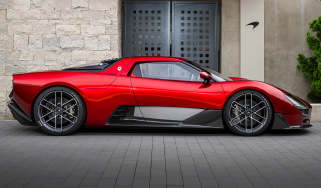
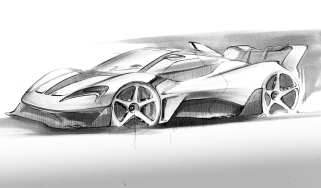
The 788HS isn’t as exclusive as its predecessors – McLaren is building 200, split evenly between coupes and Spiders – but its philosophy is very much the same. It’s still unmistakably 750S in its design but the new add-ons and air pathways for the full carbonfibre body (exposed, if you wish) strike you immediately, and the cumulative effect isn’t dissimilar to the transformation from GT3 to GT3 RS. The biggest change at the front is a new S-duct bonnet, which channels air from the nose, through the bonnet and over the top of the car, and works in conjunction with a new front splitter.
The front wheelarch louvres and side sills, the latter featuring air intake pods, are derived from the 765LT, while at the rear there’s a new, taller diffuser and a huge rear wing. It looks like a fixed item but it can flip up as an airbrake or move into a DRS position. An air snorkel protruding from the engine lid is a nod to the McLaren F1 GTR, but isn’t actually an engine intake – rather, it provides extra cooling for the 4-litre twin-turbo V8, and thus allows it to be run harder. There’s more cooling directly beneath the rear wing, in the form of louvres that draw hot air out of the car. Together, the aero upgrades provide a 10 per cent increase in downforce over the 765LT.
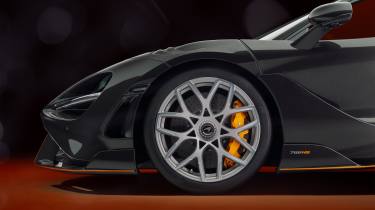
New centre lock forged wheels complete the visual transformation (interestingly, a traditional five-lug fixing would be a lighter solution, so the centre lock is a design-led choice), along with a 5mm lower front ride height than the 750S. Tuning for the springs and dampers is derived from the 765LT, the difference being that – like the 750S – the 788 uses McLaren’s latest Proactive Chassis Control III system, with improved software to manage the hydraulically cross-linked dampers. Braking is by forged aluminium monoblock calipers and ceramic discs derived from the Senna, completing a chassis specification that seems aggressive and geared towards the track.
McLaren, however, doesn’t predict that the 788 will see as much circuit use as an LT, so certain elements have been tuned with road use in mind – like the engine mounts, which aren’t as firm as an LT’s. The engine itself is the McLaren’s familiar M840T V8 in a more powerful state of tune, calibration tweaks bringing it up to 777bhp – a 22bhp boost over the 765LT. Peak torque remains at 590lb ft, and the delivery should be more visceral thanks to a new titanium exhaust (with intricately textured tips) plus revised sound generators for induction and exhaust. These are physical devices that transmit real engine sounds into the cabin, rather than pumping them through the speakers.
Drive is sent to the rear wheels through a seven-speed dual-clutch gearbox and an open differential with McLaren’s Brake Steer system to manage torque between the wheels. There’s a limit to how much power you can put through a pair of rear tyres, even if they are Pirelli P Zero Trofeo Rs, so the 788’s 2.8sec 0-62mph time is identical to the 750S’s. Once up to speed, however, the 788 pulls two tenths ahead in the run to 124mph (7sec). The top speed is 205mph.
That performance is helped by the fact that the 788 is a very light supercar by today’s standards – a virtue of its carbon chassis, bodywork and old-school non-hybrid architecture. With a dry weight of 1265kg it’s 12kg lighter than a 750S, and undercuts the Ferrari 296 Speciale by 145kg. The Spider is only 49kg heavier, the gain coming from its folding roof mechanism.
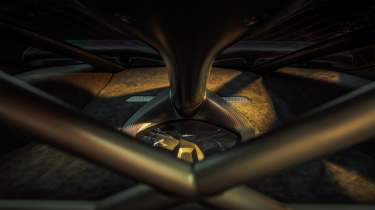
Inside the 788 is familiar 750S, with a few detail changes. Most notably the lightweight carbonfibre centre console (including cup holder – take note BMW M) and the carbon air snorkel behind you, which funnels into a viewing window for the engine. Of course, each buyer can customise it to their hearts content with different materials, stitching, trim finishes and even different tints for the one piece carbonfibre seats, which are sparsely padded but very comfortable and supportive.
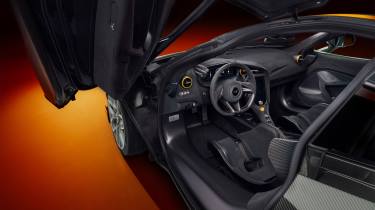
McLaren does cabin ergonomics as well as anyone, and in the 788 you sit low with your thighs kicked up and your legs stretched out to the pedals, which are well placed for left foot braking. The wheel is completely free of clutter and perfect to hold, and you’ll find rocker switches for the drive modes a finger stretch away on the instrument binnacle, with chassis modes on the left side and powertrain on the right. The bare carbon body glints at you at the base of the side windows and the windscreen, a nice touch.
McLaren is only offering the 788HS to its existing customers, and there’s supposedly already quite a big queue. And that’s despite a price tag, we predict, somewhere in the region of £500,000 – double that of a 750S. Of course, raiding through the MSO goodie box will see the price sky rocket from there. The question you might have is, why not build a direct successor to the 765LT, with higher production numbers and a more palatable price? McLaren says that creating another LT from this platform would result in something the same, or very similar to, the 765, if it were to stay true to its established long-tail philosophy.
It’s therefore built something more exclusive, customisation-led and positioned much higher in terms of price. Something that very few will get to experience as a result, which is a shame because the 788 has all the makings of a truly great supercar. A honed and refined 765LT with even more ferocity, and a purity that newer hybrid rivals lack. As much as we’re looking forward to finding out what McLaren’s new era holds, this finale for its current chapter excites us just as much.