Range Rover Sport electric revealed – British Porsche Cayenne Electric rival squares up
The Range Rover Sport electric price and performance figures have been confirmed. The Cayenne Electric doesn’t need to worry
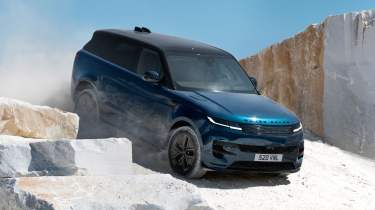
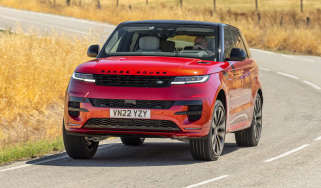
Range Rover has confirmed the all electric version of its popular Sport model, joining the current diesel, petrol and plug-in hybrid line-up. The car is available to order now from £109,810 for the EV550 Dynamic SE spec. That figure rises to £122,780 for Autobiography and £126,290 for First Edition spec.
Built on Range Rover’s MLA platform, the Range Rover Sport’s 118kWh battery is fixed between the axles and affords the Porsche Cayenne Electric rival’s 374-mile WLTP range. Range Rover also quotes ‘up to 333 miles of real world range’, as a counter to the widespread belief (and consistent with our observations) that WLPT figures are overly ambitious. With an 800-volt architecture, it’s also capable of adding 136 miles of range in ten minutes, when charging at its maximum speed and from 10 to 80 per cent in 22 minutes.
Range Rover has also confirmed the power and performance on offer in the Range Rover Sport Electric: 542bhp, 627lb ft and 0-62mph in c4.5sec. For reference, the Porsche costs from £99,900 in Cayenne S form, offering 536bhp and 401 miles of range, managing 0-62mph in 3.8sec. BMW’s iX5 will offer a claimed 500 miles of range.
In the Range Rover Sport Electric, there's a motor installed where the combustion engine would ordinarily live under the bonnet and a second in a modified rear subframe where you'd usually find a differential in the combustion and hybrid cars. Power passes between the front and the rear, not via independent motors on each wheel but via an electric gearbox control unit.
On top of the battery is more auxiliary hardware occupying the space vacated by the eight-speed transmission. In terms of packaging it’s all quite tight, with the platform designed from the outset to house both combustion and full-electric powertrains. As such, it was much less work than say, converting a dedicated combustion platform to create a BEV. There’s even room for the battery to feature double-stacked cells to provide the increased output. Impressively, it’s claimed the Range Rover Sport Electric is 61 per cent stiffer than other Range Rover Sport variants, with a 73mm lower centre of gravity.
Chassis-wise, the Range Rover Sport Electric gets all-wheel steering, dynamic air suspension and twin valve dampers, working with electronic active roll control. This is a recalibrated version of the standard Range Rover Sport system rather than an adoption of the hydraulic 6D damping system that features on the SV and Defender Octa.
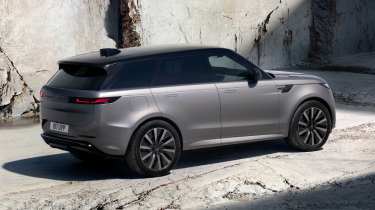
In adding an all-electric powertrain to the Sport, Range Rover is confident it has all bases covered when offering the right proposition for the right scenario for its broad customer base. In terms of positioning and power, if not performance, it sits adjacent to the P550e plug-in hybrid model. The hybrid model hits 62mph in 5.6sec, whereas the Electric covers the sprint a second sooner. It also sits below the P540 and SV V8s.
> Best performance SUVs – supercar performance on stilts
Visually there’s little to identify the all-electric Sport from its petrol and diesel equivalents, save for revisions made to the car’s bumper and intakes to improve both aerodynamics and the battery cooling requirements. And 22-inch wheels will be the largest possible fitment for now, although Range Rover’s all-season, mud and snow and summer tyre packages will be offered.
Driving the Range Rover Sport Electric prototype
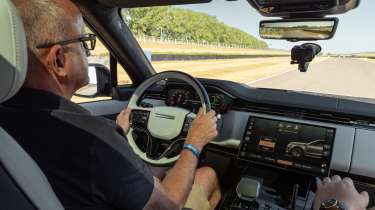
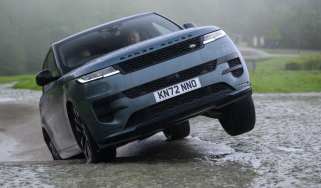
While we won’t drive a production-ready Range Rover Sport EV until the autumn, we've experienced its powertrain to negotiate a number of off-road obstacles and on-road dynamic tests.
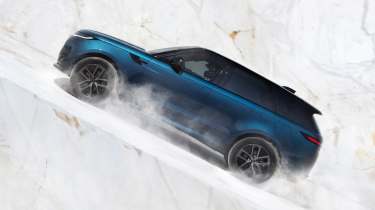
Climbing and descending near impossible inclines and declines requires no more effort from the driver than the combustion equivalents. If anything the instant and maximum torque available from the zero rpm makes negotiating such obstacles smoother and less fraught. There's no requirement to balance engine revs with momentum as sky fills the windscreen on your climb approach to the breakover point.
Throttle response is instant, pace off the line somewhere between the shove of the turbodiesel matched with the explosive nature of the BMW 4.4-litre V8s under the bonnet in SV models. Through a slalom the next-generation rear-wheel steering delivers the agility a car of this size requires, turning on its toes at low speed whilst remaining calm(ish) in the cabin.