KTM X‑Bow GT‑XR 2023 review
KTM has put meat on the bare-bones X‑Bow to create a junior hypercar, and one of the most extreme road-legal cars yet seen. As we discover, it’s as intense to drive as it looks
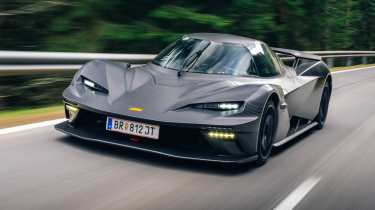
'Racing car for the road.’ It’s one of the great automotive clichés. And like most clichés, it’s rarely true, of course. Even the hardest of hardcore sports cars are generally designed as road cars first and foremost, and if they do wind up on a GT racing grid at Spa or Silverstone, it’s usually in a re-engineered, evolutionary form (or, depending on how relaxed the regs are, a clean-sheet design with only a passing resemblance to a distant road-going cousin).
But the wild-looking KTM X‑Bow GT‑XR you can see here really was designed as a racing car first – and subsequently house-trained into a productionised road car rather than the other way round. And it’s evolved from the original, minimal X‑Bow into something bigger, more potent – more supercar than sports car.
> Caterham 420 Cup review – pure driving pleasure
‘Lots of customers of the original X‑Bow told us: “It’s a fun car, but it’s a toy – I want a more ‘adult’ car,”’ product manager Lukas Barth tells evo as he shows us around the sophisticated X‑Bow production line in Graz, Austria. ‘Now we are really in the adult sphere with this car.’
The new X‑Bow GT‑XR’s story starts back in 2018, when the four-cylinder turbocharged Audi engine that powered the first-generation X‑Bow, launched in 2008, fell foul of tightening emissions regulations for homologation. That could have been the end of the X‑Bow story, had the KTM board decided to call a halt to its car division – a relative minnow compared with its separate motorcycle companies and wider portfolio. But, happily, it saw the enforced engine change not as a dead end but an opportunity.
More reviews
‘We looked at our options: the X‑Bow always stood for super-light, performance, power-to-weight ratio,’ says KTM Sportcar managing director Michael Wölfling. ‘We still had a good relationship with Audi, and we decided to go with this new aluminium-block 2.5-litre engine.’ Slotted transversely amidships, it’s the same in-line five found in the Audi RS3 and TT RS, with mapping by Graz-based firm AVL to take its power output from less than 400bhp to 493bhp. (In GT2 race versions, it’s as much as 650bhp.) To stick with the original car and implement a newer equivalent to the old four-cylinder engine would have made it much more expensive, Barth adds, with more complex cooling and control systems.
So, more power and a higher price point meant the X‑Bow could shift to a more grown-up concept – and take part in grown-up motorsport. The X‑Bow had always performed well on track, Wölfling explains, and it had branched out into racing with a GT4 evolution in 2016, but to participate in wider FIA GT racing regulations required a roof and doors. And the raison d’être of the original open-air X‑Bow was that it didn’t have a roof or doors, or even a windscreen, unless you chose the GT version with a visor-like wraparound screen. Time for a conceptual rethink. Parked next to an original X‑Bow on display at the factory, the difference in size is striking. The GT‑XR is a much wider, longer car, the wheelbase alone measuring more than 2.8m, some 40cm longer than the X-Bow’s. Ahead of the engine, it incorporates a genuinely capacious (though warm, we’ll discover) 160-litre boot and an enormous, near-100-litre fuel tank, making long-distance touring a real, if daunting, possibility.
The first car, built as a racing proof of concept in 2020, won its class in the Barcelona 24 Hours race. Next step was to industrialise it for quality, styling, safety – and to create a road-going production version: partly to keep the KTM sports car marque alive, and partly because certain racing categories require a road version for homologation.
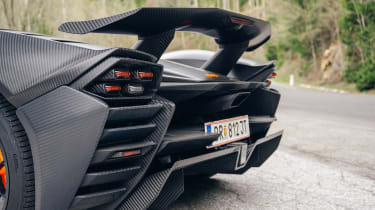
Fast forward and here we are, preparing to board a malevolent-looking pre-production GT‑XR, finished in matt clear carbonfibre. (Customers can choose more or less any paint colour they can imagine, or opt for clear carbon in matt or glossy finishes – or tinted, coloured carbonfibre, with the ability to choose the composite’s precise ratio between coloured and clear.) ‘It’s not so much a Batmobile as maybe a car the villain would drive; maybe the Joker,’ smiles Wölfling.
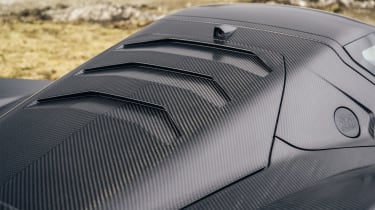
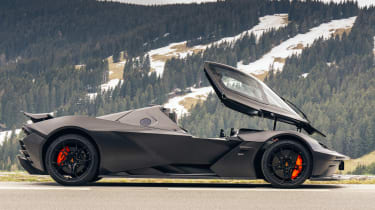
Plipping the keyfob or pulling the door handle triggers the GT‑XR’s party piece, its electric canopy. The whole glasshouse rises smoothly and silently upwards and forwards, revealing the cockpit set into the carbonfibre monocoque. Aside from the steel subframe at the rear carrying the engine, transmission and rear suspension, the GT‑XR is made almost entirely from carbonfibre.
To climb in, either sit on the monocoque’s broad shoulders and swivel your legs over, or take a John Cleese-style elongated step over the side, planting your right foot in the channel cut into the centre of the seat’s base, and then lowering yourself in. The steering wheel – also carbonfibre – is removable to make things easier, and comes to life instantly when you click it back into place. Its central screen carries all of the instrumentation. For navigation or music, you can click your smartphone into a mid-dash Quadlock mount, with wireless charging and two USB-C ports just below, and Bluetooth it to the speakers built into the monocoque’s sides next to the seats. There’s a glovebox too, between the seats, a bit like in an MX‑5, though there’s nowhere else to put anything – also a bit like an MX‑5.
The seat is part of the monocoque and doesn’t move; the pedals do. The monocoque itself is essentially the same as the original X‑Bow’s and virtually the only component carried over from that car, albeit a big one, though it weighs only 80kg. You and your passenger are positioned in separate channels, protected by deep sides.

Once you’re four-point harnessed in, lift a lever on the centre console and the canopy glides shut, clicking into place and sealing you inside. Maybe I’m being a wimp but I feel a little claustrophobic, for the first few miles at least. It’s an odd dichotomy of having an airy, panoramic view ahead through the canopy, and yet feeling a bit trapped. The canopy’s side windows can open as doors, so it’s always possible to get out, even if you’ve somehow ended up upside down. And if you were going to have a crash, the GT‑XR is a good car to do it in. The canopy forms an immensely strong assembly with the B-pillar and can withstand forces around six times greater than the X‑Bow’s weight. (KTM claims 1250kg without fuel but with a nominal 85kg for a driver and luggage, so adjusted to our preferred DIN-standard kerb weight – 90 per cent fuel load but no driver or luggage – that equates to 1226kg.)
There’s no rear window, nor physical mirrors, so three camera screens take care of your rear view. Their frame rate is superbly fast and they work well, but their positioning requires you to move your head a little more than in most cars, adding to my initial discombobulation. As does the power steering: it’s a clever, progressive variable-ratio electric system giving you effortless weight for parking and more resistance to lean on at speed, but it takes a little while to get used to, particularly at roundabouts where it’s feather-light before weighting up abruptly as speed builds. Unsurprisingly, it reminds more of power steering in racing cars than in typical road cars: less about expressive feel and more about reducing fatigue and dealing with high loads when driving hard on track.
And, as the miles tick on and the GT‑XR begins to fit like a glove rather than unfamiliar clothes, it becomes clear that’s exactly how it wants to be driven. It’s perfectly happy trickling around in traffic; one of the main differences between the racing GTX and GT2 versions and the GT‑XR road car is that the former have a racing gearbox with straight-cut gears, good for motorway speeds in first gear, where the latter has a smooth, slick dual-clutch road-car gearbox sourced from VW. But it’s still a racing car at heart.
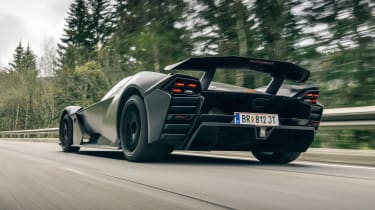
As we climb higher into the Styrian Alps, traffic evaporates and a dream-like road unfurls ahead: long, well-sighted straights, fast, cambered curves and tight, stop-press hairpins. The GT‑XR relishes it gleefully, like a dog let loose from a lead. In the fast stuff your shoulders are supported by the wraparound seat shrouds, letting you lean into the forces, and in the slow bits brake feel is superb. The pedal needs seriously firm pressure: without the servo assistance of a regular road car, what you press is what you get. But they definitely get it stopped. With such fine feedback it almost feels more natural to left-foot brake, although the pedals in this car are spaced for right-foot braking.
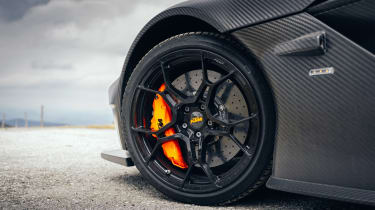
As standard, the GT‑XR has similar iron Brembo discs to those used on the Audi R8, albeit in a car that weighs about half a ton less. This car is on the optional carbon-ceramic brakes, which avoid feeling grabby from cold the way some can and make a sound like fine-grit sandpaper when pulling to a halt.
All kinds of sounds abound throughout the GT‑XR driving experience: there are turbo gasps, whooshes and belches, and flutters off-throttle like there’s an aviary in the engine bay. Unsurprisingly there’s a reasonable amount of road noise from the tyres, and photographer Aston Parrott and I need to raise our voices a fair bit to chat. Our sentences echo around the cockpit’s bowled canopy, as do the resounding clacks from the gearchange paddles.
What’s missing is the engine’s note itself: the Audi five-cylinder sounds mellifluous in the TT RS on evo’s Fast Fleet but its note is partly lost in the mechanical hubbub here, and only makes itself heard when you’re dashing for the red line. At which point you’re travelling seriously quickly. There’s no question this is a very fast car.
What’s holding it back today, and making it difficult to make a definitive judgement on its dynamics, is the set of winter tyres it’s wearing – a legal requirement in Austria at the time of our drive. ‘Next week we can put semi-slicks on,’ head of development Christian Sams had told us back at the factory, while climbing out of a similarly shod development car.
The requirement makes sense: from one corner to another there’s bright sunshine and bone-dry tarmac one moment, then the next there’s a sudden damp sheen on the road in the shadows under trees. Frost and even patches of snow line the verges in places (and there are no verges in others; just a steep drop or a solid tree). So the winter footwear is probably for the best, but the GT‑XR doesn’t feel happy on these tyres. The traction-control light is winking away under power right to the top of third gear, and using the halfway-off ESP Sport mode as a minimum is essential to be able to make any progress out of slow corners. The squirming treadblocks take some of the bite out of the brakes (and no doubt some of the feel out of the steering) and it’s more difficult to trust the car and feel its limits – something that’s brought home when, in a fast, downhill sweeper, I suddenly find myself needing a reasonably big stab of corrective lock. And a bit of a breather.
I’m sure it’s the tyres that are responsible for the lack of feedback at the limit rather than anything inherent in the chassis or suspension. In fact, the suspension seems to be doing a stellar job. This is a low car – its adjustable ride height can sit as low as 90mm – but manoeuvring over bumps in town it never grounds its nose. Running through corners at speed for the camera, Aston’s photos show the rear bodywork nearly touching the ground in a compression and the rear tyres finding fresh air over a bump, but all feels relatively serene inside the cockpit.
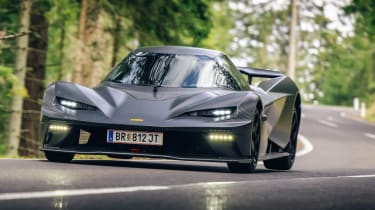
We raise the canopy for a longer breather and a chance to drink in the GT‑XR’s arresting lines one more time. With the canopy lifted, the front suspension’s inboard dampers are visible, the pushrod set-up operating them positioned to keep out of the airflow. There are no radiators in the nose: all of the car’s cooling is in its flanks, avoiding the chances of a race-ending crunch in traffic. The body’s entire nose section is attached with just four bolts and one electrical connection, for quicker replacement in a heat-of-battle pit stop. It’s all been thought through.
I love the GT‑XR conceptually, even if adding more of everything – power, size, price – is at odds with the initial motorcycle-on-four-wheels approach of the first X‑Bow. Ah, yes, price. I’ve been meaning to mention that. Ten years ago a X‑Bow GT cost around £73,000. The new GT‑XR costs €299,150 plus taxes, so around £316,800 in the UK at current exchange rates. It’s a completely different business approach for KTM: going from a strategy based on building a larger number of cars at a lower price point to no more than 100 cars a year, at super- or even hypercar pricing. And it makes a great deal of fiscal sense: the GT‑XR is sold out to the end of 2025 and the first 100 special-edition cars off the line were oversubscribed by some margin.
The car is fully homologated worldwide, although there won’t be a right-hand-drive version, sadly; that would double production costs. Production has all but ended of the original open-air four-pot X‑Bow now, with only a few more cars being built for the US market, where it’s not road-legal and used purely for track days. The GT‑XR is a new start for KTM.
As we visit, production is ramping up. The first three customer cars have been delivered, and one immediately embarked on a 600-mile journey to the Ring, running the engine in on the way. To drive, it truly is a racing car for the road, and a successful one – despite needing to run a great deal of ballast for Balance of Performance against rivals from Porsche and Audi, the X‑Bow GT2 had won at Monza shortly before our visit, for all the good and bad that entails.
As much as I love the presence, character and uniqueness of the GT‑XR, I didn’t fall in love with driving it quite as much as I thought I would. But I would love to experience it on its natural tyres, and perhaps in its natural habitat of a racetrack. Because there are glimpses of a brilliance – cornering forces squashing me into the seat, kickback-free steering holding a line, carbonfibre body all but brushing an improvised apex marker – that could make a ‘normal’ supercar feel anodyne and ungainly.
For KTM’s customers – many of whom have plenty of cars in their collection already – I can absolutely see its appeal. There’s nothing else quite like it, except perhaps Radical’s RXC, which is harder work on the road and can’t quite compete with the X‑Bow’s fit, finish and Joker’s-wheels allure. It’s not for everyone, but the sports car world is a richer place for this car’s creation, and KTM’s continued presence in it.
KTM X‑Bow GT‑XR specs
| Engine | In-line 5-cyl, 2480cc, turbocharged |
| Power | 493bhp @ 6350rpm |
| Torque | 428lb ft @ 5550rpm |
| Weight | 1226kg (409bhp/ton) |
| 0-62mph | 3.4sec |
| Top speed | 174mph |
| Basic price | c£316,800 |
This story was first featured in evo issue 310.