Jaguar Type 01 prototype review – doesn’t look like a Jag, but certainly drives like one
Jaguar’s all-electric Type 01 has now been revealed – we got an early taste of a prototype in Sweden, and found it’s not averse to a little snow-drifting

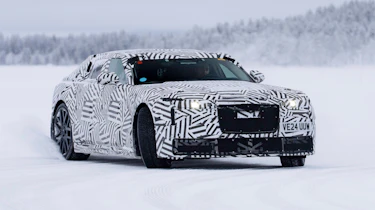
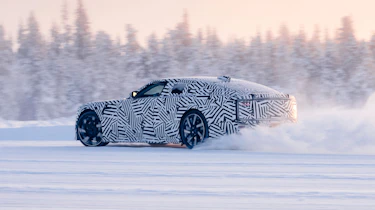
No matter how hard I try, I can’t make the new Jaguar Type 01 spin. The engineer next to me reckons it’s impossible, and so it proves, because the car is shrugging off my most erratic, hamfisted attempts to unsettle it. Crank the steering on, plant the throttle and it enters a neat four-wheel drift, precisely metering out 1016bhp and dampening your inputs just enough to stop the tail swinging wide. Try throwing its weight around by lifting off and flicking hard from left to right, and the electronics soften the direction change and dial out any sideways momentum in the car.
There’s never the slightest hint that the rear might want to overtake the front, some 5.2 metres ahead of it. But as well as being fool-proof, the systems feel like an aid rather than a hindrance, keeping the Jag on its path while still giving as much freedom as they can to you, the driver. The most impressive bit? We’re driving on snow, on factory-fit unstudded winter tyres…
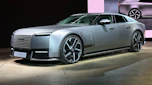
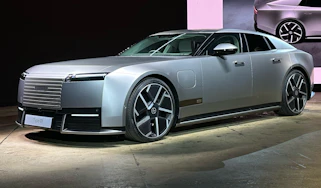
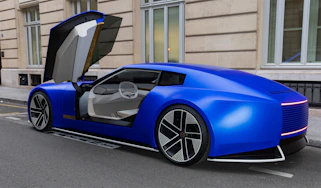
Getting a glimpse behind the curtain of a car’s development is always fascinating, but never more so than for something designed and engineered from a totally clean sheet. Jaguar’s new Type 01 is exactly that – the first of a new generation of Jaguars that’s radical in every sense, from its technical makeup to its high-end market positioning. And yes, its design. Much has been said of the Type 01’s bold look but this is a chance to cut through the noise and get under that new skin – and get a taste of what it's like to drive at Jaguar’s REVI winter testing facility in Sweden.
As a circa-£120k four-door grand tourer powered by batteries, it's tempting to draw comparisons between the Type 01 and the Porsche Taycan, but according to Jag’s engineers it’s a very different proposition. Yes, it has over 1000bhp, torque vectoring and a focus on engaging driving dynamics, but it’s not trying to match the precision and connection of a Porsche. Instead, it’s a tourer first and foremost, and capturing the effortless character of iconic past Jags has been the key target.
‘I drove a few of the classics to get familiar with that DNA,’ says Matt Becker, formerly of Lotus and Aston Martin, and now JLR’s Vehicle Engineering Director. ‘One of them was a V12 XJ-C. The way that car breathed with the road and felt on its toes, there were certain things it did in its composure, comfort and isolation that we wanted to reinterpret in something modern.’
That character has been baked into the Type 01’s brand new, 850-volt Jaguar Electric Architecture (JEA) platform from the beginning. The structure has been designed to be exceptionally rigid, and serves as a base for twin-chamber air suspension with Bilstein adaptive dampers, and a triple-motor drivetrain and 120kWh battery pack. There’s a single motor at the front, driving the wheels through an open differential, but the rear gets independent units for each wheel, enabling full torque vectoring.
The headline power figures are astonishing – 1015bhp and 1007lb ft of torque – but again, outright performance wasn’t the primary goal. The Type 01 will do 0-62mph in 3.2sec, but Jaguar intentionally hasn’t chased the instantaneous thrust usually associated with fast EVs, instead mapping the torque curve to be more progressive, giving the impression of sustained thrust at higher cruising speeds – fitting for a GT. As such, one of the targets for the project was a 4sec sprint from 62mph to 112mph.
Range is, of course, another critical element for a long-distance tourer, and the Type 01 will achieve up to 450 miles on the WLTP cycle, with 350kW charging adding 200 miles in 13 minutes. That’s more range and a quicker charging rate than a Taycan, but the Jag uses a bigger battery and thus weighs more. As much as half a ton more, in the region of 2700kg. It has a bigger footprint than the Porsche and its focus on comfort and refinement does come with a natural weight penalty, but for a clean-sheet, new-generation EV to be so lardy is disappointing.
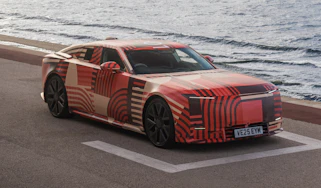
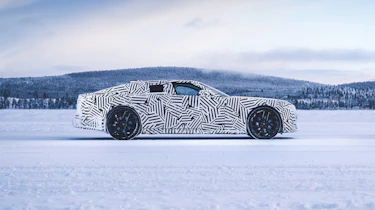
The Type 01 prototypes we’re driving have production hardware but the software tuning isn’t representative. LEVI’s low-grip test circuits are ideal for honing elements like the ESC, torque vectoring and over-the-limit handling, all of which we’re sampling in a pair of disguised pre-production cars.
The first – dubbed PT3 – was built 18 months ago, and evidently has a fair few development miles under its wheels. It’s a bit ratty, in other words, albeit in an endearing way. Inside there’s a mix of familiar GT cues, like having an expansive bonnet ahead of you, and a relatively low, laid-back seating position. You’re not on the deck, but more hunkered down than the vast majority of EVs thanks to the layout of the battery – it’s made up of five packs measuring just 120mm in height. The overall architecture feels new and fresh, with a low, flat dashboard and a very shallow letterbox windscreen. There’s a sense of occasion, even with most of the cabin disguised by makeshift fabric coverings.
Set off and there’s impressive silence, too. This prototype isn’t production-spec in terms of noise and refinement but it feels cohesive and vibration-free, with only the crunching of ice and snow beneath its wheels disturbing the cabin. The steering, meanwhile, is light and measured in its responses. Not overly bright and certainly not bristling with a sense of connection, but calm and intuitive as you wind on lock. The overall feel is much closer to something like a Bentley than the sports car precision of a Taycan.
That also extends to the ride. On the access roads to one of LEVI’s handling circuits, the Type 01 feels plush and settles into a relaxed stride as it picks up speed. It doesn’t precisely track the contours of the road, and instead flows freely on its suspension to absorb long wave bumps. Exploratory waggles of the wheel also reveal some roll and movement in the body as the loads increase – perhaps due to the fact Jaguar has chosen not to fit active anti-roll bars to prop up the Type 01’s considerable mass. Clearly, this isn’t a car with physics defying responsiveness and absolute body control – it seems to embrace the fact that it’s a large, comfort-oriented GT.
But it’s also one with 1000bhp to manage, and the scale of that challenge comes to light on the handling circuit. There’s a monstrous level of forward thrust, and with the stability systems disabled the wheel speed flares up to an indicated 100mph in the brief moments you can reach full throttle. A very sensitive right foot is required to carve tidy lines on the ice.
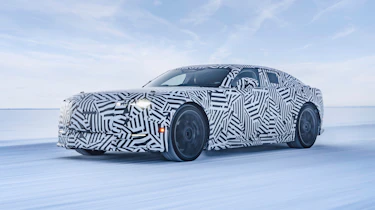
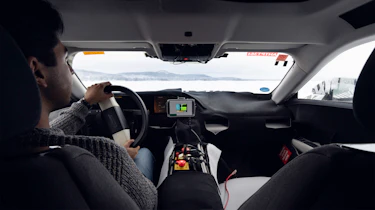
Vehicle Dynamics Manager James Hazlehurst rides with me in the passenger seat, with a laptop hooked up to the Type 01’s electronic brain. There are three driving modes – Rain/Ice/Snow, Comfort and Dynamic – and we begin in Comfort. It’s not the most rear-biased mode, but I’m surprised by how playful and fundamentally neutral the car feels. Tipping it in and steering it on the throttle is immediately easy, and there’s a lovely sense of the car propelling itself forwards while it holds a slight drift angle. The way it can corner with a near-straight wheel is almost balletic.
When settled like this the Type 01’s enormous weight isn’t a factor, but it does come to light under braking, or when slinging through direction changes. The body shifts over on its springs and though the movement is cushioned and controlled, you need to slow down your inputs to account for it.
Drive beyond that satisfying neutral window and the four-wheel drive calibration in Comfort starts to reign things in. Adding armfuls of correction prompts the system to engage the front motor and pull you straight, keeping you pointing the right way but stopping you from fully indulging in the Type 01’s balance. Switching to Rain/Ice/Snow takes this further, being less prone to oversteer and almost making the Type 01 feel like a front-wheel drive car at times in how it uses the front axle to correct itself.
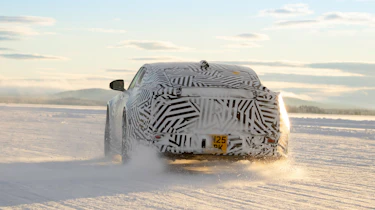
We switch to Dynamic for the next few laps, and suddenly the handling becomes more rear led. With less support from the front axle there’s more propensity for the rear to slide out of corners and continue to do so well into the next straight, but the upside is a free, malleable balance. Despite the mass at play, very rarely does the front end push on entry, which allows you to rotate it on the power from the moment you turn in all the way to the exit.
Get it right and it’s really satisfying, though there were times when the systems didn’t anticipate exactly what I was asking for. For instance, when balancing the car through certain tight corners I’d add throttle to tighten its line, but drive was sent to the front instead, pulling the nose wide when I needed it to tuck in. How relevant is that to tarmac driving? Probably not very, and optimising the systems perfectly for snow would surely compromise them on tarmac.
We later try a VB (Verification Build) prototype with the stability systems active, and as impressive as PT3 was, the full might of the electronics is more apparent here. The electric motors enable such fine control of wheel slip and hold the car precisely at the limit with real finesse, whether from a launch or through corners. But the real genius is in the dual motor rear axle. It not only manipulates torque to each wheel under power, but also works off-throttle to either stabilise the rear or improve turn in. It softens aggressive direction changes and, if you wind on excessive amounts of steering lock, works to minimise understeer when you’d otherwise go straight on. It’s an impressive box of tricks, and makes the Type 01 pretty much unspinnable.
To say there’s a lot riding on the Type 01 would be a massive understatement. Jaguar has boldly rolled the dice on a premium EV at a time when other manufacturers are struggling to sell them, and governments have changed tack to be more lenient towards hybrid power. Simply being a competent, highly impressive EV won’t be enough for its success, as demonstrated by the brilliant but slow-selling Taycan. In design terms the Type 01 is a bold statement – probably more desirable than the naysayers would like to admit – and on this evidence it drives like a Jaguar should. Will customers desire it and more importantly, buy it? Time will tell.