One last drive in the world's best hot hatch – goodbye to Honda's Civic Type R
It's one of the very best hot hatches ever made but now production has ended we say an emotional goodbye to Honda's Civic Type R with an epic drive
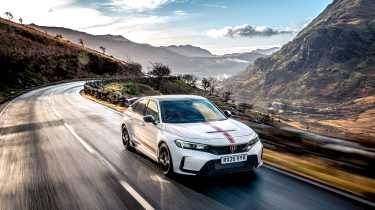
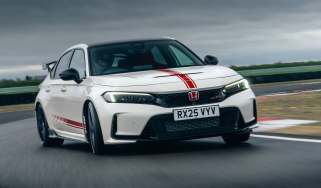
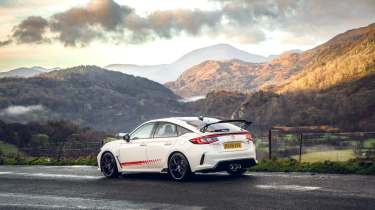
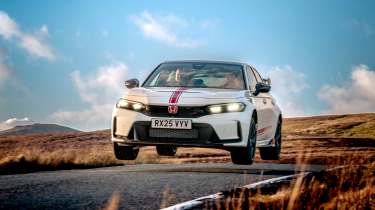
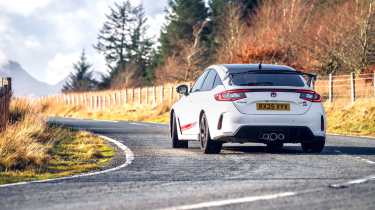
It had to be championship white. Any other colour just wouldn’t have seemed right for Honda’s farewell to the celebrated FL5 Civic Type R. As one of the last remaining manual, pure ICE hot hatches and an evo favourite from its launch back in 2022, we couldn’t resist taking this ‘Ultimate Edition’ – one of just ten destined for our shores from a total of 40 cars built for the UK and Europe – for one last hurrah.
Great cars come and great cars go, but there’s an added sense of finality to the FL5’s demise in this tumultuous era of transition. As we’ve discovered with hybrid supercars, what follows can be great in its own way, but comes at the expense of the purity and simplicity of final-gen internal combustion. As such, the Ultimate Edition bids farewell to the Type R as we have come to know and love it.
It doesn’t seem like four years since I flew to Portugal to drive the FL5 at its European media launch. The weather was foul – never good when you want to get a handle on the nuances of a critical new performance car – but at least what driving opportunities we had were divided between a morning session around the Estoril circuit and an afternoon on the road.
The pre-drive product briefing – usually the bit where road testers fidget like schoolkids in assembly – also proved to be fascinating. Such was the detail, pride and passion contained within the lengthy presentation, it was impossible not to be seduced by the Type R team’s remarkably meticulous engineering ethos.
Where most manufacturers have blanched in the face of swingeing legislation and dwindling sales, Honda gave this dedicated band of engineers the chance to obsess over every single detail. What they did was effectively blueprint the FK8 from nose to tail, finding gains and improvements in every meaningful area of the car before repackaging it in a newer body, which was, of course, significantly stiffened over the regular model. It weighed a bit more than the previous Type R (circa 50kg), but a chunk of that was due to new gasoline particulate filters.
It’s always interesting to look back at first drive reports. Trepidatious, too, if you happen to be the person who wrote it. Fortunately, despite the caveat of ropey conditions and less than revealing Portuguese roads, I reckoned the FL5 was a cracker, reserving special praise for its immaculately honed powertrain, exceptionally tactile brakes and steering, and the welcome maturity of its styling. For the first time since the original 1990s EK9 screamer, the Civic Type R looked and felt like a car I would love to own.
And so we head to Wales. Specifically, the spectacular roads of Snowdonia. You might expect this region to have been a happy hunting ground for the Civic, but aside from the 2020s Eras feature late last summer, when it came to group tests the Type R slugged it out on the equally rugged roads of Northumberland and the Scottish Borders, plus a local skirmish on our network of roads close to evo Towers.
It was back in issue 307 – just one month after the launch in Portugal – that we arranged a special welcoming committee for the CTR on its arrival in the UK: a group test of the best contemporary hot hatch rivals in the shape of VW’s Mk8 Golf R, Audi’s potent RS3 and Hyundai’s ever-impressive i30 N. The diversity of those rivals was indicative of the FL5’s new positioning. For though it borrowed heavily from the mechanical underpinnings of its FK8 predecessor, its elevated pricing (£46,995 at launch, some £14k more than the car it replaced) and more mature appearance somehow shifted the CTR recipe into new territory.
John Barker was presiding over the test and found the FL5 to be pretty much irresistible. Even the firm suspension – usually a red flag for JB – didn’t deter him from announcing it the winner, celebrating its honed controls, exceptional feel, ample pace and all-round star quality.
Fast-forward to 2026 and his bond with the CTR remains strong: ‘What’s always been deeply impressive about the Civic Type R is the attention to detail, the refinement of certain attributes which show an engineering ability and understanding that would be right at home at Porsche. The stand-out on the FL5 Type R is its brake feel, which is incredible, the best of any road car I’ve driven.
‘What makes it more impressive is that it’s in a hatchback, a compromised starting point for a driver’s car. That hasn’t been an issue in at least the last couple of generations of Civic because the small Type R team has had input into the model’s fundamental design.’
In many ways JB’s thoughts echo comments made by the Type R project leader who, when asked what they had benchmarked during the FL5’s development, paused before saying the only competitor car they had benchmarked was the FK8. That could have sounded arrogant, but the honesty somehow embodied the singularity of the CTR. There’s never been anything quite like it.
> Honda NSX-R review – Japan’s Porsche 911 GT3 RS is one of the most exciting supercars ever
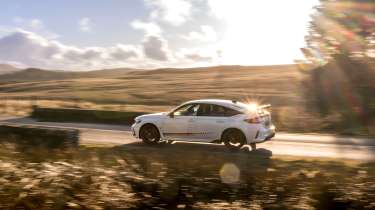
Up on our Snowdonian test loop, the FL5 is truly dazzling. It took a while to adapt to the shift from Honda’s original, naturally aspirated VTEC screamers to the torquier and more muscular delivery of the later turbocharged engines, but Honda managed to preserve enough of that rev-hungry character in the forced-induction CTR to ensure it felt commensurately sharper and fizzier than its European counterparts.
Even so, the FL5 never outgunned the biggest hitters from Audi and AMG. But while it lacked their headline-grabbing peak power outputs, it always punched hard enough when it mattered. In truth Honda could have left the FK8 engine alone, but as you might have gathered, that’s not in their nature. Instead, as with the rest of the car, the Type R team squeezed every drop from the 2-litre turbocharged four, achieving new highs of 324bhp at 6500rpm and 310lb ft between 2500rpm and 4000rpm, up from 316bhp and 295lb ft.
What you feel in the CTR is a sense of balance in all things, along with a focus on maximising the performance and excitement that could be extracted from a front-wheel-drive chassis. There’s a singularity of purpose about the FL5 that’s deeply impressive. Laudable and welcome though the bumps in power and torque are, it’s the efforts to further improve the way the engine responds that see the CTR deliver a driving experience that exceeds spec-sheet bragging rights.
Top Trumps-style comparisons have never done the CTR any favours, simply because there’s no easy way of imparting the granular details that make the difference. And yet, if you love all that stuff, the FL5 is a treasure trove of geeky gains: the flywheel is 18 per cent lighter, which reduces inertia weight by 25 per cent; the turbocharger’s redesigned internals spool up 14 per cent faster, and the engine can breathe better thanks to a 10 per cent increase in intake airflow and an exhaust system that’s 13 per cent less restrictive.
As I wrote after the launch, ‘Where pretty much every turbocharged four-cylinder hot hatch feels like it’s powered by an unexceptional engine that does the numbers thanks to forced induction, the Civic’s engine feels like a sharply tuned naturally aspirated motor that’s been further boosted by a turbo. It’s a small but crucial distinction.’ Four years later, and with pure internal combustion engines on the endangered list, the zingy CTR shines brighter than ever.
If there’s a criticism to level at the FL5 it’s around the firmness of its suspension. There’s adjustment of the adaptive dampers via the HMI system, but however much you dial them back it always has an edge to the ride and a tenseness to the body control that’s too much for some tastes. As JB observed in that first group test, Comfort in the CTR was equivalent to the RS3 in its firmest suspension setting.
You do get used to the knuckleduster aggression, and if you’re on the right road in a suitably racy frame of mind it elevates the Type R experience well beyond that of other, less hardcore hot hatches. But only if you accept that Comfort is as firm as you’re likely to need in most circumstances and Sport is reserved for maximum attack on smooth roads with big crests or compressions that need a little extra body control. Anything more is overkill.
Don’t believe me? When setting lap times in our 2023 evo Track Car of the Year test at Cadwell Park, the FL5 was too stiff in +R mode, skipping around on the straights sufficiently to need knocking back into Sport mode to truly find its feet. Thankfully, while Comfort, Sport and +R modes offer combined simultaneous adjustment of suspension, powertrain and steering, Individual mode permits you to mix-and-match to find your own sweet spot. It’s the FL5’s saving grace, allowing pin-sharp throttle response and mid-weight steering with the softest suspension setting.

A highlight of the FL5’s showings in evo was its fifth-place finish in 2023’s eCoty test. In a very strong group of cars on extremely challenging roads, it easily outpointed machines many times more prestigious, potent and expensive, including the Aston Martin DB12, Porsche 992 Carrera T and BMW M3 CS. There was more than a pinch of that year’s winner – the epic 992 GT3 RS – in the way the CTR went about its business, and while it ultimately couldn’t take a top-three finish, it proved that a brilliantly resolved front-wheel-drive car can mix it at the very highest levels.
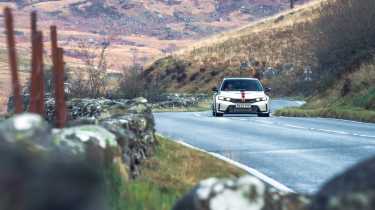
There’s a particular stretch of road in north Wales that’s been a favourite of ours for 30 years. I won’t name it because I don’t want to repeat the evo Triangle debacle, but suffice to say it’s a sensational stretch to which we have an almost magnetic attraction. The CTR feels mighty, almost as though it was developed here. Whether it’s a series of tight turns, sweeping kink or tricky transient combination, it feels absolutely on point, relishing commitment, rising to the challenge.
It’s not playful in the old-school hot hatch manner. Rather it feels laser-guided, the abundance of grip and tenacious traction combining with exquisite steering feel and perfectly judged rate of response, so you can commit with absolute confidence from the millisecond you turn the wheel. It’s one hundred per cent under you at all times, so instinctive that you scribe clean, steadfast lines with one steering input, leaning into the lateral grip as it builds and builds.
So evenly distributed is the cornering load that you can make minute adjustments to your line with just the slightest modulation of the throttle. No big lifts or flamboyant bungs to get the thing to rotate, just innate balance that works in harmony with the limited-slip differential to hook you through the corners. Absolute confidence combined with livewire poise is a rare blend, but it’s something that comes very naturally to the Civic Type R.
The gearshift and brakes are also the absolute gold standard for effectiveness, tactility and precision. As with the engine, they feel immaculately honed, and that’s no surprise: the six-speed stick-shift transmission was also singled out for obsessive attention by the engineers. Gearshift loads were measured and analysed; even the weight of the gearknob itself was carefully evaluated in order to perfect the effort and feel when snapping the lever through the H-pattern gate. Clearly Honda felt that if sticking with a manual gearbox was a celebration of the pleasure to be had from human-machine interaction, then the shift quality had to be an exemplar.
Squeeze into the brakes and you are immediately treated to the firmest and most feelsome of middle pedals. Close your eyes and it could very easily be the work of Andy Preuninger’s team at Weissach-Flacht, such is the accuracy and consistency with which you can apply force and judge your braking efforts. They make the automated throttle-blip function largely redundant because the pedal travel and location are perfect for heel-and-toe. Cleverly, Honda’s system recognises when you’re blip-shifting and momentarily disables itself, happy to leave you to it, but ready to step in when required.
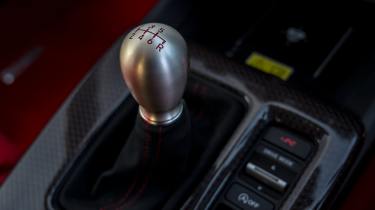
The gearbox and brakes also feel expensive, if that’s a suitable descriptor, by which I mean that everything feels like it has had immense time lavished on it. Better yet, you also get the impression that when the bean-counters in accounts might normally have expected to intervene and force costs – and therefore corners – to be cut, the Type R team has sent them packing. This is an engineer’s car as much as a driver’s car.
It’s this meticulously metered delivery and the equal emphasis on outright performance and engrossing engagement that ensured the CTR could outpoint its rivals; that sense of direct, proportionate response coupled to uncanny connection from all the major controls counting for more, more of the time. It’s a lesson in execution, but also in the importance of an overarching philosophy that informs every aspect of the car.
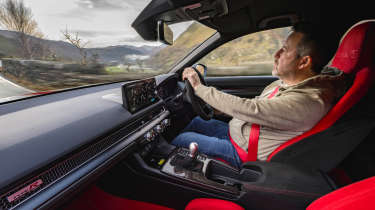
It’s not all about the nuts and bolts, either. From the moment you settle into the seat, you know you’re in a car designed by enthusiasts. I’ll admit I have a soft spot for Honda’s Type R interiors – there’s just something about the plush-yet-purposeful scarlet-upholstered seats and cool-to-the-touch machined alloy gear knob that strikes the perfect tone – but the FL5 elevates this even further with an increased sense of quality. Just as well given the elevated price tag, which rose to £57,900 for the admittedly hens-teeth rare Ultimate Edition.
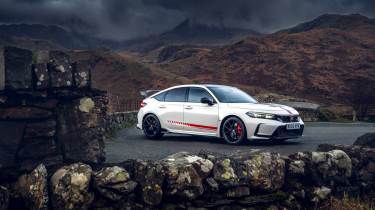
Like most ICE age legacy models, the FL5 is enduring something of a protracted demise, phased out territory by territory as the grip of emissions legislation finally strangles the life out of the last remaining non-hybrid performance models. Fittingly it lives on for a while in Japan, not to mention the US and some RoW markets, but sadly its days are numbered.
What follows the FL5 is unclear. It’s hard to imagine Honda not resurrecting its most successful Type R model, albeit with a hybrid powertrain. When it might come is less certain, but the recent showing of a Prelude HRC concept and confirmation of HRC performance parts for the production Prelude is clear evidence of Honda’s continuing desire to build motorsport-influenced models.
With Honda’s renewed commitment to F1, not to mention the domestic Japanese GT series, the likelihood is that we’ll see a new hybrid Type R model in the not-too-distant future. Whether that’s a two-door Prelude or five-door Civic is unclear (though if we were to make a wager we’d bet on the former), but in truth it doesn’t really matter. What does is that Honda continues to apply its uniquely meticulous approach to its mainstream performance cars, for they are special things indeed.