Ford Puma review – the best-seller that’s still no patch on the Fiesta
The Ford Puma melds some of the Fiesta’s charm with big-selling crossover form factor, but we still miss a proper small Ford hatch

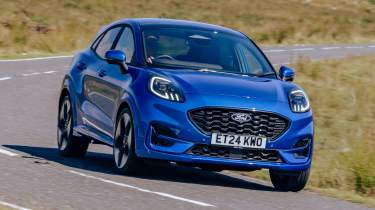
I knew back in 2019, when my old boss came back from a Ford event where he had been privy to a top-secret preview of the upcoming Puma, that it was going to be a seriously impactful car. The buzz around it was enormous – winning Fiesta underpinnings tweaked for a stylish (with Ford GT influences), easy-to-sell small SUV form factor. Its best-seller status was all but guaranteed.
It jumped with ease into the top ten of the UK sales charts on its 2020-2021 introduction, claimed fourth place overall in 2022 then locked out the top spot for the following three years, picking up much (if not all) of the slack left by the Fiesta after its discontinuation in July 2023.
Time hasn’t dulled its appeal either, with sales reaching upwards of 55,000 units in 2025 for a new yearly record for the model, albeit thanks in part to the increased exposure from its 2024 facelift. Commercially then, the Puma has proved a solid replacement for the Fiesta, which itself clocked up 12 consecutive years as the UK’s best-seller between 2009 and 2020.
Many love the Puma but for those who delighted in the Fiesta’s honest, sweet and sophisticated-above-its-station driving dynamics, it can feel like something is missing.
Engines, gearbox and performance
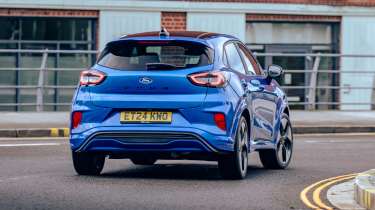
- All Pumas are mild hybrid; regenerative braking you can’t switch off annoys
- 153bhp engine pulls well at low speeds, hits a wall when going faster
- Sounds nice while it’s at it though
More reviews
The Puma’s engine lineup throughout its life is relatively simple to understand. All standard Pumas in the UK are powered by a version of Ford’s 1-litre EcoBoost three-cylinder engine. The engine quickly gained a 48-volt mild hybrid system, with the old unelectrified unit discontinued relatively early in the model’s life. The mild hybrid system consists of an integrated starter generator powered by a 0.48kWh battery. This allows the Puma to sit in traffic engine-off for extended periods but not to run on electric only, the generator instead contributing 37lb ft of low-end torque and 15bhp to the equation.

There is also the electric Ford Puma Gen-E, launched in 2025, that offers a WLTP combined range of up to 259 miles from a 166bhp, 216lb ft electric motor, fed by a 46.86kWh (usable) battery. A diesel engine was offered in foreign markets but never in the UK. The Puma ST arrived originally with the Fiesta ST’s 1.5-litre 197bhp three-cylinder EcoBoost engine. This has however been discontinued, with only the ‘Powershift’ 168bhp mild hybrid in its place.
All base-spec petrol Pumas, whether mild-hybrid or not, have 123bhp, with the current mild-hybrid good for 125lb ft from 1750rpm. That allows for 0-62mph in 9.6sec in the most popular seven-speed dual-clutch ‘Powershift’ model. The 153bhp version of the engine also has more torque, with 140lb ft available from 1750rpm, allowing a 0-62mph time of 8.7sec.
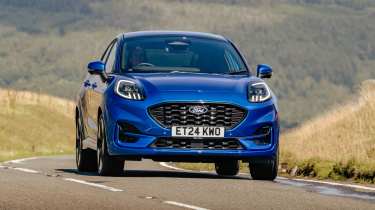
It’s the top-end 153bhp model that we had on test, in ST-Line X trim. That means the seven-speed auto is the only transmission option, unlike the lesser EcoBoost that’s available with a six-speed manual. The mild hybrid motor itself is a fine little mill, the electric element offering an appreciable punch in most low-speed driving situations. This is a predominantly combustion-powered car that sports the kind of response and urgency of a low-end EV thanks to its electrification.
What you mustn’t do is assume that this strength you perceive when in a small pond, means the Puma is a big fish. If you ask too much of it out on faster flowing roads, the motor feels like it hits a hard buffer. Though its maximum of 153bhp arrives at a peaky 6000rpm, the sense of urgency in the powertrain you enjoyed at lower speeds dissipates into tepidity as the revs rise. That doesn’t bode well for the even less potent version.
It’s something we’re used to from the Puma ST Powershift, though the effect seemed more profound in that car given its performance billing. The standard Puma isn’t lumbered with the requirement to be an engaging powertrain and so, that the little three-pot has a nice thrum to it when it’s trying (and failing) to deliver some more serious performance, is a nice bonus.
There’s no way to manually control the seven-speed dual-clutch transmission, with only the flagship ST featuring shift paddles. As such, you’re very much at its mercy. The Sport mode is very much required if you’re looking for anything more than glacial response. Once you do select Sport, however, it’s surprisingly intuitive.
Ride and handling
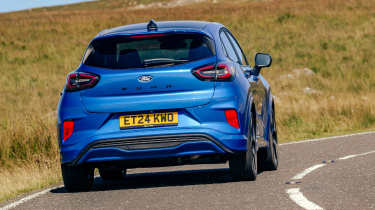
- Fiesta underpinnings mean it’s good to drive, for a crossover
- Ride is firm a lot of the time but you can have fun with it
- Rubber band-like steering self-centring is odd
Engine options aren’t what define the differences between the bygone Fiesta and the Puma Ford insists is its worthy and adequate placeholder. It’s the dynamics and handling. The challenges are obvious. As a crossover, it’s 6.1cm taller, with a higher centre of gravity than the traditional hatch. Trying to achieve the same sense of responsiveness and body control as the Fiesta is therefore that much more difficult.
A lot of hard work has gone into preserving some of the Fiesta magic. The Puma’s track is wider (by 7cm), its rear twist beam and suspension bushes stiffer and its dampers more substantial than those of the Fiesta it replaced. Its steering is also quicker than is typical of a small crossover without any sporting pretension.
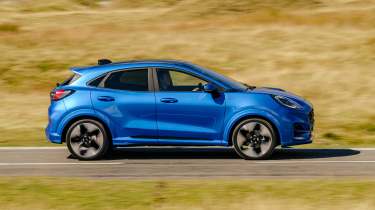
You can feel the effects of that work on strides between pockets of countryside and civilisation. The Puma is responsive, nicely balanced and reasonably well controlled on a flowing B-road. You do feel the deficits of its raised height, however, the Puma eventually starting to feel topsy-turvy, or rolling uncomfortably onto its sidewalls if you push too hard.
I don’t have much love for the steering either, which has an artificially bouncy self-centring effect, as if the rack is tethered to the straight-ahead by a rubber band. I’m not overly fond of the regenerative braking system, either. You can’t turn it off and it feels a bit stronger than conventional engine braking.
ST-Line cars are slightly lower and stiffer than standard Pumas, which no doubt informed our test car’s relative competence and entertainment factor. However the sacrifice is a jitterier ride in normal driving through town. The Puma ST-Line’s passive set-up is at its best when loaded up, not while trundling around, so if it’s a buttery-smooth, low-speed driving experience you want, ST-Line spec might not be the pick.
MPG and running costs
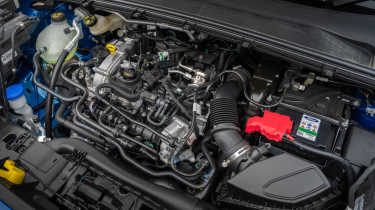
- Tiny EcoBoost engines sip if you’re a gentle driver
- 48-volt system contributes noticeably to day-to-day efficiency
- Gets thirsty at pace, or high-speed cruising
The Puma is ostensibly a very frugal little car, though the same powertrain in the smaller, lighter, more aerodynamically efficient Fiesta would obviously be even more so. I digress. Official figures have it that both the 123bhp model and the 153bhp model will be good for an average of 49.6mpg with the seven-speed powershift transmission. The lesser engine with the manual is a bit more efficient, scoring 52.3mpg.
In our experience, Puma fuel consumption is one of two things: nicely minimal or surprisingly excessive. It has a comfort zone, bimbling around town and A-roads up to 60mph. The motorway is not in the Puma’s comfort zone, nor is extended time with your foot buried in the throttle bulkhead.
Around town and cruising at a medium speed, over 40mpg is no bother at all, with 50mpg cropping up on occasion. On the motorway, you’re circling 40mpg, if not sometimes dipping below it. Being still (relatively) light and with regenerative braking, consumables like tyres and brake pads and discs shouldn’t be too frequently in demand, or break the bank when needed.
Interior and tech
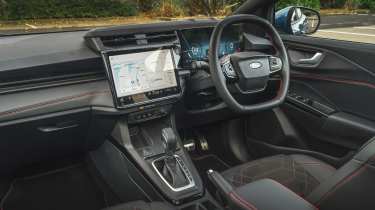
- Quality is reasonable, if patchy in places
- Not the most spacious for adults in the back
- A lot of functions relegated to the infotainment system
With its facelift the Puma underwent a fairly significant cabin overhaul. The strange square/circle two-spoke wheel has familiar controls but is reminiscent visually of the one in the Ford Transit that can double as a table. Through it, you view a slightly uninspiring 12.3-inch driver’s display. There’s a large main touchscreen, spanning 12 inches. This features the Ford SYNC software that, frankly, isn’t hugely intuitive. It can be an issue because a lot of the important controls are now contained within it.
Happily, unlike in the Jaecoo 7 that’s had a go at nicking the Puma’s top sales spot in the UK a couple of times, pairing your smartphone doesn’t get rid of the climate control band at the bottom of the screen. Lane-keep assist can be switched off via a button on the steering wheel but some other meddling driver aids are buried within menus.
The Puma is spacious enough in the front, with nice enough materials. There’s a mix admittedly - the seats with their elaborate red stitching (in ST-Line X trim) juxtaposed with some slightly cheap-feeling, ill-fitting plastics on the centre tunnel, for instance. The view out is okay, though the rear window is a little slim.
In the back, things aren’t perfect. It’ll be fine for a young family, but once kids get to near adult size they’re going to start feeling a little cramped. And that’s behind the driving position of someone of average height. The boot’s a reasonable size too – a rare area of great improvement for the Puma over the Fiesta in terms of capacity. With the Puma sitting higher though, lifting heavy bags in will be more of a workout than with a Fiesta.
Price and rivals
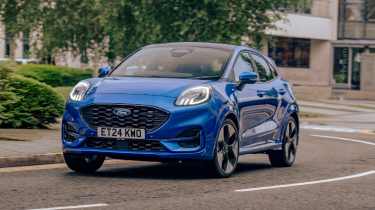
Inflationary pressures have hit all small cars hard, including small cars that aren’t that small, like the Puma. An entry-level Puma at launch back in 2020 was a £20,000 prospect. Today, you won’t pay any less than £27,145 before options, for a 123bhp Titanium model. Happily, there’s reasonable standard equipment, with LED headlights, 17-inch alloy wheels and the full-size 12-inch infotainment system.
Raising the spec doesn’t raise the price too much. ST-Line and ST-Line X models cost from £28,045 and £29,695 respectively, bringing sportier styling and in the X, 18-inch wheels – though we’d stick with the 17s.
The automatic gearbox raises all respective prices by about £1800, while jumping to the 153bhp engine in the ST-Line X jumps the price by £2645, to £32,245. Even at this level, the winter pack that brings the heated front seats and steering wheel, is an option, albeit not a costly one at £350. The Puma Gen-E starts from £26,245 with the government’s Electric Car Grant.
Rivals to the Ford Puma include the Peugeot 2008, Hyundai Kona, Citroen C3 Aircross, Nissan Juke, Renault Captur, Toyota Yaris Cross, Vauxhall Mokka and Seat Arona. The Ford bests them all as a thing to drive, though it doesn’t lead the class for comfort, equipment, value or practicality.