Ferrari 360 Challenge Stradale (2003 - 2004) review – the original 911 GT3 RS rival
Ferrari’s 360 Challenge Stradale set the template for Maranello’s lightened, hardcore mid-engined specials
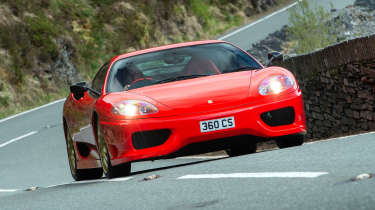
Compared to some of Ferrari's modern names, '360 Challenge Stradale' sounds pretty good, doesn't it? It was the first of Ferrari's now hallowed line of lightweight mid-engined road racers. It's effectively a road version of the 360 Challenge race car of the time, used by Ferrari’s one-make series for its V8-engined baby supercar. Hence the Stradale bit, which rougly translated, means 'road-going'.
The Challenge Stradale seemed daringly cutting-edge in 2003. Shunning the open-gate manual gearbox for paddle-only is standard fare today but it was unheard of at the time. Today the CS seems compact and almost cuddly compared to its modern counterparts, the 488 Pista and 296 Speciale, its telltale carbon mirrors, moderately massaged bodywork and meshed grilles, if not the famous stripe, subtle by today's standards.
As it approaches its 25th anniversary (the Challenge Stradale made its debut at the Geneva Motor Show in 2003), Ferrari’s first junior road racer is generating buzz among prospectors due to some recent outlier auction results. Even if seven figures is a reach, the 360 Challenge Stradale is a very special modern classic Ferrari and worthy of acclaim.
Ferrari 360 Challenge Stradale in detail
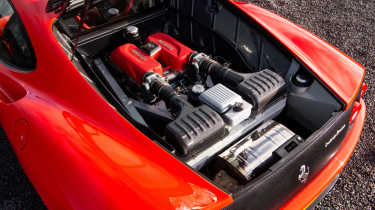
- 420bhp 3.6-litre V8 – 26bhp up on the 360 Modena
- Full lightweight spec gets it down to a (claimed) 1280kg
- 'Race Mode' button unlocks 150ms shifts from automated manual 'box
More reviews
The 360 Challenge Stradale was one of the last of the original V8s – it can trace its roots back to Ferrari’s prototype racers of the early 1960s. But in ‘F131’ CS tune it's 3.6-litre good for 420bhp (up 26bhp from the 360 Modena) at a furious 8500rpm, thanks to titanium internals, a revised intake and polished intake ports, higher compression (increased from 11:0:1 in the Modena to 11:2:1 here), with internal friction reduced and the engine blueprinted. Perhaps most famously there was also a new exhaust system.
The F1 single-clutch automated manual was the only transmission offered. It was lauded for its responses at the time but its 150ms shift time - in Race Mode - seems quaint today. There’s nothing antiquated about the braking set-up, with the carbon-ceramic brakes as per the 380mm discs and six-piston (front) callipers of the Enzo.
The doors aren't much more than their aluminium skin and carbon door card and are featherweight as a result, opened via a very basic rectangular lever. The electric windows are found on many examples, though Perspex side windows with sliding openers were a rare factory option. So configured and if the first owner didn’t also add back in the optional stereo but did go for the lightweight bucket seats, the CS could weigh as little as 1280kg according to Ferrari’s scales.
Interior
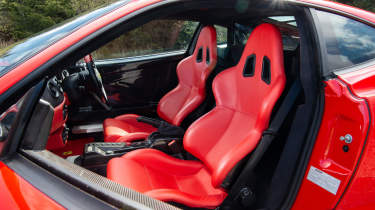
The 360 Challenge Stradale interior is simple, bare and frankly, refreshing: bare metal floors strike you first, the welds on the chassis in full view. Switchgear is limited – there are manual vents and heater controls, a traditional stereo and a few ghosts of Fiat's 1990s parts bin. That doesn't matter for this is a car that's all about what's necessary and that dispenses with the superfluous. It's all about the driving.
That simplicity extends to the pre-manettino steering wheel. It’s still a push-button start, but the red button is positioned quaintly down on the centre console, and rouses the engine to a harsh, vibratory blare. A small carbon pannel between the seats features a 'Challenge Stradale' plaque, a 12-volt port and buttons for reverse, the hazards, central locking and launch control - a very new thing in 2003. Another also reads 'ASR' with a strikethrough – that's how you turn off Ferrari's pre multi-stage 'Anti Slip Regulation' traction control system.
Driving the Ferrari 360 Challenge Stradale
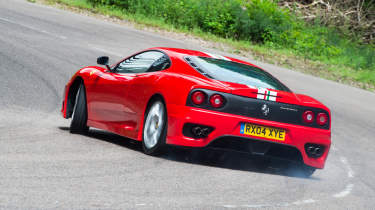
- Compact, raw, thrilling
- Gearbox is charming but does date it
- Unique shrill V8 sound
We’ve had a number of encounters with the Ferrari 360 Challenge Stradale over the years. Here is an excerpt from this comparison test with its hardcore mid-engined Ferrari relatives.
‘Push the big red starter button (after you’ve stuck the key in the column and turned it – keyless was a few years and generations of Ferrari away in 2003) and the V8 catches and idles busily at your back, bassier, fizzier and busier-sounding than anything today.
‘The CS’s single-clutch automated manual feels slow and a little clumsy to begin with, demanding care and consideration from the driver to knock the edges off – small lifts before you shift up, careful applications of throttle at low speeds. Nonetheless, the Challenge Stradale feels special almost immediately, as you settle into its bucket seat.
‘Immediately it's race-inspired road car through and through: a little edgy in its dynamics, flighty between the road's cambers, low and prone to scuffing in modest compressions, its engine loud and lethergic at low revs but strong and urgent as the tach climbs.
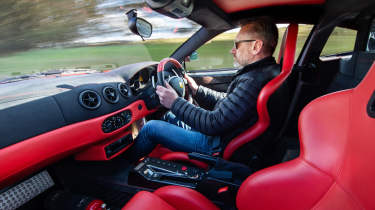
'If the CS experience is tense, the steering is somewhat out of step – it's relaxed with a relative slow-ratio feel, especially compared to more modern Ferraris. That doesn't get in the way of you enjoying the Challenge Stradale, just something you learn and factor into your driving. After a few miles you're used to it and able to get the best out of the CS – to revel in the dynamics.
‘ Throughout quick corners the Challenge Stradale has a racer's feel. It grips strongly and corners flat, neutrally and four-square. It feels light and responsive as you change direction with good feedback coming back to you through the uncluttered steering wheel and carbonfibre seat. It's calm and controlled even as you approach the limit, with a sense of poise and a lack of inertia.
‘The sound of the V8 is all-enveloping, filling the cockpit, only the occasional nose scuff - not something I recall from the launch - interupting your undivided attention. You need to remember the gearbox isn't a modern DCT or auto and drive around its limitations, especially when driving at slow speeds. But this is just another point og engagement and part of the The gearbox needs some help on the upshifts and an appreciation that it’s not an auto or DCT when you’re manoeuvring, but in a way that’s part of the challenge.’ – John Barker, evo editor-at-large.
Buying guide and values
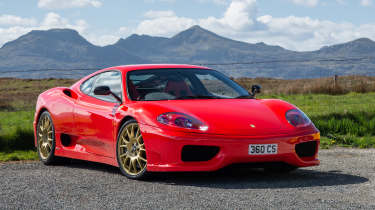
Intrinsically, the Stradale seems to be a hard-wearing bit of kit. A full service history is still essential, and check that the three-year engine belt change has been done. It’s also near-essential getting a Ferrari dealer or specialist to run a diagnostics test to find out what percentage worn the clutch and brake pads are.
Pirelli P Zero Corsa tyres are recommended though everything from Pirelli’s own Trofeo R to Michelin Pilot Sport 4 S and Cup 2. As many classic supercars will attest, having a choice between tyres and not having to wait for sporadic production runs of niche tyres is a luxury. A clicking noise that seems to come from the glovebox is probably a ball joint, while exhaust butterfly valves can also stick, requiring the replacement of the tailpipe (minimum £1300 per side). Be sure there's plenty of health in those ceramic brakes, or that they've been recently replaced, too. In period, Ferrari's recommendation was that discs be changed with every two sets of pads, incurring a £12,000+ cost. And that was in the mid-to-late 2000s...
Other than that, it’s mostly cosmetic; the Alcantara dash top fades yet can be rejuvenated, but carbonfibre panels that have gone milky, such as those in the engine bay, can only be replaced, at great expense. Check all panels fit and paint matches as it should and if your chosen example does feature the distinctive optional (£3100 when new) stripe, that it’s painted per the factory specification.
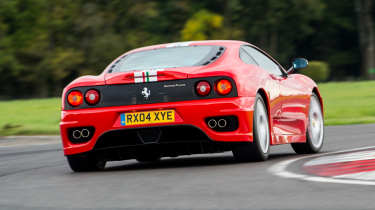
The hot topic of the moment is of course, what a Ferrari 360 Challenge Stradale is worth. While the $1.8million (roughly seven-times what’s considered to be current market value for the average 360 CS) sale of a 375-mile, British Racing Green car at the Mecum Kissimmee sale in January 2026 is noteworthy, it would be a reach to suggest it’s too much more than an anomaly – the result of a battle between two or more people very keen to own what is a unique example. It wasn’t the only high seller, mind. A Giallo Modena car sold at the same auction for just over £800,000.
Some cars have since been for sale at over half a million in the time since but realistic current (February 2026) values are in the £250,000 - £500,000 range. Unlike the 458 Speciale that succeeded it, numbers weren’t explicitly limited for the 360 CS – some 1288 examples were produced for the world in total. Nonetheless, it’s likely a safer place to park the cash than anything you can buy for that money new – its status as one of the most covetable modern classic Ferraris is assured.
Specifications
| Engine | V8, 3586cc |
|---|---|
| Max power | 420bhp @ 8500rpm |
| Max torque | 275lb ft @ 4750rpm |
| Weight | 1280kg (333bhp/ton) |
| 0-62mph | 4.1sec (claimed) |
| Top speed | 186mph (claimed) |
| Price new | £133,025 |
| Price now | £250,000+ |
| On sale | 2003-2004 |
| Number built | 1288 |