Chevrolet Corvette Z06 review – America’s 911 GT3 is unruly, and not in a good way
The C8-generation Corvette Z06 is the most ‘European’ yet, with a Ferrari 458-inspired V8 and a chassis tuned for the track. Here’s what it’s like on the road

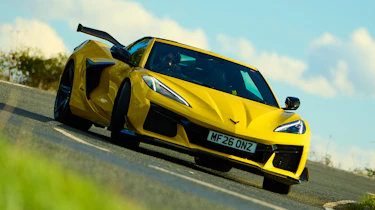
We’re big fans of the C8 Corvette at evo. In standard trim it's a genuinely great sports car; polished to drive and very usable with a cracker of a V8 behind you, making it an endearing and very credible Porsche 911 Carrera rival. Since its launch in 2020 the range has been expanded with the hybrid, four-wheel drive E-Ray and three track focused versions – the Z06, ZR1 and ZR1X. The ZR1s are serious bits of kit – 1000bhp+, sub-7-minute Nürburgring monsters – but we don't get them in the UK. We do get the Z06, however, which is hardly lacking focus with its widebody stance, stiffer chassis and 8600rpm V8.
It’s Corvette’s answer to the 911 GT3, although in the UK it’s not the bargain alternative you might expect at £182,920 when equipped with the track-oriented Z07 Performance Package. Does it have the performance and finesse to do that price justice? Read on to find out.
Engine and performance
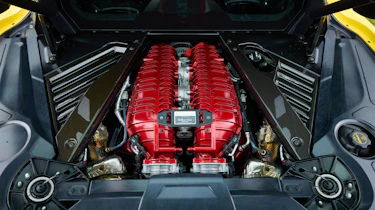
- 5.5-litre naturally aspirated V8 inspired by Ferrari
- A thinner engine note and sharper responses than a normal C8
- Wildly accelerative (as long as the Cup 2 Rs are warm)
The Z06 remains a rare concept in 2026: a non-hybrid, naturally aspirated V8 supercar with rear-wheel drive, and a power figure starting with a six – not a seven, eight or nine (although with 637bhp, UK cars are down by 33bhp over US models). The hand-built 5.5-litre unit was heavily inspired by the Ferrari F136 V8 you’ll find in a 458 Speciale. As such it uses a flat-plane crank rather than the cross-plane layout of the base Corvette’s V8, giving it more motorsport edge and an 8600rpm redline.
More reviews
There are solid engineering reasons behind the switch. The key advantage is that a flat-plane crank pairs firing strokes on opposite cylinder banks and so requires minimal crankshaft balance weights, so it is faster to rev and is capable of higher revs (and therefore higher power) than a cross-plane V8. However, while primary balance is excellent, secondary balance is an issue and vibrations can play havoc with the reliability and durability of ancillary items. It’s an issue that can be mitigated to a degree by using lightweight materials for the reciprocating parts, and the Z06 engine does, employing titanium con rods and short-skirt aluminium pistons (which further improve response), but being so big at 5.5 litres amplifies the secondary balance issue.
Naturally, the Corvette development team benchmarked their rivals, paying particular attention to Ferrari. They actually bought a 458 Speciale engine from Poland to inform the development of the Z06 motor, and it was worth every dollar, particularly in terms of how to isolate electrical components from vibrations.
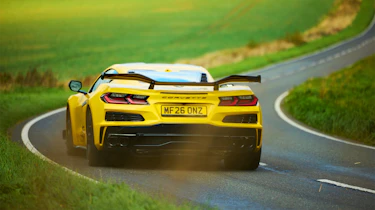
Fire up the Z06 and there’s a quick whap of revs rather than a low V8 rumble. Sure enough, there are hints of Ferrari V8 in its timbre and tone, but perhaps a bit less smoothness, the steering wheel trembling slightly at idle. Sink into the long-travel throttle and the V8 smooths out, feeling really eager, responsive and more flexible than you’d expect of a naturally aspirated lump. But it really wants to live at high revs. Then the V8 finds its full voice, slams its shoulder behind the mass of the car and explodes with power, delivering an aural sweet spot between 5 and 6 before wailing to the 8500rpm redline. It’s stunning, like a huge, mega-punchy Honda VTEC. Chevy claims 0-62mph in 3.1sec, and you can believe it.
The flat-plane V8 is missing the warm, burbling character of the standard C8, but it’s a fierce, exciting powertrain that suits the car’s focused nature. The gearbox works well too – smooth and fast on the way up, albeit a little slower when pulling for downshits.
Driver’s note
‘Keeping the revs above 5000rpm, the Z06 is thrilling and absorbing. I love the challenge of keeping the engine in the manic zone and exploiting the enormous grip.’ – John Barker, evo Editor-at-Large
Ride and handling
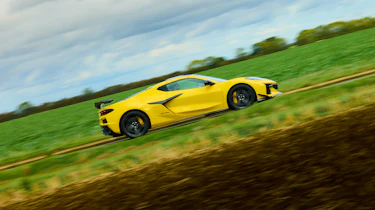
- Wider tracks, stiffer setup and Cup 2 Rs help generate enormous grip
- Too fidgety unless on a perfectly smooth surface
- On cold tyres, the rear can bite with very little provocation
The Z06 is a different beast to the Stingray in terms of its chassis, too. You get upsized brakes, bigger wheels and tyres and wider arches front and rear to cover them. You also get adjustable magnetorheological dampers and springs that are 35 per cent stiffer, and a more comprehensive cooling system configured with track use in mind. All the radiators you can see – three in the nose, two in the yawning side scoops – are for water. The flow is front to rear, with some of the water diverted through those side radiators and then to the centrally mounted engine and transmission oil coolers.
Serious stuff, but the Z07 Performance Package has even more. There are stiffer springs again (rates are up another eight per cent) and more aggressive aero, including canards or dive planes on the front corners and the fixed, stepped carbon rear wing. They help double the downforce to 333kg at 186mph. You also get huge, Brembo carbon-ceramic brakes and massive Michelin Pilot Sport Cup 2 R tyres – 275/30 ZR20 front, 345/25 ZR21 rear – which look like cut slicks.
Our test car is also equipped with the optional carbonfibre wheels made by Carbon Revolution, an Australian company. They replace the standard 10 x 20in and 13 x 21in forged aluminium wheels and save the best part of 5kg of unsprung mass per corner. This is such a significant amount that the power steering and ABS have to be recalibrated, and it’s claimed that fitting the wheels alone is worth 1 to 1.5 seconds per lap on mainstream racetracks... The wheels come with a heat-shield lining on the inside of the rim, but given that the bespoke Michelins are only said to give their best towards the end of a 12-lap stint, cool-down laps are apparently essential to avoid melting the spokes.
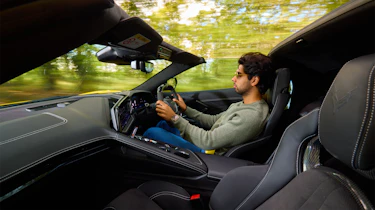
The Z06 is very definitely tuned for the track – particularly with the Z07 pack – but we’re sadly only driving it on the road here. Although as the 911 GT3 and GT3 RS prove, ultimate track focus doesn’t need to come at the expense of on-road polish.
On the move the Z06 feels really firm and four-square. It's tough even with the magnetic ride control suspension in its softest Tour mode, and the steering is heavy, and not keen to whip around back to centre. There’s some margin to work with around the straight ahead but the nose feels really darty when you get into the lock, and you sense there are very wide contact patches at the front. The stiffer setup of the Z07 pack no doubt contributes to the stiff-limbed feel.
Pick up speed and this is a very busy car, pulling around over ruts and cambers and keeping your arms tense and your eyes laser focused on the road. Whether it’s the wide tyres or aggressive geometry, the Z06 really doesn’t feel at ease on anything other than a perfect surface, taking up the entire lane as it bobs and weaves its way along. Try to relax your hands on the wheel to allow the car to track straight and that only makes things worse – it genuinely feels like it might throw you off the road at times. Combine that with the frantic delivery of the engine, and it’s a car that’s always switched on, never fully relaxed.
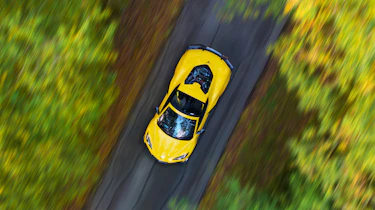
Smoother, dry roads show the Z06 in a much better light. When less distracted by the surface it’s an intensely capable car, warm Cup 2 Rs biting into the surface to deliver mighty turn in, and enough traction to deal with the torrent of power. With the engine primed at high revs you have fine control of the rear end with the throttle, and slides are much more predictable with the tyres closer to their operating window. It’s a car to attack with, diving into corners and catching small slides under the frenzied delivery of the V8. The carbon ceramic brakes work better with more commitment too, feeling less dead underfoot and easier to modulate (although you don’t feel ABS intervention through your foot, with the system being by-wire).
Though it has its moments – and can’t really be blamed for not working on Cup 2 Rs in winter – the Z06 really ought to have a wider operating window as a road car. Find yourself on the wrong stretch and it becomes downright unruly – a shame because it has the makings of an appealing road-going package, with a very habitable interior, plenty of luggage space and as with all C8s, a removable roof panel for open-air driving. With the Z07 pack it is admittedly optimised for the track, but so are the 911 GT3 and GT3 RS, and they manage to double as sensational road cars with a much wider bandwidth than the Corvette.
Driver’s note
‘Whipping the Corvette along at the pace it’s capable of reveals a few other things. Although it’s similar in concept to the Ferrari 458/488/F8, it doesn’t have their lightness of touch, their feeling of dynamic agility, which is partly down to set-up and partly because the Corvette is about 150kg heavier.’ – John Barker, evo Editor-at-Large
Interior and tech
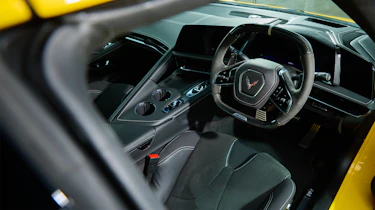
The Z06’s general cabin architecture is familiar C8 – angular, cocooning and a little busy – although there have been some major changes as part of the Corvette's range-wide 2026 update.
Gone is the quirky spine of buttons on the centre console that separated driver and passenger, in its place a grab handle. The climate controls, which used to be stacked vertically on that spine, are now on a bank of switches beneath the infotainment screen, and much easier to use. The displays are new too, with a larger 12.7-inch central touchscreen and 14-inch digital dash being joined by a smaller driving information screen off to the left. There’s a lot going on, and the C8’s square steering wheel remains a bit awkward to hold, but it does feel special and very well finished. The carbon seats are really supportive too, although they don’t go low enough.
Price and rivals
As well as its frantic and twitchy dynamics, the biggest downfall of the Z06 is the fact it costs £182,920, with this test car being specced to a very punchy £220,315. That’s a chunk more than a 911 GT3, and scarily close to bonafide supercars like the McLaren Artura and Maserati MCPura. It’s no longer the affordable alternative to mainstream Europeans, it’s aiming at them head-on. On the road it doesn’t have the finesse to compete, although a track test might be a different story.