
BMW iX3 review – a cheaper 500-mile alternative to the Volvo EX60
The iX3 is the model to kickstart a new era for BMW, and while its looks might be divisive, its class-leading stats certainly are not
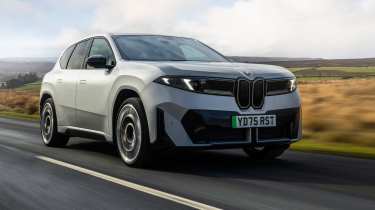
Those who slated BMW for its adoption of oversized grilles will be pleased to hear that this era is officially over, signalled by the launch of this; the all-new iX3. Taking design inspiration from BMWs of the ‘50s and ‘60s with a modern interpretation of their small, vertical kidney grilles, it’s clear that this is a departure from the norm. Admittedly this new approach hasn’t resulted in a design that will be quite as unanimously admired as those old timers, but it’s what lies behind it all that makes this car so significant.
The launch of an electric SUV isn’t typically something evo would devote much time to, but the iX3 is different. Being the very first car built upon the Neue Klasse platform, it both provides us with our first look at what a truly next-generation BMW is capable of, and in turn, a glimpse at what we can expect from the 40 entirely new or significantly revised Neue Klasse cars to launch between now and this time next year, including the incoming electric M3.
> The BMW M3 is going electric next year, but it sounds like a V10
Powertrain and technical highlights
It’s been a long wait, but the BMW Neue Klasse lineup officially begins with the iX3, and it’s already on sale. The only catch is that there’s just a single variant available at launch, but it’s probably the one you’d want. The iX3 50 xDrive utilises the very biggest battery BMW will fit to the iX3, a huge 108.7kWh pack that makes it one of the largest on the market. Combine this with 800V architecture and quoted efficiency of up to 4.1mi/kWh and the result is the first ever car with an WLTP-certified range of 500 miles.
Efficiency is one thing, but fitting such a huge battery pack into a car of a reasonable size (it’s actually lower and narrower than an X3) is not an easy task. To achieve this BMW has utilised a new cell-to-pack and pack-to-body battery design which, in short, contributes towards a 25 per cent increase in energy density and an improvement in cooling too. In our real-world use consisting of hundreds of motorway miles and inefficient B-roads we saw in the region of 3mi/kWh, with over 400 miles of range easily within reach. Select ‘maximum efficiency’ and it displays a predicted range of just shy of 700 miles on a full charge – while driving at a maximum of 60mph and without climate control for hours on end wouldn’t be preferable, that number finally brings EVs in-line with their combustion-powered alternatives.
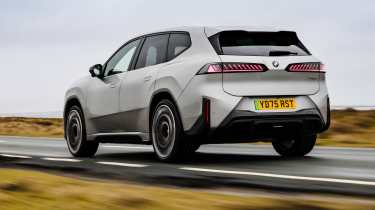
This clever battery is not only huge and efficient, it’s also capable of accepting charge at speeds of up to 400kw, almost twice that of the current i4 M60. That means that should you find a compatible charging station, you can gain 231 miles of charge in just 10 minutes. When you consider that the incoming Neue Klasse i3 saloon will be a lower, more efficient take on this package, it’s quite clear that BMW’s new range ought to cause some disruption.
BMW will be launching a more basic, cheaper iX3 variant with a smaller battery pack at a later date, but for now, the 50 xDrive combines power from a motor on the front and rear axles for an output of 463bhp and 476lb ft of torque, exceeding that of the more expensive combustion-powered X3 M50. These numbers do put it quite a way behind Volvo’s 500-mile capable alternative in the 671bhp EX60 P12 AWD, but you’ll have to pay over £6000 more for the privilege.
Performance, ride and handling
There’s no dedicated start button in the iX3. The brake pedal acts as the car’s signal to engage its systems, and it’s changes like this that make it very clear that BMW has reconsidered every aspect of the experience. It even seems it’s tried to redesign the steering wheel for this car, making it a very… erm, unusual, chunky four-spoke item in standard-trim – our M Sport Pro car comes with a slightly more conventional two-spoke wheel which thankfully has a much thinner rim.
Set off and the first thing you’ll notice is the lack of regenerative braking in its default mode. The iX3 free-rolls out of the box for efficiency purposes, using ‘adaptive’ regenerative braking to increase deceleration when it feels you need it most. This can be a little disconcerting at first as off-throttle deceleration and required braking effort are rarely the same, but a few hundred miles behind the wheel allows you to understand the best way to approach it.
Pull back on the gear selector for ‘B’ mode and you can engage normal lift-off regenerative braking for strong one-pedal driving, but leaving the systems as they are makes the iX3 most efficient. This also unlocks neat features like ‘soft stop’ which allows you to make freakishly smooth limousine stops almost every time. This feature makes use of the new-to-Neue Klasse centralised ‘Heart of Joy’ control system, drastically improving processing efficiency to have each element of the car work in perfect harmony. In this case, it allows the system to make minute, fine adjustments to regenerative braking as you’re coming to a stop, blending its inputs with your own for the smoothest stop possible.
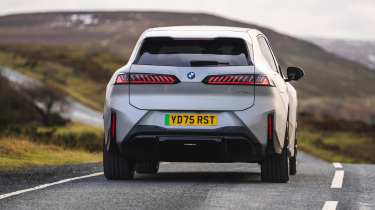
This Heart of Joy system not only improves processing power and speed, it also allows for the removal of 600m of wiring from the car that would previously be run to independent systems. It’s upgrades like this that have allowed BMW to achieve a weight figure of 2360kg, which while hardly lightweight, is just 75kg heavier than the i4 M60, despite the iX3’s increased size and a battery pack with over 27kWh more capacity.
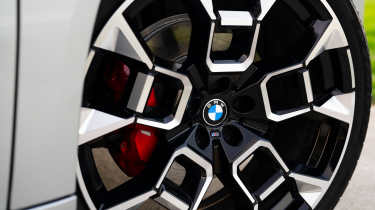
Our M Sport Pro car comes with huge 22-inch wheels on 35-profile wheels, which probably isn’t the best option should you frequently encounter potholes – standard cars come with more UK-friendly 20-inch wheels on 45-profile tyres. Nevertheless, ride is good in all modes, excellent on the motorway and at high speeds with only low speeds allowing the worst imperfections to make themselves known. This is a great car to cover miles in, with refinement excellent and spring rates well-judged for our motorways.
Head onto a B-road and things aren’t quite as rosy. Steering is reasonably responsive but the rack is slow and should you request a sudden direction change, you’re soon reminded of its kerb weight. The iX3 isn’t the worst offender by any measure, but that comfortable ride means you trade some body control for comfort, with the chassis gently heaving over the worst bumps and dulling the iX3’s response to your steering inputs. It’s not a car that encourages you to hustle, but for maintaining speed over a roundabout for efficiency purposes, it does have grip in abundance.
Its 463bhp feels just as strong as it looks on paper, with more pull than you’d ever reasonably need for everyday driving – 0-62mph in 4.9sec is hardly slow, but that does put it behind the X3 M50, equivalent Tesla Model Y and the aforementioned Volvo EX60 P12 AWD. Throttle mapping is soft-edged and well measured in its standard modes and while Sport does tighten things up, the iX3’s character encourages a smooth, refined driving style as opposed to one where you push on. If you do though, the brakes do a good job of bringing you back down to a stop, with strong regenerative braking taking a good portion of the load from the friction brakes.
If you don’t actually want to drive the iX3 at all, you won’t have to wait too long. BMW’s launching ‘Assisted driving’, developed in partnership with US semiconductor manufacturer Qualcomm this July in the UK which will utilise the iX3’s in-built hardware to navigate hundreds of miles of the motorway network, without any physical inputs from the driver (in theory) – simply look at your mirror to check for oncoming cars and the iX3 will change lanes and depart the motorway for you, completely hands free. Based on our test of its impressive new self-parking function, one that might finally be consistent enough to start gaining some traction outside of tech demos, it’ll be interesting to see how this progresses.
Interior and tech
The iX3 performs the same light dance we’ve come to expect from any car in this segment on unlock, illuminating the entire front facia, pop-out door handles and puddles around the car with a projection of the M logo. This is because our test car is equipped with the £4000 M Sport Pro package, equipping additional exterior lighting and more aggressive trim as standard.
If this wasn’t to your taste, the interior won’t be either. That steering wheel is one of the more divisive designs we’ve seen, but thankfully it’s a lot less unconventional to use than it is in its looks. Two transparent ‘pads’ provide access to a number of controls for cruise, media and the displays, and while they don’t feature independent buttons, they provide solid haptic feedback to confirm your inputs. To prevent information overload, the buttons you’re most likely to use next illuminate and change colour depending on the scenario.
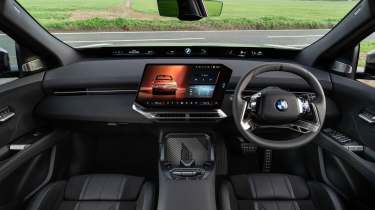
It feels like there’s been a conscious effort to make the iX3 a pleasant car to use day-to-day, with minimal actions required for any given task. Speed warning and lane departure buttons are placed in a permanent tab on the central infotainment display to the left of the wheel, and one of this car’s biggest new features is designed specifically to reduce fatigue too.
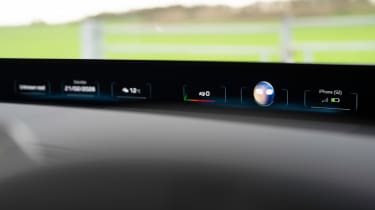
Named ‘Panoramic iDrive’, the iX3 comes as standard in the UK with a slim display spanning the full width of the dashboard, just at the base of the windscreen. While the neat way in which these three displays are integrated into the package is impressive, it also has a real purpose. Repeatedly focussing your eyes on the road, then all the way back down to the infotainment display besides you causes fatigue over time, but having key information accessible at a glance on this full-width screen does provide some real relief on long journeys – you can even option a sharp head-up display to add another level to this equation.
This is a very spacious cabin and while you don’t get a completely flat passthrough in the front like in models from Hyundai and Kia, you do get that in the back. BMW says rear space is more akin to an X5 than an X3, and we believe it – boot space is 40 litres down on the combustion-powered X3, but you do get an underfloor compartment plus a sealed cable storage compartment under the bonnet for added practicality.
Steering wheel aside, the iX3 takes clear notes from the design of the standard X3. There’s plenty of backlit, textured fabric atop the dash which adds a nice premium touch, and the seats are upholstered in a clever recycled material that’s designed to be easily recycled at the end of its life. The phone charging pad, gear selector and door controls have very clear ties to the X3, and while that does make them familiar, it doesn’t necessarily make them good – these elements feel quite hollow and cheap to the touch, which falls out of line with the quality of the powertrain and tech in this car. The lower door cards are also constructed from hard plastics, and while the software seems snappy for the most part, we did experience a few hitches and bugs during our time with the car.
The cabin of the iX3 is a very quiet place to be no matter the road or speed, with wind, road and powertrain noise some of the best in its class, even on the larger 22-inch wheels with skinny 35-profile tyres. You don’t get any of that odd synthetic Hans Zimmer sound in its standard mode unless you really push on, as this only comes into play when in Sport mode, but what you do get is the constant sound of the cooling fan behind the wireless phone charging pad in the centre console – a small but noticeable point in a car so quiet.
BMW has worked hard to introduce more customisation to this car, so buyers can tailor their user profiles to suit their needs prior to delivery. Once you have the can you can place custom widgets and rearrange the Panoramic iDrive display to suit your use case, with parking the car remotely or simply setting climate control possible from within the mobile app – even passengers can access these functions, allowing for access to media controls and climate without touching the central display in the front. Real-world use of features like this is limited in my experience, but it’s nice to know they’re there.
Price, specs and rivals
Direct rivals for the BMW iX3 are surprisingly limited, as while there are endless EVs on the market, the majority target a lower price point, sacrificing specs in the process. Volvo's new EX60 is the closest on-paper though, starting from a very similar £56,860. The catch is that to get its headline 503-mile WLTP range figure you'll need to opt for the range-topping P12 AWD Electric which costs from £64,860, £6105 more than the iX3. For that extra outlay you do get much more performance though, with power standing at 671bhp for a 3.9sec 0-62mph time.
The Tesla Model Y is perhaps the car most will cross-shop it with and comes in at a slightly lower £51,990 price point should you opt for the Long Range All-Wheel Drive model with 391 miles of WLTP range, and a 4.6sec 0-60mph to beat that of the BMW. For a little more than the iX3 you can have the much quicker Performance with a 360-mile WLTP range and a 3.3sec 0-60mph time.
For around £50,000, Hyundai offers the Ioniq 5 rear-wheel drive with its larger 84kWh battery pack. Even then, this pack is a whole 24.7kWh smaller than the BMW's and so WLTP range comes in at a maximum of 354 miles. Being the rear-wheel drive model, there's also a significant sacrifice made to performance in the pursuit of range, with output standing at a modest 225bhp.
While a single iX3 variant limits the lineup at the time of writing, BMW will launch a cheaper entry-level model with a small battery pack in not too long. While this will lose that 500-mile range figure, it will undoubtedly come in at a lower price point than this higher-spec car.
BMW iX3 50 xDrive specs
| Powertrain | Dual-motor, all-wheel drive |
| Power | 463bhp |
| Torque | 476lb ft |
| Battery size | 108.7kWh |
| Weight | 2360kg |
| Power-to-weight | 196bhp/ton |
| 0-62mph | 4.9sec |
| Top speed | 130mph |
| Basic price | £58,755 |
