Bentley Bentayga review – Range Rover rival is a school-run bus fit for a king
Bentley’s Bentayga soldiers on some 10 years after its launch. Improved over the years, it’s still a commendable luxury SUV
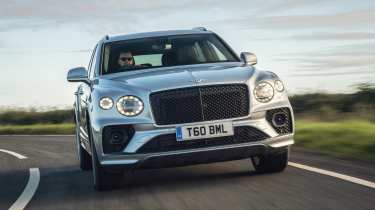
Bentley was first to throw its hat into the ring to face the Range Rover head on in the luxury SUV space all the way back in 2016. The model it sells today, while nipped, tucked and tweaked over the years, shares the same basic bones. It is however a much improved car than the original, following more than a decade of optimisation.
To date, it’s been one of Bentley’s most successful models, supercharging its volumes and bolstering its profitability. Bentley announced earlier in the year it had been profitable for seven straight years up to the end of 2025, in spite of recent industry headwinds. The company crossed the 15,000-unit yearly sale barrier for the first time in 2022, with the Bentayga accounting for 42 per cent of those sales. It’s still popular in spite of its age, but has the Bentayga moved with the times and its rivals enough to stay competitive?
Engines, gearbox and performance
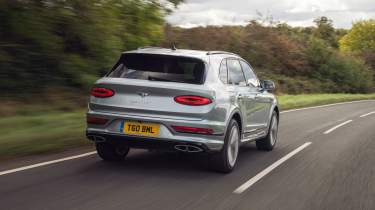
- W12 engine now dead – 641bhp V8 Speed leads lineup
- Bentayga does not receive the latest hybrid tech
- Non-hybrid V8s and PHEV V6 now the only options
The Bentayga engine lineup has evolved significantly over the years, though all its various engines have put power to all four wheels via derivations of ZF’s eight-speed automatic gearbox. The model was only ever at most in a class of two (with the Rolls-Royce Cullinan) in the absurdity of offering a 12-cylinder engine in an SUV.
More reviews
Reviews
- Bentley Bentayga Speed 2025 review – should the Aston Martin DBX need to worry?
- Bentley Bentayga EWB 2022 review – a new Mulsanne?
- Bentley Bentayga S 2022 review
- 2020 Bentley Bentayga review – facelifted luxury SUV driven
- Bentley Bentayga V8 – new twin-turbo V8 results in best Bentayga yet
- Bentley Bentayga review – the ultimate luxury SUV?
- Bentley Bentayga Diesel review - continent-crossing comfort comes at a price
The 600bhp 663lb ft W12 with which it launched afforded it the title of ‘fastest SUV in the world’ when new, with the lump leaping to 626bhp in Speed specification. The engine was redesigned compared to its first iterations in the original Continental GT, gaining twin-scroll turbochargers to improve response and cylinder shut-off tech to reduce emissions. That only borrowed it time though; the W12 has now been discontinued, along with the short-lived 429bhp 664lb ft diesel V8.
The W12 was enormously potent and certainly smooth enough to fit the Bentayga’s luxury billing. Nonetheless it was always the ubiquitous 4-litre twin-turbo hot-vee V8, added to the lineup in 2018 and found across the Volkswagen Group from Porsche’s Panamera to Audi’s RS6 and Lamborghini’s Urus, that best-suited the Bentayga and still does now. Its lower weight makes the nose feel less burdened and there was no discernible loss in character. In fact, so muted was the W12, that the V8 actually added life to what was up to that point a swift but staid luxury SUV.
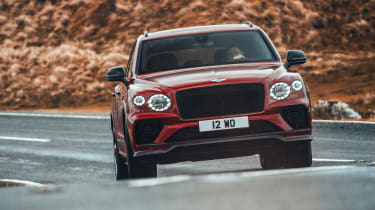
The current Bentayga Speed’s 641bhp, 626lb ft 4-litre twin-turbo V8 is actually more powerful than any of the W12 variants, allowing it to hit 62mph in 3.9sec on the way to a 193mph top speed. Its gains are made via bigger turbos, increased boost and a higher-flow fuel injection system. It’s also snappier to respond thanks to revised gearshift mapping.
In its base tune, it’s still the core engine in the current Bentayga lineup in 542bhp, 568lb ft form in addition to the PHEV. The plug-in model has 456bhp and 616lb ft, courtesy of its twin-turbo V6 and electric motor. The PHEV with its 17.3kWh battery does of course weigh over 200kg more than the V8 and as such, its 456bhp and 516lb ft don’t deliver the most spectacular performance numbers, with the 0-62mph sprint taking 5.5sec. The Bentayga has yet to be adapted for the new hybrid powertrain of the latest Continental GT and Flying Spur models, which use a larger 25.9kWh battery and augment their V8s with an electric motor.
As powertrains go even the base V8 is as strong as an ox, hauling the Bentayga’s 2416kg (unladen) weight around without a fuss, the eight-speed gearbox a willing companion that works impressively hard to keep its shifts as seamless and unobtrusive as possible.
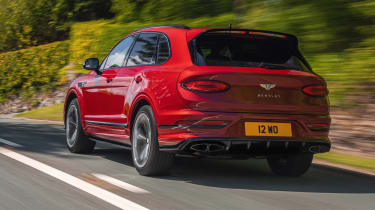
The Speed as you’d expect ups the ante, with added potency and intensity to its V8’s delivery. The most noticeable surge comes from both V8 engines is in the mid range, with the maximum torque figure largely tailing off after 4500rpm, even though the full 641bhp of the Speed arrives at 6000rpm. Either way, you don’t miss the W12 in performance terms.
The optional (£7740) titanium Akrapovic exhaust isn’t for shy and retiring types (if anyone that could be described as such would be interested in a Bentayga) giving it thunderous vocals too, even more so than the most potent GT and Spur models.
It’s worth noting the Bentayga’s four driving modes: Comfort, Bentley, Sport and Individual. Unless you’re driving the Bentayga on its door handles, keeping it in Bentley rather than Sport gives you all the performance and response you could need.
Ride and handling
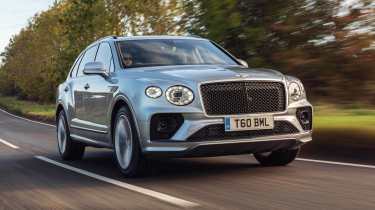
- Bentayga uses a modified version of the MLB Evo platform
- Air springs with adaptive dampers
- ‘Dynamic Ride’ features 48-volt active anti-roll bars and rear-steering
Bentley would rather you not talk about it too much but the Bentayga’s bones are closely related to those under the skin of Audi’s Q7, Porsche’s Cayenne and yes, even Lamborghini’s Urus, riding as it does on the MLB Evo platform. The fundamental technical make-up of the Bentayga hasn’t really changed over the last 10 years.
However Bentley has continuously improved and added to the Bentayga’s dynamic arsenal, to evolve it from the flawed machine it started out as, to one of the most complete, if not dynamically sensational, cars of its class on sale today. From the steering feel to spring and damper rates, Bentley hasn’t rested on its laurels with the Bentayga.
Key to getting the best out of the Bentayga is the now-standard Bentley Dynamic Ride system, which includes both the 48-volt active anti-roll system and the rear-wheel steering system. The former can decouple to aid comfort, or apply 1300Nm of force to act against body roll, reacting within 0.3sec. The rear-steering meanwhile steers against the fronts to make the car feel smaller in low-speed maneuvering and more nimble and responsive on turn-in, and steers with the fronts at high speed for greater stability.
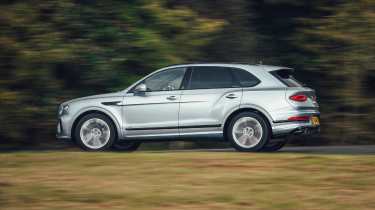
Today’s Bentayga certainly drives better than the original, predominantly because it feels more tightly tied down, precise and reactive thanks to the slack having been ironed out of the chassis, air springs, dampers and steering systems. The experience from the driver's seat now matches your expectations, with a higher level of sophistication to how the Bentayga’s chassis reacts to imperfections in the surface and deals with the reaction.
It also feels more together, more controlled and resolved than the original while at the same time upping the refinement levels in terms of noise suppression in the cabin and low frequency noise through the steering and chassis. The original Bentayga never settled, there was always a degree of body roll and a minor steering adjustment required to keep it all on track. We’re not talking Herculean inputs, rather constant tweaks that, over time, rubbed away the quality of the experience.
Now there’s a solidity and precision to how it drives with no loss of refinement through the cabin. It’s no Aston Martin DBX when it comes to dynamics and feedback, with the Bentayga preferring a seven-tenths approach rather than being stretched to its limit. It is however a step on from a Range Rover when you need to press on and take advantage of the V8’s resources.
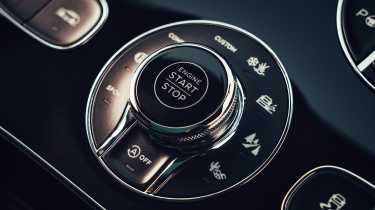
The S (that's now off the configurator) has the standard 542bhp engine but features spring and damper rates that were recalibrated to increase control, firm up the ride and better manage body roll, with the standard-fit air-suspension also tweaked to provide firmer support but not at the expense of comfort. The result is that in the Bentley or Comfort driving modes the Bentayga S feels more tied down, the pitch and roll eradicated to an extent that it’s only really now there to feed back when you’re beginning to push on it.
In the Speed there’s a new Dynamic ESC mode that loosens the shackles of the electronic systems further and allows you to fully explore its surprising throttle adjustability. Turn in with aggression and a glob of power and the four-wheel-drive system will send torque to the rear axle, at which point the e-diff sends it to the outside wheel.
This along with the rear-steering aids the sense of agility and, in excess, will deliver one of the most incongruous bouts of oversteer in all of motoring. It’s still no Range Rover Sport SV, Ferrari Purosangue or Aston Martin DBX S in terms of a fully cohesive feel, but it puts in a fine effort for such a sumptuous and imperious monster. It also stops a lot more consistently with the optional carbon ceramic brakes.
Interior and tech
- More customisability than ever via Bentley’s ‘Mulliner’ program
- Sumptuous and refined
- A few hints of shared componentry
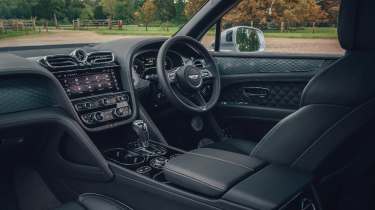
The Bentayga is as ostentatious inside as it is out. Clamber inside and you’ll find swathes of quilted leather, incredibly intricate wood veneers and handcrafted details all over the place, as you would in any Bentley. It’s all very lovely, but try not to prod too hard or you may find certain controls or features that have more than a whiff of ‘Audi’, albeit with a touch of knurled or chrome finish.
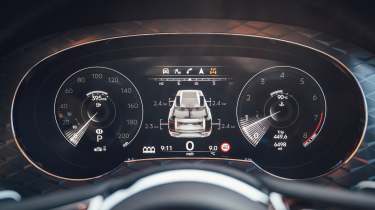
The most noticeable upgrades inside between the pre- and post-facelift models are to the tech, with a digital instrument cluster replacing the analogue dials, an upgraded, larger infotainment screen and reprofiled air vents. To be clear, the updated Bentayga is a step up from the original. On top of being better put together, it’s more customisable, with the traditional wood’n’tan approach joining more esoteric and dare we say it, youthful spec options.
Nonetheless, the new Bentayga also feels more Bentley-like. There’s a considerable step up in design, quality and a sense of being in a car that is hand-finished by a dedicated and immensely talented team of craftsmen and women.
From the instrument display ahead, the touchscreen to your right and the auxiliary controls around it, the fit and finish is elegant, solid and a reminder that Bentley can finish an interior like few others. Although a Conti GT and Flying Spur still feel more bespoke.
MPG and running costs
- Rare diesel is the most frugal Bentayga
- PHEV makes the most sense for urban motoring
- V8 more efficient than the W12 at least
Fuel economy will be an alien phrase to most Bentley buyers, but owners of the W12 can expect mpg figures in the late teens in real-world driving – compared to Bentley’s official figure of 21.6mpg. We’ve found the V8s to be a bit more efficient, capable of delivering figures in the low to mid 20s with mixed driving. Over a long run it wouldn’t be unreasonable to hope your V8 Bentayga is capable of delivering 350-400 miles on a tank of super unleaded.
For those seeking out a Bentayga with which to do lots of loping motorway miles, the rarified V8 diesel might be worth seeking out. Only sold between 2017 and 2018, it was capable of between 30 and 35mpg on a run. Bentley still sells the plug-in hybrid model, but it doesn’t share the bigger battery of Bentley’s other models. As such, it’s realistically only good for 15-20 miles of electric driving, though it’s still the best Bentayga if you can plug in at home and your driving is mostly short distance or urban.
All Bentaygas (bar a used hybrid that no longer incurs the expensive car supplement), are expensive to tax. All Bentaygas (bar none) are expensive to maintain, though savvy owners can work with specialists on shared componentry that’s cheaper with a VW or Audi logo on it than a Bentley symbol.
Price and rivals
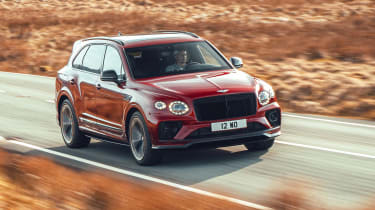
The Bentayga is, as you’d expect, in rarified air when it comes to price, starting from £179,900 for a standard hybrid and £182,600 for a standard V8. The more luxurious Azure trim sees prices rise to £210,700 and £217,300 for the hybrid and V8 respectively. The Speed starts from £223,600, before you’ve added the ceramic brakes (£10,370), Akrapovic exhaust (£7740) and upgraded Naim audio system (£7350). Our Speed test car with options was almost £300,000.
Rivals to the Bentayga depend on what flavour of SUV you’re in the market for. The sportiest, 641bhp Speed model for example, can count the Range Rover Sport SV (from £146,195) and Aston Martin DBX S (from £210,000) as direct-rival super-SUVs that lack the complication of hybridity and focus on driving thrills. For the same money, the DBX certainly feels the more complete, satisfying driver’s car, while the Range Rover is a value proposition, with that extraordinary 6D cross-linked hydraulic suspension and BMW M-sourced 4.4-litre twin-turbo V8.
As a luxury car, the Bentayga is almost without peers. The latest Range Rover SV runs it mightily close from £181,400, though the Bentayga sports a more prestigious badge and for some, its more traditional cabin will hold greater appeal. There’s also Rolls-Royce’s Cullinan, if the Bentayga strikes you as being a little on the subtle and cheap side… Then comes the usual reminder that luxury saloons exist too. You could have a lot of Mercedes-Benz S-class or indeed a Bentley Flying Spur, with the best of V8 and hybrid worlds, for strong Bentayga money.
At 10 years old now there are plenty of Bentaygas on the used market to choose from. Many have depreciated to the point of being purchasable for the cost of the options alone on our latest Speed test car. As the most family-friendly Bentley to date, many have done big miles too, with a few of the cheapest (circa £40-45k) in the 70-80,000-mile range. Needless to say, full service history, a clean, long-lasting MOT and an appealing presentation – no damage, premium tyres, good life in the brakes – are desirable, and make sure the air springs are working as they should.
| Bentley Bentayga PHEV | Bentley Bentayga V8 | Bentley Bentayga Speed | |
|---|---|---|---|
| Engine | V6, 2995cc, turbocharged | V8, 3996cc, twin-turbo | V8, 3996cc, twin-turbo |
| Power | 456bhp | 542bhp | 641bhp |
| Torque | 516lb ft | 568lb ft | 627lb ft |
| Weight | 2645kg (170bhp/ton) | c2416kg (228bhp/ton) | 2391kg (272bhp/ton) |
| 0-62mph | 5.5sec | 4.5sec | 3.9sec |
| Top speed | 158mph | 180mph | 193mph |
| Basic price | £179,900 | £182,600 | £223,600 |