Audi TT (Mk3, 2014 - 2023) review – no Porsche Cayman rival but still a modern icon
Audi’s coupe rarely pretended to be a proper sports car in the traditional sense, trading instead on inimitable style and enviable quality
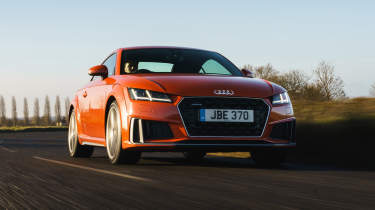
The Audi TT is probably the closest thing to a modern-era icon. It stunned all on its debut, was loved by many throughout its three-generation life and even now, three years on from its discontinuation, the chasm it’s left in Audi’s range hasn’t closed up. Audi showrooms are decidedly less interesting for not having the TT to brighten them up. It was never a driver’s icon, mind. It was never in the running to truly trouble Porsche’s Boxster, or the Cayman that came later, as authentic, wholly rewarding driving tools. Some versions were sweet enough, a few had really enjoyable charismatic engines. But by and large, the TT went out as it came in, as a style icon first and foremost.
Introduced in 2015, the Mk3 evolved the TT silhouette with Audi’s sharper design language, while retaining plenty of its engineering hallmarks and points of universal appeal: aluminium bodywork, dual-clutch and manual transmissions and a range of engines, from 1.8-litre and 2-litre petrols, to a hot five-cylinder in the TT RS, and even diesels. It’s a car that represents a high point for fit, finish and quality, predating post-dieselgate cost-cutting and feels thoroughly contemporary today. That’s saying something for a car that debuted over a decade ago.
Engines, gearboxes and performance
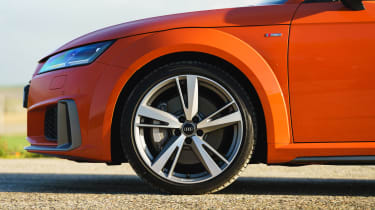
- Range of four-cylinder petrols headed by the 316bhp TTS
- Offered initially with a 2-litre diesel that was later discontinued
- TT RS was the five-cylinder flagship, bowing out with close to 400bhp
More reviews
In the end all Mk3 TTs bar the RS featured a 2-litre turbocharged four-cylinder engine with 194bhp, 242bhp and and 316bhp in the flagship TTS. The V6 of the previous generations didn’t carry over and while the Mk3 did launch with a 2-litre TDI and an entry-level 1.8 TFSI, these were later discontinued for the 2018 facelift. With the update, the TT also dropped a manual gearbox option, with a dual-clutch seven-speed the only transmission available for its final years.

TTs are all built on the Volkswagen Group MQB platform, meaning the engines are transversely mounted and the all-wheel-drive system is therefore front-biased, with a centre differential shuffling power rearwards when slip is detected. The quattro system was standard on the TTS and RS and optional on the more powerful standard four-cylinder option and the diesel.
The S-Tronic (Audi’s name for DSG) gearbox offers snappy shifts, but does have a habit of slurring through the gears for the sake of smoothness, if not clutch life, around town. Increasingly stringent emissions regulations forced manufacturers to calibrate them for maximum efficiency, which can make the gearbox feel sluggish when left to its own devices. Knock the lever back into Sport mode and the response does sharpen, but so too does its desire to hold unnecessarily low gears for rather too long.
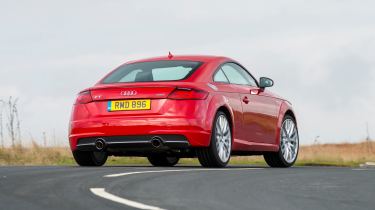
Although the base-model TT feels and sounds a little flat, it delivers impressive acceleration figures, with the entry-level car reaching 62mph in 6.6sec, and the more powerful 45TFSI quattro in 5.2sec. Naturally, the diesel and the 1.8 are the motors that are most out of sorts character-wise in the TT’s svelte body. All the same, the TDI’s combination of torque and efficiency has its own appeal.
As with most Audis, you can adjust the demeanour of the car via the Driver Select menu. Pre-defined Comfort, Auto and Dynamic modes tailor the dampers, steering and engine in the usual fashion, or you can have it your own way and mix-match the various settings to your individual taste, something we’ll come back to later.
The TTS has the same basic EA888 engine, DSG transmission and all-wheel drive system as lesser TTs, but has a much more potent 316bhp and 295lb ft of torque – good enough to enable the car to sprint to 62mph in 4.5sec and on to a limited 155mph top speed.
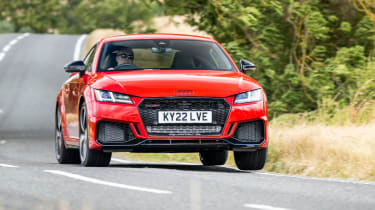
The acceleration figures were certainly quick enough to put the TTS ahead of its closest rivals (a Porsche 718 Cayman took 4.7sec even with a PDK ’box and Sport Chrono pack) and while the Audi’s four-pot isn’t stirringly musical, there’s a pleasing edge to its voice under load and you do get a crackle of aural fireworks on a trailing throttle. The engine pulls cleanly and strongly, with a linear delivery for a turbocharged unit.

The flagship TT RS is the only model in the range with a different powertrain, and generates 395bhp and 354lb ft of torque from an in-line five-cylinder turbo engine. For the facelift it was updated with new exhaust particulate filters and lost some of its wonderful warble in the process, but it still hits incredibly hard and has a special character.
The TT RS is by some margin the quickest TT, reaching 62mph in just 3.7sec. It's a fantastic engine too, with a spine-tingling whip-crack soundtrack that elevates the RS to another level above the TTS. Performance might even exceed Audi's own claims, with a brief test on the RS's launch revealing a 3.4-second sprint to 60mph. Either way, the engine and gearbox is a potent combination, delivering near-supercar performance in the TT RS.
Ride and handling
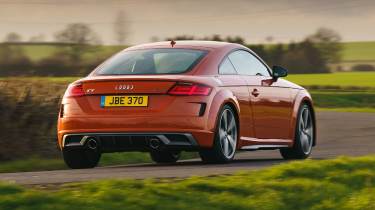
- Adaptive dampers were optional on lower specs, standard on TTS and TT RS
- All TTs have a punchy ride quality
- Not the most playful chassis but reasonably balanced
The TT went out in familiar form, as a stable, nose-led car with less off-throttle adjustability than many hot hatches, and a less involving driving experience than a ‘true’ traditional sports car. But that’s not to say it’s a dull car, and in Mk3 guise it was certainly a sharper drive than before.
Its attitude can still be manipulated on the brakes and a trailing throttle, and lateral grip and braking performance are remarkable, particularly in the hotter TTS and hottest TT RS variants.
A refresher drive in facelift TTS is a reminder just how swift a car this is, and it feels more alert and responsive than its reputation, and memory, serves. The steering is light (almost disconcertingly so in Comfort mode) and remains lacking in feel, but it’s quick and eager to respond. While the overall handline balance is still toward understeer, it changes direction eagerly and the corner-speed it can carry is eye-opening.
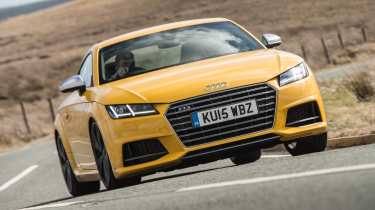
The brakes are strong but sensitively servo’d, and take a little getting used to. Ride quality on the TTS’s standard-fit adaptive dampers is very choppy in Dynamic, and far smoother in Comfort, although the car still gets a bit upset and unsettled by rough B-roads. It’s worth noting however that the Mk3 TT in lower specs sports a tough ride even without the adaptive damper option.
In the UK we’ve tried the car on Bridgestone Potenza S001 rubber rather than the Hankooks that have been fitted to previous TTs we’ve tested. The biggest difference is a pleasing reduction in road noise, and they also feel a little more malleable and progressive.
In the fabric-roofed TT Roadster, refinement on motorways and longer journeys is impressive. You lose the (negligible) practicality of the coupe’s small back seats but with the canvas folded away you get as much wind in your hair as you want (or as little: there really isn’t much ruffling if you’ve got the windows up).
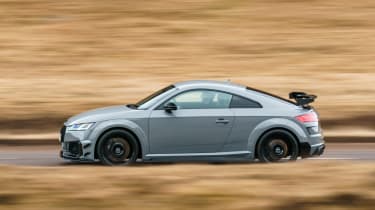
The TT RS is rapid but not the most engaging of performance cars for all tastes: the steering is rather lifeless, and it can be something of a point and squirt machine.
Since the grip levels are so high, rather than feel out the limit of grip in every corner it’s a case of getting on the accelerator early, sensing the torque shuffle rearward to straighten your line (there isn’t a torque-vectoring rear diff on the all-wheel-drive system, so torque is managed front-to-rear, rather than side-to-side) then fire off down the next straight. Very quickly.
That’s not to say there’s no fun to be had: the brakes are remarkably strong and the TT RS can handle rapid-fire direction changes in its stride (no doubt aided by the sometimes comically/painfully firm suspension, even in the adaptive dampers’ softer settings). Find the right sequence of turns and the speed at which it can dissect them can be genuinely sweaty-palms exciting.
Interior and tech
- Still a high watermark for quality
- Design is clever and attractive, only elevated by solid quality
- Decent view out and decently practical – a compromise between most sports cars and hot hatches
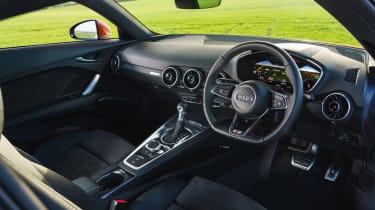
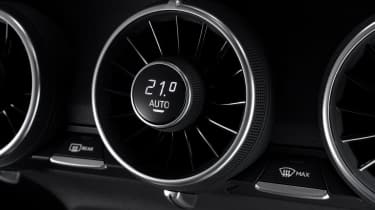
The original round vents in the dashboard of the first TT evolved for the final TT, looking more than ever like beautifully miniaturised jet engines pinched from a Boeing. They were also given a technical twist, with digital readouts placed at the centre of the vents with the right option ticked.
Settle into the driver’s seat, wake the electrics, however, and a beautiful 12.3-inch screen comes to life in place of traditional dials, filling the instrument cowling with jewel-like graphics. You can toggle between a conventional two- dial layout, a big central rev-counter (TTS and RS only) and a screen mostly filled with a satnav map. There’s no traditional central infotainment screen, which adds a timelessness to the cabin but does leave your passenger slightly out in the cold.
A decade on from launch, the digital instrument cluster’s graphics are now looking dated, especially the basic map graphics, though it’s all still intuitive. The instrument panel’s bright display can be weary at night – like sitting a bit too close to your laptop screen.
Telephone, media, trip and car setting functions all appear on the screen and can be controlled using both the touch-sensitive MMI controller or the multi-function wheel. And everything inside the Mk3 TT is a pleasure to use. There’s a satisfying expensive action and click to all the controls and this sense of quality – that it shares with the R8 supercar – hasn’t really returned to Audis following a spate of costcutting in the late 2010s.
A prominent din of tyre roar can make larger-wheeled TTs quite tiring on a long journey. The driving position can be wearing too if you’re long-legged. The TT’s chop-top coupe dimensions mean it doesn’t have the same broad range of adjustment and spot-on ergonomics of the A3/Golf family it’s distantly related to; the steering wheel can’t come out quite far enough, meaning you may need to adopt a legs-akimbo driving position.
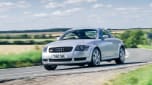
Considering its style-led design, the TT coupe is reasonably practical. It’s almost exactly the same length as the Mk2 TT, but the wheelbase has grown by 37mm, liberating a teeny bit more interior space. The rear seats however are still tiny and only really suitable for occasional use, even by small children.
As before, the rear seatbacks fold flat, and the TT’s long tailgate provides good access to the luggage area. Think of the TT as a two-seater with a big (if shallow in terms of height) boot, and you won’t go far wrong. That gives you a very decent 712 litres of luggage space. And even with the rear seats in place you still get 305 litres – 13 more litres than the last-generation TT.
MPG and running costs
- Diesel coupe the most frugal, weird though it is
- Quattro system sensitive to tyre choice and mismatching
- Even the petrol four-pots can achieve c/40mpg
Relative efficiency is a welcome attribute of VW’s four-cylinder engines. Entry-level models can crack (an achievable) 40mpg on the WLTP cycle, with the 242bhp models slipping just below that. Quattro models suffer a bit efficiency wise, with even the 2-litre diesel struggling to touch 50mpg in the real world so-equipped.
The calibration of the standard-fit seven-speed DSG is partly the source of these strong efficiency figures, but so too is the relatively lithe 1280kg kerb weight of front-wheel-drive 40TFSI models. Quattro models add a further 100kg or so to the total.
A TT can be barely more taxing to run financially than an Audi A3, with little in the way of exotic materials or high-stress components, short of the rubber band-like 30-profile of the 20-inch tyres standard on the top-two trim levels. However Quattro cars demand diligence when it comes to tyre choice and can throw faults if you mix and match. They also demand diligent servicing per the stated intervals.
Price and rivals
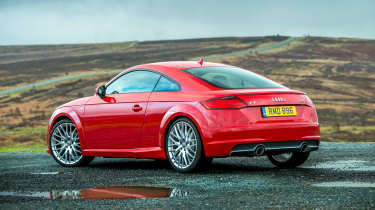
The Audi TT left the market priced from £36,000 for the base 40 TFSI, rising to over £60,000 for the wild warbling TT RS. At the time of writing, low-spec low-ish miles early Mk3 TTs can be had for under £15,000. Higher specs – early TTS and facelift standard models – are priced closer to £20,000 and beyond. TT RS prices range from the mid-£20,000 range right up to over £40,000 for the newest, lowest-milage cars.
Good service and MOT history should be a given, especially as these cars can be sensitive to neglect. Quattro cars in particular can have diff issues if not serviced as they should be and have the correct, matching tyres all around. The EA888 engine has been known to have thermostat issues too. TT bodies are mostly aluminium and plastic and so, rust isn't a huge issue. However, cars that haven't been cared for as they should can get blocked drains under the active spoiler, which leads to water ingress into the number plate lights. That can be an expensive fix for the sake of an MOT, if undertaken through a dealer that will replace large amounts of componentry. Specialists can dismantle and repair parts at a smaller scale.
Few direct coupe and roadster rivals to the TT remained at the time of its discontinuation, let alone now. The Porsche Cayman, Toyota Supra, Toyota GR86 and BMW Z4 are all gone, as is Alpine’s A110. All that remains now is Mazda’s MX-5, while the BMW 2-series Coupe is still hanging on too. One new coupe has arrived in the form of Honda’s Prelude, which like the TT, is a stylish, hatchback-based pleasant-driving coupe that stops well short of being an extreme driving experience, but is satisfying all the same.
Considered with the benefit of hindsight over its four-decade-straddling run, it’s been a car with a remarkable breadth and depth of talents. In late-model TTS spec, it’s a genuinely enjoyable drive, it’s packed a great deal of design-value desirability into a platform with humble origins, and it’s easily slotted into many people’s lives and enlivened them just a little. It’s still sorely missed.