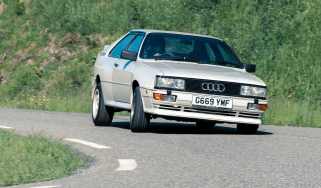
Audi Quattro restomod uses RS4 underpinnings, with an optional 10,000rpm V8
A modern interpretation of the original Quattro swaps five-cylinder power for high-revving or supercharged V8 power

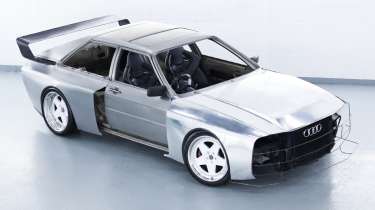
The B7 Audi RS4 doesn’t have much competition at the top of the tree of Audi’s most iconic and beloved models, though most would have it take second-step at least, to the Quattro. Audacious Automotive however has a plan to amalgamate them, clothing an RS4’s structure and mechanicals (with some notable upgrades) in a body inspired by the rallying legend. This is the Audacious IV.
The structure, suspension, hard points, geometry, braking system and electronics of the B7 RS4 are carried over. The company is keen to stress that this is a more cost-effective solution, rather than extensively re-engineering and developing the structures of existing Quattros.
As a result the IV won’t need a roll cage or other extensive strengthening measures to bring it up to modern standards, to be able to cope with the high horsepower and torque it will produce. The challenge is in adapting the RS4’s proportions to the Quattro’s aesthetic. The RS4 has a much more sloping windscreen, for example. It also ought to be no less drivable or habitable, depending on how the customer has the car set up, than the RS4 on which it’s based.
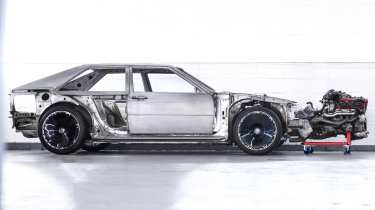
The full drivetrain is carried over, though not kept standard. The company will offer differing states of tune, with up to 750bhp from an upgraded version of Audi’s 4.2-litre DOHC FSI V8. It will achieve this using a TTS supercharger, along with commensurate supporting internal upgrades. The engine’s character will be ‘defined by supercharged force, torque and breadth’. The six-speed manual transmission and all-wheel drive system carry over from the RS4 and will be upgraded to suit the increased power and torque demands if required.

A second version of the V8 will be offered however, which sounds even more enticing. All we know is that the target is a 10,000rpm redline, its remit being ‘throttle response, induction and exceptional rotational character’. That’s a 20 per cent higher limit than the standard RS4 and a 43 per cent increase in stress on internal components.
The specifics of the changes being made are to be revealed but suffice to say, it’ll be an extensive lightweighting and strengthening package, to achieve those revs reliably. Power and torque figures are TBA, though given that this engine will build upon the peaky, high-revving nature of the existing engine, a driveline-troubling torque figure is unlikely to accompany a surely ear-melting soundtrack.
If you’re wondering why the five-cylinder turbo (or entire platform) of the RS3 wasn’t used, that would have ruled out the use of a manual transmission. The structure, longitudinal engine and rear-biased four-wheel drive syste of the RS4 is preferable too.

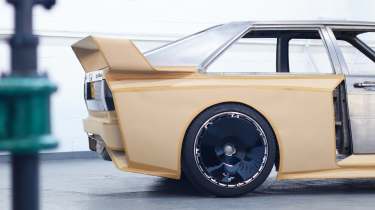
The Quattro bit is of course in the bodywork and design, using real Quattro components to develop, then marry to the RS4 substructure. Audacious plans to offer both a steel and aluminium body and a carbonfibre body. The metal bodies, being hand-formed, mean that buyers can customise the car’s dimensions at a reduced expense by comparison to carbon.
The carbonfibre cars, which will still take the RS4’s bones as their underpinning, will be fixed as far as width and other dimensions are concerned. Not that the IV is looking like it’ll need much additional extroversion, inspired as it is by the Group B Quattros with its enormous box arches. The finished cars will be at least 250kg lighter than the 1650kg B7 RS4 was as standard. The carbon-body cars ought to be lighter still.
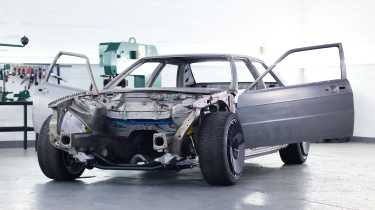
If you’re worried about precious iconic Audis being sacrificed to create these cars, fear not. Audacious plans to use cars that would otherwise be in need of an unrealistic level of maintenance and restoration, to give them a second lease of life.
The car is in development now with the structure and bodywork near-finalised and development underway on the powertrain options. Audacious will build no more than 50 examples and future models are in the works that build on the learnings from the IV’s development.