Aston Martin Vantage (1993 - 2000) review – Britain's last truly hand-built supercar
One of Aston Martin's last true hand-built models, the ludicrous twin-supercharged Vantage was a muscle car crossed with a stately home
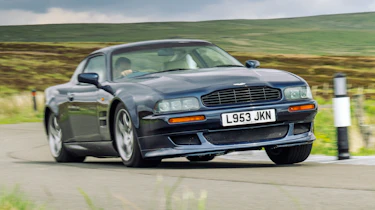
Forget Bond and his gadget-laden Silver Birch DB5. When it comes to ultimate Astons, my heart has always belonged to the big, ballsy GT flagships. From the 1970s Vantage to today’s epic, twin-turbocharged Vanquish, there’s something about these bruising machines that speaks so eloquently of the marque. To me, they will always be the quintessential Aston Martin.
Of all these rollicking flagships, it’s the Virage-based V550 Aston Martin Vantage that makes the most emphatic statement. At least to me. This could have something to do with it being introduced at a time when I was just experienced enough for Aston’s PR boss, Harry Calton, to entrust me with its humble, Ford-sourced ignition key. As a kid who’d grown up with a fascination for all cars, but especially Astons, getting near one of these hand-built, two-tonne monsters was a source of awe and wonder.
Engine, gearbox and performance
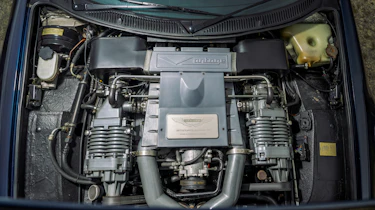
- This bespoke twin-supercharged V8 is cocophonous and overflowing with character
- It’s not as industrial as an American small-block, though
- It’s extraordinarily fast and needs its enormous torque, thanks to super long knotty gears
This brand-new breed of old-school Vantage, launched in 1993, was based on the underwhelming Virage but heavily reworked, with only the roof and doors remaining of the original shell. Not one but two Eaton superchargers were fitted to Aston Martin’s Tadek Marek-designed 5.3-litre V8, reworked by Reeves Callaway, who was also responsible for the engines in Aston’s AMR‑1 Group C racer.

The blowers boosted power to 550bhp (hence the V550 name) from the Virage’s original 330bhp, and the V8 fires up with the throaty eagerness of a stock car, with an offbeat idle and super-sharp throttle response. With 550lb ft, it developed more torque than any other production engine of the time.
More reviews
The engines were hand-built from bare block upwards, a one-man, 65-hour job. A plaque proudly proclaims this one was built by Terry Durston. Top speed topped 180mph and by decade’s end the Vantage would be a 200mph car. Production continued until 1999, by which time it had been given an extra 50bhp and 50lb ft to become the V600, Britain’s fastest production car, and its most expensive at £233,000.
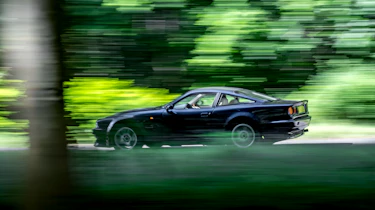
It pays to remind yourself that this is a 25-year-old car. One with 550bhp, 550lb ft and no traction control or adaptive damping to tame it. Things were different in the ’90s, so rather than hoofing down the road and trusting in an invisible electronic safety net to catch your indiscretions, you read the road ahead and weigh up all your critical inputs, ‘safe’ in the knowledge that the V550 will hold you accountable if you don’t.
> Used Aston Martin V12 Vantage (2009 - 2018) review – manual V12 for less than a Cayman
It might look the antithesis of compact, but the V550 is responsive and keen to change direction. This sense of energy is amplified by the engine, which has a sharp and, at times, abrupt delivery. At low speed this somewhat jagged throttle response can be a bit disruptive, especially if you’re blending in and out of the throttle, so care is needed if you’re not to kangaroo your way down the road.
Soundtrack-wise, it’s very clearly a V8, but with brightness and clarity to the note that’s very different to the down-and-dirty thump of, say, a Chevy small-block. And, of course, there’s the additional layer of sound coming from the Eaton superchargers, which whistle and whine as the car starts to work hard. It’s an amazingly mechanical cacophony. One that’s all the more enjoyable when you can separate the contributions made by each of those big lumps of hardware beneath the bonnet.
The V550 has a six-speed manual gearbox, though there was the option of an automatic. A popular period modification to the manual ’box was to blank off the absurdly tall sixth gear and change the final drive ratio to create a close-ratio five-speeder. With or without those mods, it’s a bit gristly and knotty to navigate the H-pattern gate, but once you get used to it, you can cut some clean shifts.
Describing the standard six-speed gearing as tall is a bit like saying Jeff Bezos is comfortably off, but such is the motor’s muscle the loping ratios don’t blunt the performance. Indeed a squeeze of the throttle in pretty much every gear apart from intergalactic sixth will lift the nose and push your head into the seat. Contemporary road tests paint an impressive picture: 0-60mph in 4.6sec, 0-100mph in 10.1sec and a top speed of 186mph. Those figures certainly weren’t messing about back in 1993, and the intervening 28 years have done little to diminish the experience those numbers represent.
This is a seriously fast machine. Not in the context of today’s supercars, but then they can’t match the Aston’s runaway-train sensation as it climbs on top of its intermediate gears. There’s also something deeply impressive about the sense of energy and physics at work in picking up 1990kg of car and lobbing it down the road with such disdain. For a party piece, select a high gear and go from walking pace to warp speed in one eye-widening, ever-intensifying lunge. It really is like a steam locomotive once it hits its stride
Ride and handling
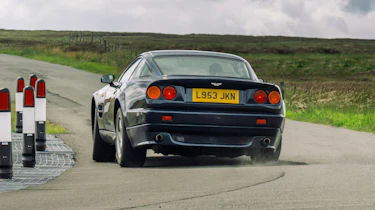
- More responsive and feelsome than you might expect…
- There’s good deal of pitch and roll, which makes it odd odd that the low-speed ride is brittle
- Its fundamental balance is trustworthy though. You can lean on the tyres more than you expect
Thankfully, the brakes give you a bit of confidence. And so they should, for the huge 362mm ventilated front discs and brick-sized AP Racing calipers were the largest fitted to a road car when the V550 was introduced. They have considerable work to do, but there’s enough bite and stamina to give them a fighting chance against Sir Isaac Newton and his pesky laws of motion. The pedal is firm, the response nicely modulated. It’s not a car that you stand on its nose on the entry to corners, but it’s reassuring to feel the stoppers have the power to live up to their name.
> Aston Martin V8 Vantage (1977-1989) review – Britain's supercar-baiting muscle car
Handling-wise, there’s a good deal more feel and response than you might expect. Like pretty much all power-assisted systems of the period, the steering is a bit on the light side, but surprisingly quick-witted. This does a good job of masking the car’s weight and size, and is backed up by an impressive keenness to turn in. There’s body-roll of a magnitude anyone weaned on 21st century GTs and supercars would be alarmed by, but, despite the lean, under lateral load the V550 works its tyres more evenly than you’d expect across the axles, with a nice sense of unity front to rear.
This natural handling balance is trustworthy and easy to read, so while you’re respectful of the car’s mass and the lack of ultra-responsive, finely tuned electronic driver aids as we know them today, the V550 finds decent grip and exhibits sufficient vertical body control for you to carry proper speed on undulating roads without undue fear of the big Aston squeezing its floorpan into the road through compressions.
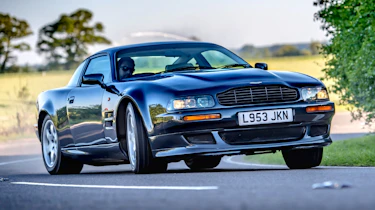
If the primary ride is reasonably supple when the suspension is working meaningfully through its travel, the secondary ride has a slightly brittle edge, with less low-speed isolation than you’d expect from a big GT. It’s not crashy or intrusively stiff, but sharp-edged potholes send a momentary shudder through the car. It’s the kind of trade-off you have to make when you’re trying to contain so much mass without the operating range of today’s adaptive dampers.

As you might imagine with such an abundance of near-instant torque, it’s easy to overwhelm the rear tyres. Goodyear Eagle GS-Ds are hardly state-of-the-art rubber, but the 285/45 ZR18 rear tyres put a sizeable slab of tread on the tarmac. Dry-road traction is strong in a straight line but, once you heel the V550 into a corner, it’s easier to break them free.
The first time you do is a bit of a sweaty-palmed moment, but more because of how you’re expecting the big Aston to behave than the reality. The speed of the steering, balance of the chassis and solid response from the throttle make it far more playful than you’d ever believe could be the case. It’s great, if somewhat juvenile fun, though I suspect the game would have rather higher stakes in the rain. Brave would be the driver who takes liberties with this 1990kg monster on a wet road. Better, I suspect, to slot a high gear, trust in the taming qualities of a tall gear ratio and lean on the front end more than the rear.
Design and interior
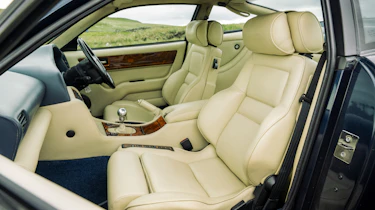
- The last of the hand-made Astons, its coachwork and cabin are imperious and special to behold
- Plenty of space inside what is a proper continent-crushing GT
- It’s traditional in its material use, with plenty of waxy leather and glossy wood veneer
Dressed in alloy bodywork that began as two-dimensional sheets of thin-gauge aluminium, each panel was lovingly wheeled, hammered, dollied and planished into glorious sculptural forms by craftsmen. These were the last of the coachbuilt Astons to emerge from the storied Newport Pagnell factory.
> Used Aston Martin Vanquish (Mk1, 2001-2007): Britain's answer to the Ferrari 550 Maranello
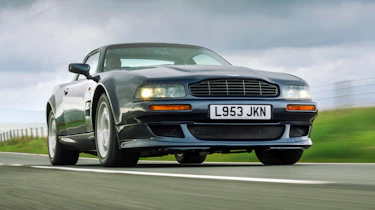
The V550’s imposing style was defined by designers John Heffernan and Ken Greenley. Given they were also responsible for the somewhat limp and rather anodyne Virage on which the V550 was based, this transformation was less a redesign and more a glorious act of redemption. Few cars have more presence.
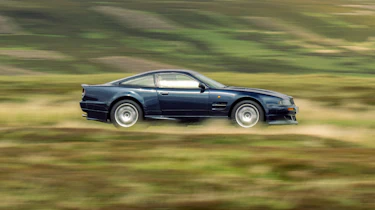
Only the roof and doors of the Virage survived their reworking. The glasshouse is more drawn-in at the C-pillars, the tail more truncated. The boot lid is flatter, but still with an upswept lip, below it a bold quartet of lollipop taillights. The nose is more of a shovel. Six headlamps give it an evil, aggressive face, but thanks to that iconic radiator grille aperture it’s still unmistakably an Aston Martin.
The interior uses a classic palette of tactile and aromatic natural materials. It’s a spectacular slice of ’90s aristo-supercar, with several herds-worth of cream hide and a tree or two of glossy burr walnut veneer. With the shallow side windows, tall dash and rising instrument binnacle, you’re struck by the not-unpleasant sensation of being sat down in the bowels of the beast. They don’t make ’em like this anymore.
The seats themselves have a bewildering array of adjustment buttons, and Sod’s Law dictates the last one you press is the one you wanted first. But they’re comfortable and supportive.
evo eras supercars test – James Taylor
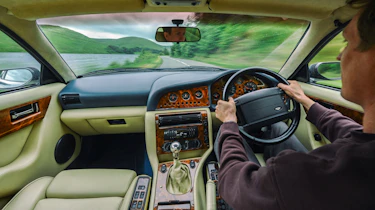
‘Initially, the Vantage feels big, heavy – despite the alloy bodywork, this is a two-ton car – and a little vague. The power steering is light and not particularly full of feedback, and the gearshift, with the leather-gated lever topped by a large aluminium bauble, has a broad gate to navigate. Whereas the original Honda NSX feels just right straight away, the Aston is a very different kind of car that needs a little acclimatisation. But once you click with it – oh boy.

‘Despite its size, it sheds speed quickly (its 14-inch brake discs were the largest fitted to a production car at the time, with front calipers sourced from Group C racing) and turns in positively. The Vantage doesn’t really do understeer; you begin corners early, and use the big body’s weight transfer to carve through bends with considerable momentum.
‘Although there’s so much torque you could easily spin the wheels in the low gears, it rarely feels wayward. Despite appearances and initial impressions, this is a very controllable and balanced car. It’s not so well suited to bumpy, technical roads, but on fast, flowing sections it’s a mighty thing. ‘On the right road and when you commit to the car, it’s got a really nice balance,’ Dickie says. ‘It doesn’t just turn and go through a corner like a modern supercar, but it’s surprisingly adjustable and playful, once you’ve got it in its zone.’
‘The engine, meanwhile, is a psychopath. The twin superchargers whip the revs up quickly, and that whipcrack throttle response needs delicate footwork at low speeds. It can be abruptly jagged when you’re tipping in and out of the throttle, and you sometimes need to dip the clutch to avoid kangarooing around town.
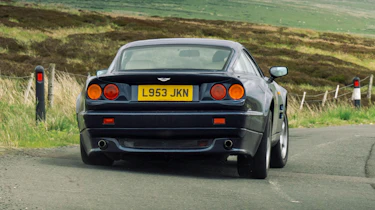
‘Out in the open when there’s space to let it off its leash, however, the V550 lives up to its billing as one of the ’90s’ fastest cars. There’s no red line on the tacho, perhaps because it would be uncouth behaviour for a gentleman to go to the red line, or perhaps because Aston Martin realised most drivers would be so awestruck that they’d back off long before reaching it. Peak power is at 6500rpm but the needle doesn’t need to travel past 4000rpm to get an impression of just how mighty this car is.
‘‘The engine dominates the experience,’ Meaden says. ‘I think it comes as a shock to people who don’t know Astons and might expect it to be a big, ponderous, lazy thing. Actually it’s sharp and exotic, a proper supercar engine. I have a considerable soft spot for this car,’ he adds. ‘It’s an event, an occasion. Aston Martin was a very different company then and that was reflected in the cars.
‘’The Vantage is not to everyone’s taste but it represents a kind of car which is dead now,’ Dickie concludes, slightly wistfully. ‘It’s a proper dinosaur, isn’t it? You can take that as both a criticism and a compliment but I personally love it for that, because there was never anything like it then and that’s truer now than ever.’’
Values and buying guide
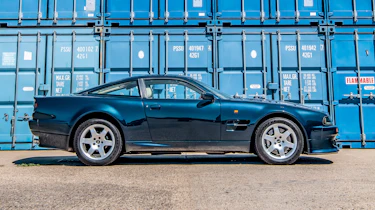
Introduced in 1993 and in production until 1999, just 239 of these amazing cars were built, around 80 of which received upgrades to V600 spec. With production drawing to a close as attention turned to readying the Mk1 Vanquish for production, Aston Martin built a further 40 to celebrate the 40th anniversary of Aston’s first (and only) outright win in the famous 24-hour race.
Called the V8 Vantage Le Mans, they incorporated the Works brake and chassis upgrades (and most, but not all, had the V600 engine, too) along with more extensive – and expensive! – bodywork modifications, including a pair of aggressive nostrils and DBR1-style side strakes.
As you’d expect the latter are the most prized by collectors. Costing £250,000 when new, values today are over £200,000. Cars featuring V600 upgrades are next in terms of values, with the best examples pushing £300k. Investment buyers tend to fixate on these rarest of the rare, but the ‘vanilla’ V550 has every bit of their charisma, wants for little in terms of performance and is still far more exclusive than most of today’s limited-run specials. High-mileage cars in less desirable colours can be had for around £150,000, while the best examples nudge £200k. In the context of today’s collector market, that’s a lot of car for the money.
Rather like buying a historic Listed property, owning one of these last-of-the-handbuilt-era Astons requires financial fortitude to stay on top of essential maintenance. What you get in return is a car with abundant character, the like of which you simply cannot expect to find in a modern car. Even something like a DBS Superleggera. As such, the V550 is a monument to a bygone era. The ultimate post-historic Aston? You’ll hear little argument from me.
Aston Martin Vantage V550 specs
| Aston Martin Vantage V550 | |
|---|---|
| Engine | V8 5340cc, twin-supercharged |
| Power | 550bhp @ 6500rpm |
| Torque | 550lb ft @ 4000rpm |
| Weight | 1990kg (281bhp/ton) |
| 0-60mph | 4.6sec |
| Top speed | 186mph |
| Price new | £177,600 (1993) |
| Price now | c/£180,000 |